
A Psalm 83 Prophecy
Psalm 83 tells us the Ishmaelites, Edom, Ammon, Amalek, Hagarenes, Tyre, Gebal and the Philistines wanting to attack Israel; for they have said,
“Come, and let us cut them off from being a nation, that the name of Israel may be no more in remembrance.”
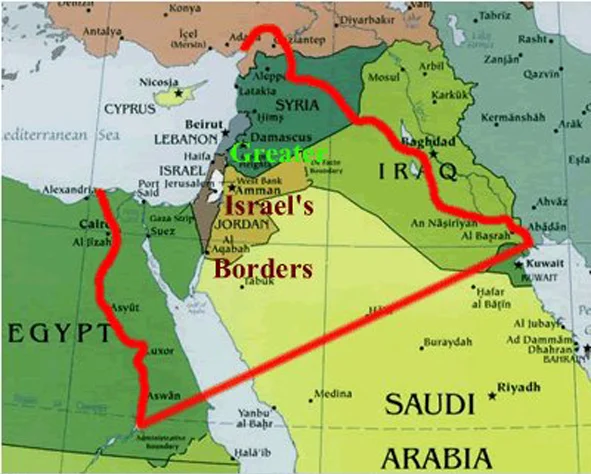
The most important question facing this Study is whether Psalm 83 is a prophecy of the past or is it one yet to come.
There are two possibilities: (1) of the Past, during the dynasty after David’s reign. This could be during the fall of the Ten tribes and carried away by the Assyrians; (2) of the future, one still yet in the endtime future.

(1) If it was of the past that could had happened during the captivity of the northern Kingdom of Israel, when they were carried into captivity by the Assyrians, or Asshur. It was a prophecy when phases of the Ten Tribes were exiled, carried away by the Assyrians, the last, by Sennaherib, was in 721 BC. These Ten Tribes are the tribes of Reuben, Simeon, Dan, Naphtali, Gad, Asher, Issachar, Zebulun, Manasseh and Ephraim.
Further, it says in Isaiah 1:1 that the prophetic years were during “the days of Uzziah . . . and Hezekiah, kings of Judah;” this occured from 740 BC to 686 BC; and perhaps Isaiah had delivered his warning message (of its forthcoming captivity by Shalmaneser) to the northern house of Israel, and thus his message wasn’t meant to be prophetic for the endtime.
The scriptural basis for the idea of the Lost Tribes is II Kings 17:6: “In the ninth year of Hoshea, the king of Assyria took Samaria, and carried Israel away unto Assyria, and placed them in Halah, and in Habor, on the river of Gozan, and in the cities of the Medes.”
The dominant power of Mesopotamia at that time was Assyria. All these nations named in Psalm 83 as being in a state of war against Israel which wanted to wipe out its people. Proponents further says there is no reference to (a) a latter day; (b) endtime or any time frame further into the future. Nothing in Psalm 83 identifies this as a latter day prophecy.
(2) If this is a prophecy of the future, this would be another rise of a group of Israel enemies at the endtime. Some assert that it might have an unstated latter day application because some true latter-day prophecies mention the number “ten” (as in Daniel 2’s mention of ten toes and the “seven heads and ten horns” of Revelation 17).
They claim that the ancient warlike Assyrians migrated into Europe along with many other Semitic peoples when the Parthian Empire fell and ultimately became the warlike Prussians. Although Prussia ceased to exist after World War II, it was dispersed and scattered westward throughout Germany to escape the Russian armies that occupied the former lands occupied by Prussia. This Assyria: Prussia or the Germans today, would rise again and invade Israel into another captivity.
A strong case in their favor is found in Isaiah 10:
5 “Woe to the Assyrian, the rod of Mine anger, and the staff in their hand is Mine indignation! 6 I will send him against a hypocritical nation, and against the people of My wrath will I give him a charge, to take the spoil and to take the prey, and to tread them down like the mire of the streets. 7 Yet he meaneth not so, neither doth his heart think so; but it is in his heart to destroy and cut off nations not a few. Isaiah 10:5-7
Perhaps a prophecy is dual, as had often been the case; and this is the assumption taken in this study:
The Psalm 83 Prophecy
1 Keep Thou not silence, O God; hold not Thy peace, and be not still, O God. — Asaph’s plea demonstrates the urgency and fervency that should characterize our prayers, especially in times of crisis;
— keep not thou silence, O God; plead for us, not by words, but by thy actions; hold not thy peace; God seems to be indifferent to the danger of His people: their enemies are mustering unrebuked: but He has only to speak the word, and their schemes will be utterly frustrated;
2 For lo, Thine enemies make a tumult, and they that hate Thee have lifted up the head. — wicked people are commonly noisy, arrogant, roaring out their blasphemies against God, belching out oaths and curses, and breathing threatenings and slaughter against the righteous;
3 They have taken crafty counsel against Thy people, and consulted against Thy hidden ones. — they have consulted; these devised cunning devices, formed crafty schemes for the destruction of the Lord’s people;

4 They have said, “Come, and let us cut them off from being a nation, that the name of Israel may be no more in remembrance.” — Let us utterly destroy them, let the name Israel be no more; let’s drive them off the sea and root them out from among the nations;
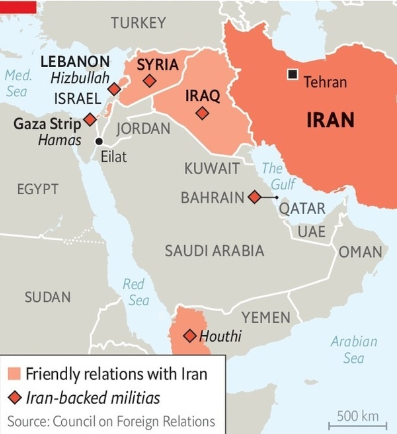
Today, a country like Iran and its proxies: Hezbollah, Hamas, the Houthis, would have said this, to drive the state of Israel into the sea; but “the head of the snake” Iran or Persia, or Elam by its ancient name, who would say the same thing, is conspiciously not listed among these nations in Psalms 83 wanting to put an end to Israel.
Why is ‘Persia’ or Iran missing?
Its absence speaks volumn! Nevertheless this Iran could be a type that could re-emerge, in the form of “Gog and Magog” in Ezekiel 38-39 (Ezekiel 38:5 ‘Persia, Ethiopia, and Libya with them, all of them with shield and helmet’) and again in Revelation 20:8.
5 For they have consulted together with one accord; they are confederate against Thee:
6 the tabernacles of Edom and the Ishmaelites, of Moab and the Hagarites, — the posterity of Edom is a long and complex subject. Needless to say, they migrated to Spain and then into the New World; and today, they had morphed as the Latinos in general;
— the posterity of Edom; Rashi and Jewish writings idenified Edom (Magdiel) as Rome; together, Spain and Italy (Rome), they are the core Catholics nations; and this alliance is further analysed in (1) Obadiah; and (2) A Sword from the South!
— second, the tent of Edom; this prophecy of Edom in Psalm 83 in the Old World could occur at the same time as the Sword and Fire emerge from the South in the New World: A Sword from the South!; that is, these two prophecies could run parallel to each other;
— the Moabites shouldn’t be distressed but when they pledged “Come, and let us cut them off from being a nation, that the name of Israel may be no more in remembrance,” they themselves lost the right to their name and land; see God’s earlier commitment till they lost it:
“And the Lord said unto me, ‘Distress not the Moabites, neither contend with them in battle; for I will not give thee of their land for a possession, because I have given Ar unto the children of Lot for a possession.’ Deuteronomy 2:8-9
And when we passed by from our brethren the children of Esau, who dwelt in Seir, through the way of the plain from Elath and from Eziongaber, we turned and passed by the way of the Wilderness of Moab;
— many obervers rightly believe the brown Arabs of Saudi Arabia spring from lshmael; and Hagar, the Egyptian handmaid of Abraham’s wife Sarai (as an interesting aside, Hagar means flight; the flight of Muhammed to Medina is known as the Hagira); they are descended from the Mizraimites (Genesis 16:1-4, 15). They are largely the Muslim nations and their allies;
— the Ishmaelites, the Moabites and the Hagarite remained where they were, around the Arabian peninsula; but the posterity of Esau or the Edomites later moved to the Iberian Peninsula (except, perhaps, some of the Amalekites, who could have remained there and intermarried with the local inhabitants, especially the Philistines; and over the centuries to be known as the Palestianians we come to know them today);
— others, from Spain, Portugal and Italy, the core Catholic nations, had then spread over to Mexico and South America where they are today; for more about the posterity of Esau or Edomites, see Obadiah

7 Gebal and Ammon and Amalek, the Philistines with the inhabitants of Tyre. — Gebal or Gubleans, or Gebalites, as the Targum; the same with Giblites, or men of Gebal, Ezekiel 27:9 the same with Byblos: these dwelt in Phoenicia, near Tyre, or today’s Lebanon;
— Ammon; this is Jordan, with its capital at Amman; notice that without the vowels, the consonants are exactly the same;
— the inhabitants of Tyre; this parallels the destruction of Damascus in Isaiah 17; as commented above, some of the Amalekites could have remained there and intermarried with the the Philistines, and over the centuries became known as the Palestianians today.
8 Assyria also has joined with them; they have helped the children of Lot. Selah — “Assur” is in the original: the Assyrians are listed among them, and is Syria intended here, that in the view of the Greek writers, a corruption of Assyria (“The Greeks call them Syrians, but the Barbarians Assyrians;” Ellicott’s Commentary;
— of course, another explanation could be that the name Syria was given to a more docile state but when the same entity became arrogant and aggressive, and with additional land conquests, it was designated as Assyria; both names of which originally derived from Assur; and both have Aramaic as the lingua franca for their empire (Wikipedia);
Hence the Targum says, “Sennacherib, king of Syria, is joined with them;” whereas II Kings 18:13 says “Sennacherib, king of Assyria, came up against all the fortified cities of Judah and took them.”
Second, it appears that Assur, often translated as Assyria, is more associated with the state and politics, whereas Aram, translated as Syrian or Aramean, has more emphasis on people and language.
— the children of Lot were the Moabites and Ammonites; for some, this confederacy has a helping hand from today’s Jordan; while for others, this hybrid nation seems to be singled out as the leaders of the confederacy.
9 Do unto them as unto the Midianites, as to Sisera, as to Jabin at the Brook of Kishon, — do unto them as unto the Midianites; that is, let them be overthrown and completely destroyed as the Midianites were; as reference in Numbers 31;
— in summary, the ancient tribes and countries mentioned in Psalm 83 are:
of Edom and the Ishmaelites, of Moab and the Hagarites (verse 6); Gebal and Ammon and Amalek, the Philistines with the inhabitants of Tyre (verse 7); Assyria also has joined with them; they have helped the children of Lot (verse 8); the Midianites, as to Sisera, as to Jabin at the Brook of Kishon (verse 9); their nobles like Oreb and like Zeeb, yea, all their princes as Zebah and as Zalmunna (verse 11);
— notice that these tribes and countries mentioned are largely land bound by “between the rivers” that is, within the bound of God’s given land allocated to Abraham and then passed on to the full House of Jacob (Genesis 15); this could be considered as the Inner Ring (in contrast to “Gog and Magog” which could be considered as the Outer Ring);
10 who perished at Endor; they became as dung for the earth. — they became as dung upon the earth; they were trodden under foot, and their carcasses left unburied.
11 Make their nobles like Oreb and like Zeeb, yea, all their princes as Zebah and as Zalmunna, — all their princes as Zebah, and as Zalmunna; the word here rendered princes means properly appointed, and was given to princes, emirs and kings; some of these could be today’s satraps, caliphs, emirs, princes, sultans, sheikh for countries like Yemen, Oman, United Arab Emirates, Qatar, Bahrain, Kuwait, Iraq, Jordan and even Saudi Arabia.
12 who said, “Let us take to ourselves the houses of God in possession.” — the houses of God here mean the habitations of God, or the places where he dwelt among the people. As there was but one ark, one tabernacle, and one temple, or one place of constituted public worship, Jerusalem, this must refer to other places where God was worshipped, perhaps in synagogues;
— hence these nations, confederate enemies of Israel, want to take over such places, houses where God dwells; in synagogues but the Temple in Jerusalem in particular;
13 O my God, make them like a wheel, as the stubble before the wind. — let them be like a wheel, hard to control, which is very unstable and dangerous; a prophecy much like Ishmael, “he will be a wild man; his hand will be against every man, and every man’s hand against him; and he shall dwell in the presence of all his brethren” (Genesia 16:12)
— and when once tumbled down from the top of a hill, runs with great force and swiftness, and stays not till it comes to the bottom; and suddenly come to ruin; or be in all kind of calamities, and continual troubles;
14 As the fire burneth a wood, and as the flame setteth the mountains on fire, — this will be the end of wicked men; not only let them be driven away as stubble, but burnt as stubble; that the fire and flame of divine wrath would consume the confederate enemies of Israel;
15 so persecute them with Thy tempest, and make them afraid with Thy storm. — the general meaning is clear; God is called upon to execute vengeance upon Israel’s enemies by sweeping them away with the storm and tempest of his wrath;
16 Fill their faces with shame, that they may seek Thy name, O Lord. — that their enemies might be so baffled in their designs; that they might be made so to feel how vain and hopeless were all their schemes;
17 Let them be confounded and troubled for ever; yea, let them be put to shame and perish, — as confederated nations; as united in such an unholy alliance; let them never again be able thus to combine; yea, let them be put to shame, by utter failure in their schemes; let there be a complete end to such a confederacy, so that it shall never be seen again.
18 that men may know that Thou, whose name alone is Yehovah, art the Most High over all the earth. — that thou whose name alone is Yehovah; to whom alone this name belongs; to whom alone it can be properly ascribed: Thou art the Most High over all the earth; Thou art the Supreme God, ruling over all people.


Overall, a strong case could be for a restricted or limited prophecy. Foremost is that Iran “the head of the snake,” is not in the picture, which is inconceivable in today’s political environment; though many of its proxies (Hamas, Houthis, Hezbollah and other militias in Syria and Iraq) are there within the Inner Ring.
Second, no one could be cetain who the Assyrians were; some claim they are the Germans, but Germany hasn’t displayed any ambition to conquer Jerusalem; neither do they have the military might to do so; the Assyrians are more likely Syria. The nation of today’s Syria is within the Two Great Rivers, and with Syria in place of Assyria, the scene becomes more complete.
And finally, the book of Psalms, unlike Isaiah, Jeremiah, Ezekiel or Daniel, is not known to be a prophetic book for the endtime. Notwithstanding, this Psalm 83 prophecy could be a type or a preamble of “Gog and Magog” to re-emerge again in Ezekiel 38-39, and again at the endtime.
Finally; note all the nations listed are TEN; which could these be the ten horns of Revelation 17:12: the Edomites, Ishmaelites and Amalekites, were on the South; the Moabites, Ammonites and Hagarenes, were on the East; the Assyrians (or the Syrians) on the North; and the Philistines, Gebalites and Tyrians, on the West: so that the land of Israel is to be completely encompassed or hemmed in by enemies on every side.
And in this Ten Nations could be connectd to Daniel’s prophecy:
41 And whereas thou sawest the feet and toes, part of potter’s clay and part of iron, the kingdom shall be divided; but there shall be in it the strength of the iron, inasmuch as thou sawest the iron mixed with miry clay.
42 And as the toes of the feet were part of iron and part of clay, so the kingdom shall be partly strong and partly broken.
43 And whereas thou sawest iron mixed with miry clay, they shall mingle themselves with the seed of men; but they shall not cleave one to another, even as iron is not mixed with clay. Daniel 2:41-43
Here are ten different nations, which will join in a confederacy against the posterity of Jacob (with its people with a core of “Protestant” nations); which relates to the ten horns of the beast, or ten kings, who agreed to give their kingdom to the beast, and to make war with the Lamb and his followers, Revelation 17:12; and the ten nations listed in Psalms 83 here are largely from the core Muslim (posterity of Ismael) allied with the Catholic (posterity of Esau) nations; with the children of Lot (the Moabites and Ammonites) as allies.
The “Gog and Magog” time frame seems different. This Psalm 83 Prophecy seems much earlier than what would have happened in Revelation 17. Here these ten nations could be coincidental, and are prophecised to be put to shame and perish; giving space “between the two rivers” to absorb those posterity of Jacob fleeing back to the land once known as Judea and Samaria, an Exodus Greater than the original Egyptian Exodus.
For a detailed analysis, see A Greater “Out of Egypt” Exodus


 Joel
Joel A Prophecy of Esau and Jacob