
Book of Jasher (13-14)
The Book of Jasher is mentioned in Joshua 10 when the Lord stopped the sun in the middle of the day during the battle of Beth Horon:
“And the sun stood still and the moon stayed until the people had avenged themselves upon their enemies. Is not this written in the Book of Jasher?”Joshua 10:13
The Book of Jasher is also mentioned in II Samuel 1:18-27 as containing the Song or Lament of the Bow, that mournful funeral song which David composed at the time of the death of Saul and Jonathan. “How are the mighty fallen!”
Book of Jasher Chapter 13
1 And Terah took his son Abram and his grandson Lot, the son of Haran, and Sarai his daughter-in-law, the wife of his son Abram, and all the souls of his household and went with them from Ur Casdim to go to the land of Canaan. And when they came as far as the land of Haran they remained there, for it was exceedingly good land for pasture, and of sufficient extent for those who accompanied them.
2 And the people of the land of Haran saw that Abram was good and upright with God and men, and that the Lord his God was with him, and some of the people of the land of Haran came and joined Abram, and he taught them the instruction of the Lord and his ways; and these men remained with Abram in his house and they adhered to him.
3 And Abram remained in the land three years, and at the expiration of three years the Lord appeared to Abram and said to him; I am the Lord who brought thee forth from Ur Casdim, and delivered thee from the hands of all thine enemies.
4 And now therefore if thou wilt hearken to my voice and keep my commandments, my statutes and my laws, then will I cause thy enemies to fall before thee, and I will multiply thy seed like the stars of heaven, and I will send my blessing upon all the works of thy hands, and thou shalt lack nothing.
5 Arise now, take thy wife and all belonging to thee and go to the land of Canaan and remain there, and I will there be unto thee for a God, and I will bless thee. And Abram rose and took his wife and all belonging to him, and he went to the land of Canaan as the Lord had told him; and Abram was fifty years old when he went from Haran.
6 And Abram came to the land of Canaan and dwelt in the midst of the city, and he there pitched his tent amongst the children of Canaan, inhabitants of the land.
7 And the Lord appeared to Abram when he came to the land of Canaan, and said to him, This is the land which I gave unto thee and to thy seed after thee forever, and I will make thy seed like the stars of heaven, and I will give unto thy seed for an inheritance all the lands which thou seest.
8 And Abram built an altar in the place where God had spoken to him, and Abram there called upon the name of the Lord.
9 At that time, at the end of three years of Abram’s dwelling in the land of Canaan, in that year Noah died, which was the fifty-eighth year of the life of Abram; and all the days that Noah lived were nine hundred and fifty years and he died.
10 And Abram dwelt in the land of Canaan, he, his wife, and all belonging to him, and all those that accompanied him, together with those that joined him from the people of the land; but Nahor, Abram’s brother, and Terah his father, and Lot the son of Haran and all belonging to them dwelt in Haran.
11 In the fifth year of Abram’s dwelling in the land of Canaan the people of Sodom and Gomorrah and all the cities of the plain revolted from the power of Chedorlaomer, king of Elam; for all the kings of the cities of the plain had served Chedorlaomer for twelve years, and given him a yearly tax, but in those days in the thirteenth year, they rebelled against him.
12 And in the tenth year of Abram’s dwelling in the land of Canaan there was war between Nimrod king of Shinar and Chedorlaomer king of Elam, and Nimrod came to fight with Chedorlaomer and to subdue him.
13 For Chedorlaomer was at that time one of the princes of the hosts of Nimrod, and when all the people at the tower were dispersed and those that remained were also scattered upon the face of the earth, Chedorlaomer went to the land of Elam and reigned over it and rebelled against his lord.
14 And in those days when Nimrod saw that the cities of the plain had rebelled, he came with pride and anger to war with Chedorlaomer, and Nimrod assembled all his princes and subjects, about seven hundred thousand men, and went against Chedorlaomer, and Chedorlaomer went out to meet him with five thousand men, and they prepared for battle in the valley of Babel which is between Elam and Shinar.
15 And all those kings fought there, and Nimrod and his people were smitten before the people of Chedorlaomer, and there fell from Nimrod’s men about six hundred thousand, and Mardon the king’s son fell amongst them.
16 And Nimrod fled and returned in shame and disgrace to his land, and he was under subjection to Chedorlaomer for a long time, and Chedorlaomer returned to his land and sent princes of his host to the kings that dwelt around him, to Arioch king of Elasar, and to Tidal king of Goyim, and made a covenant with them, and they were all obedient to his commands.
17 And it was in the fifteenth year of Abram’s dwelling in the land of Canaan, which is the seventieth year of the life of Abram, and the Lord appeared to Abram in that year and he said to him, I am the Lord who brought thee out from Ur Casdim to give thee this land for an inheritance.
18 Now therefore walk before me and be perfect and keep my commands, for to thee and to thy seed I will give this land for an inheritance, from the river Mitzraim unto the great river Euphrates.
19 And thou shalt come to thy fathers in peace and in good age, and the fourth generation shall return here in this land and shall inherit it forever; and Abram built an altar, and he called upon the name of the Lord who appeared to him, and he brought up sacrifices upon the altar to the Lord.
20 At that time Abram returned and went to Haran to see his father and mother, and his father’s household, and Abram and his wife and all belonging to him returned to Haran, and Abram dwelt in Haran five years.
21 And many of the people of Haran, about seventy-two men, followed Abram and Abram taught them the instruction of the Lord and his ways, and he taught them to know the Lord.
22 In those days the Lord appeared to Abram in Haran, and he said to him, Behold, I spoke unto thee these twenty years back saying,
23 Go forth from thy land, from thy birth-place and from thy father’s house, to the land which I have shown thee to give it to thee and to thy children, for there in that land will I bless thee, and make thee a great nation, and make thy name great, and in thee shall the families of the earth be blessed.
24 Now therefore arise, go forth from this place, thou, thy wife, and all belonging to thee, also every one born in thy house and all the souls thou hast made in Haran, and bring them out with thee from here, and rise to return to the land of Canaan.
25 And Abram arose and took his wife Sarai and all belonging to him and all that were born to him in his house and the souls which they had made in Haran, and they came out to go to the land of Canaan.
26 And Abram went and returned to the land of Canaan, according to the word of the Lord. And Lot the son of his brother Haran went with him, and Abram was seventy-five years old when he went forth from Haran to return to the land of Canaan.
27 And he came to the land of Canaan according to the word of the Lord to Abram, and he pitched his tent and he dwelt in the plain of Mamre, and with him was Lot his brother’s son, and all belonging to him.
28 And the Lord again appeared to Abram and said, To thy seed will I give this land; and he there built an altar to the Lord who appeared to him, which is still to this day in the plains of Mamre.
Book of Jasher Chapter 14
1 In those days there was in the land of Shinar a wise man who had understanding in all wisdom, and of a beautiful appearance, but he was poor and indigent; his name was Rikayon and he was hard set to support himself.
2 And he resolved to go to Egypt, to Oswiris the son of Anom king of Egypt, to show the king his wisdom; for perhaps he might find grace in his sight, to raise him up and give him maintenance; and Rikayon did so.
3 And when Rikayon came to Egypt he asked the inhabitants of Egypt concerning the king, and the inhabitants of Egypt told him the custom of the king of Egypt, for it was then the custom of the king of Egypt that he went from his royal palace and was seen abroad only one day in the year, and after that the king would return to his palace to remain there.
4 And on the day when the king went forth he passed judgment in the land, and every one having a suit came before the king that day to obtain his request.

5 And when Rikayon heard of the custom in Egypt and that he could not come into the presence of the king, he grieved greatly and was very sorrowful.
6 And in the evening Rikayon went out and found a house in ruins, formerly a bake house in Egypt, and he abode there all night in bitterness of soul and pinched with hunger, and sleep was removed from his eyes.
7 And Rikayon considered within himself what he should do in the town until the king made his appearance, and how he might maintain himself there.
8 And he rose in the morning and walked about, and met in his way those who sold vegetables and various sorts of seed with which they supplied the inhabitants.
9 And Rikayon wished to do the same in order to get a maintenance in the city, but he was unacquainted with the custom of the people, and he was like a blind man among them.
10 And he went and obtained vegetables to sell them for his support, and the rabble assembled about him and ridiculed him, and took his vegetables from him and left him nothing.
11 And he rose up from there in bitterness of soul, and went sighing to the bake house in which he had remained all the night before, and he slept there the second night.
12 And on that night again he reasoned within himself how he could save himself from starvation, and he devised a scheme how to act.
13 And he rose up in the morning and acted ingeniously, and went and hired thirty strong men of the rabble, carrying their war instruments in their hands, and he led them to the top of the Egyptian sepulchre, and he placed them there.
14 And he commanded them, saying, Thus saith the king, Strengthen yourselves and be valiant men, and let no man be buried here until two hundred pieces of silver be given, and then he may be buried; and those men did according to the order of Rikayon to the people of Egypt the whole of that year.
15 And in eight months time Rikayon and his men gathered great riches of silver and gold, and Rikayon took a great quantity of horses and other animals, and he hired more men, and he gave them horses and they remained with him.
16 And when the year came round, at the time the king went forth into the town, all the inhabitants of Egypt assembled together to speak to him concerning the work of Rikayon and his men.
17 And the king went forth on the appointed day, and all the Egyptians came before him and cried unto him, saying,
18 May the king live forever. What is this thing thou doest in the town to thy servants, not to suffer a dead body to be buried until so much silver and gold be given? Was there ever the like unto this done in the whole earth, from the days of former kings yea even from the days of Adam, unto this day, that the dead should not be buried only for a set price?
19 We know it to be the custom of kings to take a yearly tax from the living, but thou dost not only do this, but from the dead also thou exactest a tax day by day.
20 Now, O king, we can no more bear this, for the whole city is ruined on this account, and dost thou not know it?
21 And when the king heard all that they had spoken he was very wroth, and his anger burned within him at this affair, for he had known nothing of it.
22 And the king said, Who and where is he that dares to do this wicked thing in my land without my command? Surely you will tell me.
23 And they told him all the works of Rikayon and his men, and the king’s anger was aroused, and he ordered Rikayon and his men to be brought before him.
24 And Rikayon took about a thousand children, sons and daughters, and clothed them in silk and embroidery, and he set them upon horses and sent them to the king by means of his men, and he also took a great quantity of silver and gold and precious stones, and a strong and beautiful horse, as a present for the king, with which he came before the king and bowed down to the earth before him; and the king, his servants and all the inhabitants of Egypt wondered at the work of Rikayon, and they saw his riches and the present that he had brought to the king.
25 And it greatly pleased the king and he wondered at it; and when Rikayon sat before him the king asked him concerning all his works, and Rikayon spoke all his words wisely before the king, his servants and all the inhabitants of Egypt.
26 And when the king heard the words of Rikayon and his wisdom, Rikayon found grace in his sight, and he met with grace and kindness from all the servants of the king and from all the inhabitants of Egypt, on account of his wisdom and excellent speeches, and from that time they loved him exceedingly.
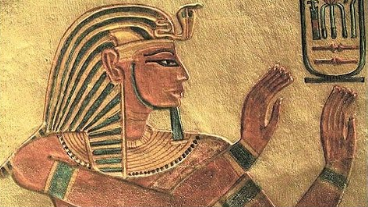
27 And the king answered and said to Rikayon, Thy name shall no more be called Rikayon but Pharaoh shall be thy name, since thou didst exact a tax from the dead; and he called his name Pharaoh.
28 And the king and his subjects loved Rikayon for his wisdom, and they consulted with all the inhabitants of Egypt to make him prefect under the king.
29 And all the inhabitants of Egypt and its wise men did so, and it was made a law in Egypt.
30 And they made Rikayon Pharaoh prefect under Oswiris king of Egypt, and Rikayon Pharaoh governed over Egypt, daily administering justice to the whole city, but Oswiris the king would judge the people of the land one day in the year, when he went out to make his appearance.
31 And Rikayon Pharaoh cunningly usurped the government of Egypt, and he exacted a tax from all the inhabitants of Egypt.
32 And all the inhabitants of Egypt greatly loved Rikayon Pharaoh, and they made a decree to call every king that should reign over them and their seed in Egypt, Pharaoh.
33 Therefore all the kings that reigned in Egypt from that time forward were called Pharaoh unto this day.


 Joel
Joel A Prophecy of Esau and Jacob