
Genesis (21-22)
~~~~
Genesis 21
~~~~
1 And the Lord visited Sarah as He had said, and the Lord did unto Sarah as He had spoken. — and the Lord visited Sarah as he had said; to Abraham, Genesis 17:16; in a way of graciousness and kindness, by fulfilling his promise, giving strength to conceive and bear a child;
2 For Sarah conceived and bore Abraham a son in his old age, at the set time of which God had spoken to him. — and bare Abraham a son in his old age; which circumstance is remarkable, that the favour might appear the greater, and the more wonderful;
— at the set time of which God had spoken to him, Genesis 17:21; God was not only faithful in fulfilling his promise, but in keeping the exact time of it.
3 And Abraham called the name of his son who was born unto him, whom Sarah bore to him, Isaac. — Isaac; this name not only recorded the fact of the laughter of the father (Genesis 17:17) and of the mother (Genesis 18:12),
— but was a standing memorial that Isaac’s birth was contrary to nature, and one of which the promise was provocative of ridicule in the sight even of his parents; who was born according to the promise, at the set time of which God had spoken;
4 And Abraham circumcised his son Isaac, being eight days old, as God had commanded him. — he circumcised his son; the covenant being established with him, the seal of the covenant, according to God’s command, was administered to him.
5 And Abraham was a hundred years old when his son Isaac was born unto him. — and Abraham was an hundred years old when son Isaac was born unto him; so that this was years after his departure from Haran, and coming into the land of Canaan, for then he was seventy five years of age;
6 And Sarah said, “God hath made me laugh, so that all who hear will laugh with me.” — Sarah said, God has made me to laugh; not through diffidence and irreverence, as my own distrustful heart before made me to laugh; but through excess of holy joy. He hath given me both cause and a heart to rejoice.
7 And she said, “Who would have said unto Abraham that Sarah should have given children suck? For I have borne him a son in his old age.” — Sarah will nurse children; children, though she had but one child, either by a usual enallage of the plural number for the singular, whereby the word sons or daughters is used when there was but one;
— for she shall bring forth a son in her old age! that she who was ninety years of age should bear a child, and suckle it, as she did; and in doing she set an example to her daughters to do likewise, since neither age nor grandeur, were any objection to this duty of nature;
8 And the child grew, and was weaned; and Abraham made a great feast the same day that Isaac was weaned. — the child grew, and was weaned; according to tradition, Isaac was two years old when weaned.
9 And Sarah saw the son of Hagar the Egyptian, whom she had borne unto Abraham, mocking. — mocking; the verb used here is the same as that rendered to laugh in Genesis 21:6, but in an intensive conjugation.
10 Therefore she said unto Abraham, “Cast out this bondwoman and her son; for the son of this bondwoman shall not be heir with my son, even with Isaac.” — for the son of this bondwoman shall not be heir with my son, even with Isaac; which he would seem to be, if continued, and would think himself so, and there would be continual bickerings about it;
11 And the thing was very grievous in Abraham’s sight because of his son. — the issue was very grievous in Abraham’s sight, the matter was evil exceedingly in Abraham’s eyes;
12 And God said unto Abraham, “Let it not be grievous in thy sight because of the lad, and because of thy bondwoman. In all that Sarah hath said unto thee, hearken unto her voice; for in Isaac shall thy seed be called. — let it not be grievous in thy sight because of the lad, and because of the bondwoman:
— that is, let not the motion displease thee, which Sarah has made, to turn out the bondwoman and her son; do not look upon the new situation as an ill thing, or as an hard thing; it is but what is right and proper to be done, and leave the bondwoman and her son to me; I will take care of them, be under no concern for them and their welfare;
13 And also of the son of the bondwoman will I make a nation, because he is thy seed.” — the son of the bondwoman; the handmaid; Hagar is never acknowledged as Abraham’s wife, though her child, as Abraham’s son, receives a noble promise for the father’s sake.
14 And Abraham rose up early in the morning, and took bread and a bottle of water; and he gave it unto Hagar, putting it on her shoulder, and the child, and sent her away. And she departed and wandered in the wilderness of Beersheba.
— and gave it unto Hagar, putting it on her shoulder; that is, the bread and the water, which might be put in one parcel or bundle, or in a basket, and so laid and carried on her shoulder: the Targum of Jonathan adds, “and bound it to her loins, to show that she was an handmaid and dismissed her with a letter of divorce:”
15 And the water in the bottle was spent, and she cast the child under one of the shrubs. — and the water was spent in the bottle; it was all drank up by them, having wandered about some time in a wilderness, where they could not replenish their bottle;
16 And she went and sat down apart from him a good way off, as it were, a bowshot; for she said, “Let me not see the death of the child.” And she sat opposite him, and lifted up her voice and wept. — Hagar, in distress said, Let me not see the death of the child; she could not bear to hear his dying groans, and see him in his dying agonies;
17 And God heard the voice of the lad; and the angel of God called to Hagar out of heaven and said unto her, “What aileth thee, Hagar? Fear not, for God hath heard the voice of the lad where he is. — God had heard the voice of the lad: Arise, lift up the lad, and hold him in thy hand;
18 Arise; lift up the lad and hold him in thine hand, for I will make him a great nation.” — Hagar is assured that he would recover and live, and become a man and the father of children, who in time would become a great nation;
19 And God opened her eyes and she saw a well of water; and she went and filled the bottle with water, and gave the lad drink. — God opened her eyes: he regarded her and directed her to a fountain close beside her, probably hidden amid brushwood, by the waters of which her almost expiring son was revived.
20 And God was with the lad; and he grew, and dwelt in the wilderness, and became an archer. — God was with the lad; He grew an archer, or multiplied into a tribe of archers.
21 And he dwelt in the Wilderness of Paran, and his mother took him a wife out of the land of Egypt. — a wife out of the land of Egypt; in Paran; that is, Arabia, where his posterity has ever dwelt;
— so the Arabians that live in the deserts and round about them, called Nabathees, from Nabaioth, another son of Ishmael; however natural this might be on Hagar’s part, it would nevertheless strengthen the heathen element in Ishmael and his descendants:
— Abraham’s posterity could be broken into four major groups: (1) Ismael: Arabs: Islam; (2) Esau: Catholics; (3) 10 Northern Tribes: Protestants; (4) Southern Tribes: Judaism
22 And it came to pass at that time that Abimelech and Phichol, the chief captain of his host, spoke unto Abraham, saying, “God is with thee in all that thou doest. — that Abimelech and Phichol, the chief captain of his host, spake unto Abraham; Abimelech was king of Gerar, the same that is spoken of in the preceding chapter, and Phichol was the general of his army; these two great personages came together and paid Abraham a visit;
23 Now therefore swear unto me here by God that thou wilt not deal falsely with me, nor with my son, nor with my son’s son; but according to the kindness that I have done unto thee, thou shalt do unto me and to the land wherein thou hast sojourned.” — Abimelek, accompanied by Phikol, his commander-in-chief, proposes to form a league with Abraham;
— that thou wilt not deal falsely with me, nor with my son, nor with my son’s son; perhaps he had heard that God had promised to give the whole land of Canaan to him and his posterity, and among the rest his kingdom, which was a part of it;
— and, seeing him grow great and powerful, he could not tell how soon it might be ere he was put in the possession of it, whether in his own time, or his son’s, or his grandson’s; and therefore desires Abraham that he would swear to do no hurt to them whenever it should be; and that they might not be driven out, but sojourn in it as he had done.
24 And Abraham said, “I will swear.” — and Abraham said, I will swear; grateful of the many favours he had received from Abimelech in times past, he very readily agreed to his proposal;
— that it would be over four hundred years before his posterity should be put into the possession of the land of Canaan; and therefore could take an oath that neither he, nor his son, nor his grandson, should be injured or dispossessed.
25 And Abraham reproved Abimelech because of a well of water which Abimelech’s servants had violently taken away. — which Abimelech’s servants had violently taken away: that is, had by force taken the use of it to themselves for their cattle, and had deprived Abraham of it;
26 And Abimelech said, “I know not who hath done this thing; neither didst thou tell me, neither yet heard I of it until today.” — neither yet heard of it but today: he had not heard of it from others, as the Targum of Jonathan rightly adds, by way of explanation, but that very day, and not till the moment he had it from Abraham himself;
27 And Abraham took sheep and oxen and gave them unto Abimelech, and both of them made a covenant. — and Abraham took sheep and oxen, and gave them unto Abimelech; in gratitude for former favours he had received from him, in token of the friendship that subsisted between them;
28 And Abraham set seven ewe lambs of the flock by themselves. — in the seven ewe-lambs which Abraham tenders, and Abimelek, in token of consent, accepts at his hand.
29 And Abimelech said unto Abraham, “What mean these seven ewe lambs, which thou hast set by themselves?” — what mean these seven ewe lambs which thou hast set by themselves? he understood what the sheep and oxen were for, that they were presents to him,
— at least some of them, and the rest were for the solemnizing and ratifying the covenant between them; but what these were for he could not devise.
30 And he said, “These seven ewe lambs shalt thou take from my hand, that they may be a witness unto me that I have dug this well.” — and he said; that is, Abraham replied to Abimelech:
— that they may be a witness to me that I have digged this well: these were to be a testimony that the well that had been taken away from Abraham was one that he had dug, and was his property, and which Abimelech acknowledged by his acceptance of these seven lambs; and his title to the well, which these were a witness of.
31 Therefore he called that place Beersheba [that is, The well of the oath], because there they swore, both of them. — the Targum of Jonathan says, “and therefore he called the well the well of seven lambs;” “Beer” signifying a well, and “sheba” seven; being expressed, because there they sware both of them; by the living God, to keep the covenant inviolably they had made between them;
32 Thus they made a covenant at Beersheba. Then Abimelech rose up, and Phichol the chief captain of his host, and they returned into the land of the Philistines. — and they returned into the land of the Philistines; from Beersheba, which was in the extreme border of it, unto Gerar, which was the capital city.
33 And Abraham planted a grove in Beersheba, and called there on the name of the Lord, the Everlasting God. — what sort of trees this grove consisted of cannot with certainty be said, nut probably the oak.
34 And Abraham sojourned in the Philistines’ land many days. — and Abraham sojourned in the Philistines’ land many days; even many years, days being often times put for years.
Genesis 22
1 And it came to pass after these things, that God tested Abraham and said unto him, “Abraham!” And he said, “Behold, here I am.” — and he said, behold, here I am; signifying that he heard his voice, and was ready to obey his commands, be whatever they would be;
— and the Targum of Jerusalem says this was Abraham’s tenth trial “these things that the Lord tried Abraham with the tenth trial”
— and the Maimonides lists them as follows:
- G‑d tells him to leave his homeland to be a stranger in the land of Canaan
- Immediately after his arrival in the Promised Land, he encounters a famine
- The Egyptians seize his beloved wife, Sarah, and bring her to Pharaoh
- Abraham faces incredible odds in the battle of the four and five kings
- He marries Hagar after not being able to have children with Sarah
- G‑d tells him to circumcise himself at an advanced age
- The king of Gerar captures Sarah, intending to take her for himself
- G‑d tells him to send Hagar away after having a child with her
- His son, Ishmael, becomes estranged
- G‑d tells him to sacrifice his dear son Isaac upon an altar
— the Targum of Jonathan says Isaac was 36 years of age, same as Chabad’s reckoning, but Josephus (Antiqu. l. 1. c. 13. sect. 2) says he was 25 years of age;
— besides, the Targum of Jonathan adds much details of the rivary between Isaac and Ishmael, which would be prophetic on the claimacy of being the firstborn:
And it was after these things that Izhak and Ishmael contended; and Ishmael said, It is right that I should inherit what is the father’s because I am his firstborn son.
And Izhak said, It is right that I should inherit what is the father’s, because I am the son of Sarah his wife, and thou art the son of Hagar the handmaid of my mother.
Ishmael answered and said, I am more righteous than thou, because I was circumcised at thirteen years; and if it had been my will to hinder, they should not have delivered me to be circumcised; but thou wast circumcised a child eight days; if thou hadst had knowledge, perhaps they could not have delivered thee to be circumcised.
Izhak responded and said, Behold now, today I am thirty and six years old; and if the Holy One, blessed be He, were to require all my members, I would not delay.
These words were heard before the Lord of the world, and the Word of the Lord at once tried Abraham, and said to him, Abraham! And he said, Behold me.
2 And He said, “Take now thy son, thine only son Isaac whom thou lovest, and get thee into the land of Moriah, and offer him there for a burnt offering upon one of the mountains which I will tell thee of.” — thine only son Isaac; the words in the original are emphatic: “Take, I pray, thy son, thine only son, whom thou lovest, even Isaac.”
3 And Abraham rose up early in the morning and saddled his ass, and took two of his young men with him and Isaac his son; and he cleaved the wood for the burnt offering, and rose up and went unto the place of which God had told him. — and saddled his ass; for his journey, not to carry the wood and provision on, which probably were carried by his servants, but to ride on;
— and Isaac his son: who was the principal person to be taken, since he was to be the sacrifice: whether Abraham acquainted Sarah with the affairs and she consented to it, cannot be said with certainty;
4 Then on the third day Abraham lifted up his eyes, and saw the place afar off. — afar off; the summit called the Mountain of the House, usually identified with Mount Moriah, cannot be seen by a traveller from Beer-sheba at a greater distance than three miles; but Mount Moriah being forty miles from Beersheba;
5 And Abraham said unto his young men, “Abide ye here with the ass; and I and the lad will go yonder and worship, and come again to you.” — I and the lad will come again to you; for he knew that God both could and would for his promise sake, either preserve Isaac from being sacrificed, or afterward raise him from the dead;
6 And Abraham took the wood of the burnt offering, and laid it upon Isaac his son; and he took the fire in his hand and a knife, and they went both of them together. — and he took the fire in his hand, and a knife; a vessel in one hand, in which fire was to kindle the wood, and a knife in the other hand to slay the sacrifice;
7 And Isaac spoke unto Abraham his father and said, “My father!” And he said, “Here am I, my son.” And he said, “Behold the fire and the wood; but where is the lamb for a burnt offering?” — “Here am I, my son?” is a little formal as a rendering. It is equivalent to a father’s reply: “Well, boy, what is it?”
— and he said, Behold the fire and the wood: but where is the lamb for a burnt offering; a great hint that the sacrificial system did not originate with Moses. Genesis 22:7; and will be there again during the Millennium: Ezekiel 40-48
8 And Abraham said, “My son, God will provide Himself a lamb for a burnt offering.” So they went both of them together. — God will provide himself a lamb for a burnt offering; in which answer Abraham may have reference to the Messiah, the Lamb of God, John 1:29, whom he had provided in covenant before the world was; and who in promise, and type, was slain from the foundation of the world, Revelation 13:8
9 And they came to the place which God had told him of; and Abraham built an altar there, and laid the wood in order, and bound Isaac his son and laid him on the altar upon the wood. — to the place which God had told him of; that is, Mount Moriah; this is the place where, later, David and Solomon built an altar in the threshing floor;
10 And Abraham stretched forth his hand, and took the knife to slay his son. — and Abraham stretched forth his hand; all things being ready for execution, the altar built, the wood laid on it, the sacrifice bound and laid on that, nothing remained but to cut the throat of the sacrifice;
— the Targum of Jonathan adds further details:
And Abraham stretched out his hand, and took the knife to slay his son.
And Izhak answered and said to his father, Bind me properly (aright), lest I tremble from the affliction of my soul, and be cast into the pit of destruction, and there be found profaneness in thy offering.
(Now) the eyes of Abraham looked on the eyes of Izhak; but the eyes of Izhak looked towards the angels on high, (and) Izhak beheld them, but Abraham saw them not.
And the angels answered on high, Come, behold how these solitary ones who are in the world kill the one the other; he who slayeth delays not; he who is to be slain reacheth forth his neck.
11 And the angel of the Lord called unto him out of heaven and said, “Abraham, Abraham!” And he said, “Here am I.” — and the Angel of the Lord called unto him out of heaven; most likely not an ordinary angel, but the Son of God, for that this was a divine Person is clear from his swearing by himself, and renewing the promise unto Abraham;
12 And He said, “Lay not thine hand upon the lad, neither do thou any thing unto him; for now I know that thou fearest God, seeing thou hast not withheld thy son, thine only son, from Me.” — and he said, lay not thine hand upon the lad; which he was just going to stretch out, with his knife in it, to slay him; and though the Lord had bid him take his son, and offer him for a burnt offering, to try his faith;
— the Lord will provide; probably alluding to what Abraham had said, God will provide himself a lamb. The Lord will always have his eye upon his people, in their straits and distresses, that he may give them seasonable help;
13 And Abraham lifted up his eyes and looked; and behold, behind him a ram caught in a thicket by his horns. And Abraham went and took the ram, and offered him up for a burnt offering in the stead of his son. — and looked, and, behold, a ram caught in a thicket by his horns; where Abraham was, behind him and he saw it;
— the Targum of Jonathan adds details which Christians could readily infer the ram foreordained before “the foundation of the world” as the Son, who would also later be ordained as the Messiah:
And Abraham lifted up his eyes and saw, and, behold, a certain ram which had been created between the evenings of the foundation of the world, was held in the entanglement of a tree by his horns. And Abraham went and took him, and offered him an offering instead of his son. Genesis 22:13 Jonathan
14 And Abraham called the name of that place Jehovahjireh [that is, The Lord will provide]; as it is said to this day, “In the mount of the Lord it shall be seen.” — God will provide himself a lamb; this was purely the Lord’s doing: where reference was made to the promised Messiah;
15 And the angel of the Lord called unto Abraham out of heaven the second time — the angel having restrained him from slaying his son, and having provided another sacrifice, calls him again;
16 and said, “By Myself have I sworn, saith the Lord, for because thou hast done this thing and hast not withheld thy son, thine only son, — by myself have I sworn; is a great oath, and abides for ever; for because he could swear by no greater, he swore by himself, his own nature, perfections, and life;
17 in blessing I will bless thee, and in multiplying I will multiply thy seed as the stars of the heaven and as the sand which is upon the seashore; and thy seed shall possess the gate of his enemies.
— and this seed is also promised the possession of the gate of its enemies, that is, the conquest of the enemy and the capture of his cities (cf Genesis 24:60: “and let thy seed possess the gate of those who hate them”)
18 And in thy seed shall all the nations of the earth be blessed, because thou hast obeyed My voice.” — and in multiplying I will multiply thy seed as the stars of the heaven, and as the sand which is upon the sea shore;
— both his natural seed, descending from him in the line of Isaac, and his spiritual seed, all the nations of the earth be blessed, both among Jews and Gentiles;
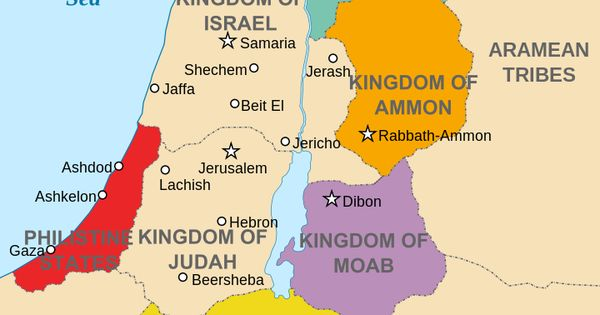
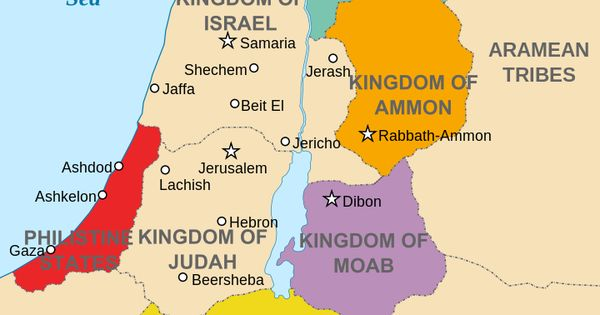
19 So Abraham returned unto his young men, and they rose up and went together to Beersheba; and Abraham dwelt at Beersheba. — Beersheba being south of both Hebron and Jerusalem.
20 And it came to pass after these things, that it was told Abraham, saying, “Behold Milcah, she hath also borne children unto thy brother Nahor: — saying, behold Milcah, she hath also borne children unto thy brother Nahor;
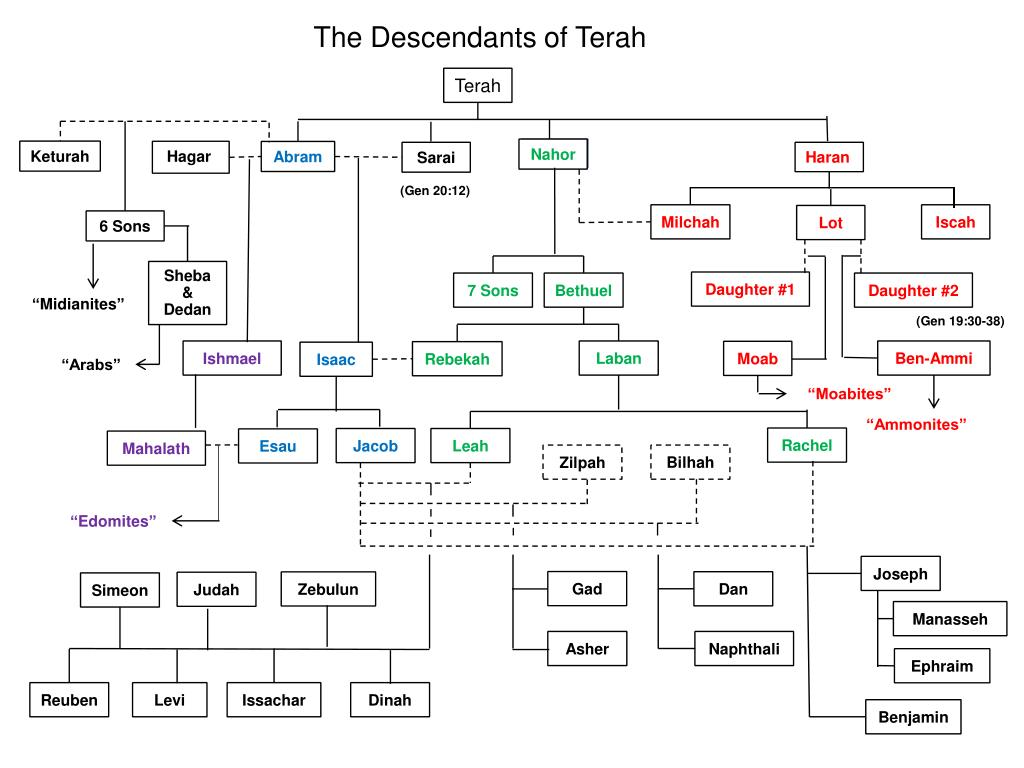
— as Sarah, supposed to be the same with Iscah, a daughter of Haran, had borne a son to him; so Milcah, another daughter of Harsh, had borne children to his brother Nahor, whom he had left in Ur of the Chaldees, when he departed from thence, and who afterwards came and dwelt in Haran of Mesopotamia;
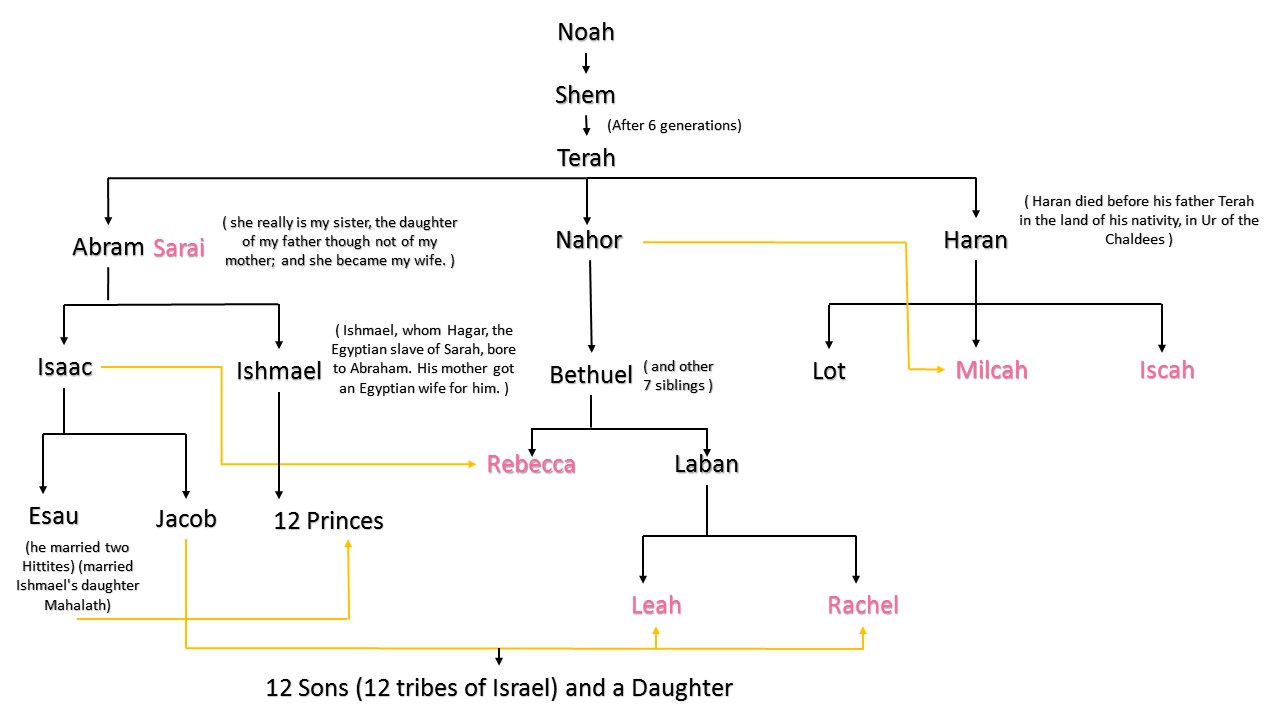
21 Huz his firstborn, and Buz his brother, and Kemuel the father of Aram, — Huz his (Nahor) firstborn, and Buz his brother; the first of these gave name to the land of Uz, where Job dwelt, and some speculate could be a descendant or related to Job;
22 and Chesed and Hazo, and Pildash and Jidlaph and Bethuel.” — all the names of Nahor’s eight children; and Bethuel became the father of Rebekah and Laban,
23 And Bethuel begot Rebekah. These eight Milcah bore to Nahor, Abraham’s brother.
24 And his concubine, whose name was Reumah, she bore also Tebah and Gaham, and Thahash and Maachah.


 Joel
Joel A Prophecy of Esau and Jacob