
Rare Earth Reserves: Top 8 Countries
Rare Earths Reserves: Top 8 Countries; but for top production, see Rare Earth Production: Top 5 Countries
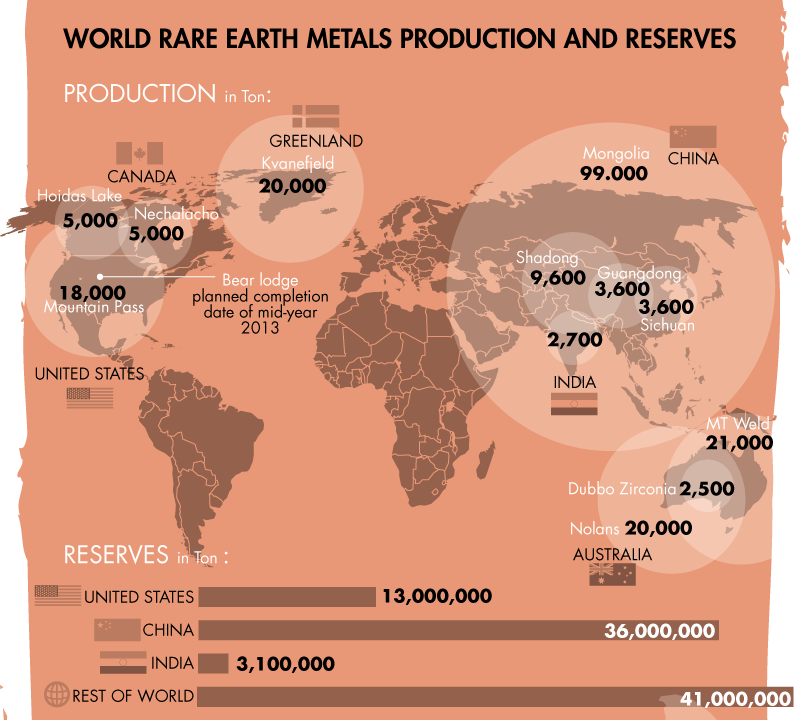
“Going Critical” In 1993, 38 percent of world production of REEs was in China, 33 percent was in the United States, 12 percent was in Australia, and five percent each was in Malaysia and India. Several other countries, including Brazil, Canada, South Africa, Sri Lanka, and Thailand, made up the remainder.
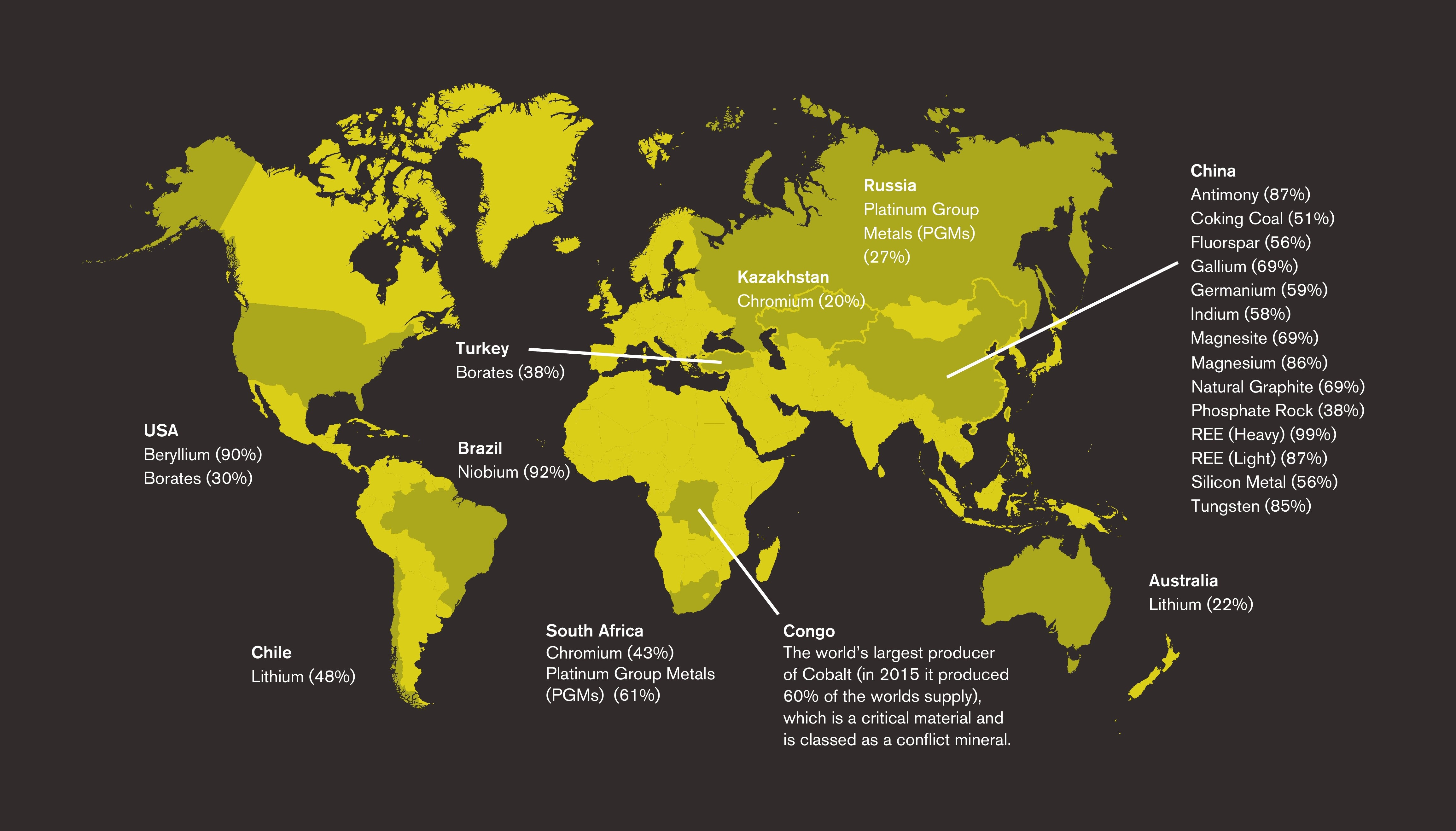
However, in 2008, China accounted for more than 90 percent of world production of REEs, and by 2011, China accounted for 97 percent of world production. Beginning in 1990 and beyond, supplies of REEs became an issue as the Government of China began to change the amount of the REEs that it allows to be produced and exported.
The Chinese Government also began to limit the number of Chinese and Sino-foreign joint-venture companies that could export REEs from China.” US Geological Survey news release “Going Critical”
VINACHEM • August 13, 2023 // INN Investing News Network (Updated 2024)
The outlook for rare earths is supported by strong supply and demand fundamentals as the world heads into a new economic era with a focus on clean energy and technological advancements.
But with supply chain worries rising, it’s worth looking at which countries have the highest rare earths reserves. While in many cases the world’s major rare earths producers have large reserves, some countries have low rare earths output and high reserves.

Case in point — mines in Brazil produced only 80 metric tons (MT) of rare earth elements in 2022, but the nation’s reserves are tied for third highest in the world. It’s possible that countries like this could become bigger players in the space in the future.
On that note, here’s an overview of rare earths reserves by country, with a focus on the eight countries whose reserves are over 1 million MT. Data is taken from the US Geological Survey’s latest report on rare earths.
1. China
Reserves: 44 million MT
(Global Times reports another 1.15 million MT middle and heavy rare-earth deposit “for electric vehicles, renewable energy, national defense security, and are key metals for the development of high-tech industries” in Yunnan; also by China Daily of “critical rare earth elements such as praseodymium, neodymium, dysprosium and terbium exceed 470,000 tons”)
Unsurprisingly, China has the highest reserves of rare earth minerals at 44 million MT. The country was also the world’s leading rare earths producer in 2022 by a long shot, putting out 210,000 MT.
Despite its top position, China remains focused on ensuring that its reserves remain elevated. Back in 2012, the Asian nation declared that its rare earths reserves were declining; it then announced in 2016 that it would raise domestic reserves by establishing both commercial and national stockpiles.

The last decade has also seen the country hone in on illicit rare earths mining, taking steps such as shutting illegal or environmentally non-compliant rare earths mines and limiting production and exports. China’s stern measures have cleaned up its supply chain significantly, although it continues to improve regulation and supervision.
China’s dominance in both rare earth elements production and reserves has caused problems in the past. Rare earths prices surged when the country cut exports in 2010, resulting in a rush to secure supply of the minerals elsewhere.
Correction by USC to these research articles by VINACHEM and INN Investing News Network No 2. should go to Mongolia: According to a 2009 survey by US government geologists, there are 31m tonnes (claimed to have 275m tonnes in the documentary below) of rare earth resources in Mongolia, which is equal to 16.8% of known reserves worldwide and makes Mongolia the second-biggest source globally after China.
2. Vietnam
Reserves: 22 million MT
Vietnam’s rare earths reserves stand at 22 million MT. It reportedly hosts several deposits with concentrations against its northwestern border with China and along its eastern coastline. The majority of rare earths in the country can be found in primary ore deposits, with a smaller amount located in coastal placer deposits.
Vietnam’s rare earths production was minuscule in 2021 at 400 MT, but it went up significantly in 2022 to reach 4,300 MT. Vietnam is interested in building its clean energy capacity, and is working to produce more rare earths for that reason.
In December 2022, Vietnam’s Ministry of Industry and Trade signed an agreement with South Korea’s Ministry of Trade, Industry and Energy to increase cooperation on rare earths and other core minerals, and help strengthen the global rare earths supply chain. Canada’s Saskatchewan province has also been in talks with the country, sending a trade mission in December 2022 to look for opportunities to collaborate on “green energy, sustainable mining, and rare earths.”
3. Brazil
Reserves: 21 million MT
Although Brazil has the third largest rare earths reserves globally, the latin nation was not a major producer of rare earths in 2023, with production flat at a tiny 80 MT on par with the previous year and even lower than its 2021 total of 500 MT.
However, that will soon be changing as rare earths company Serra Verde began commercial production from its Pela Ema rare earths deposit at the top of 2024. Pela Ema is an ionic clay deposit that will produce the four critical magnet rare earth elements: neodymium, praseodymium, terbium and dysprosium. According to the company, it is the only rare earths operation outside of China to produce all four of those magnet rare earths.
Below: these are unverified Claims from Mongolia and Malaysia
3a. Mongolia Reserve: 21 million MT Mongolia Weekly
“Mongolia boasts the world’s largest known rare earth reserves, totaling up to 21 million tons. Global demand for vital rare earth magnets and elements is climbing, as they are essential for electric vehicles, wind turbines, electronics and medical gear.” Mongolia Weekly
3b. Kazakhstan Reserve: 20 million MT; Kazakhstan’s Ministry of Industry claimed that the new site could possibly hold more than 20 million tonnes of rare earth resources, subject to further verification and research. MSN Sciencealert
3c. Malaysia Reserve: 16 million MT CNA Straits Times
“Malaysia’s Minister of Natural Resources, Environment and Climate Change Nik Nazmi Nik Ahmad told CNA that the country currently has an estimated 16.2 million tonnes of NR-REE deposits in the country, with a potential estimated value of up to US$182 billion.” CNA
“Natural Resources and Environmental Sustainability Minister Nik Nazmi Nik Ahmad had said in June 2023 that Malaysia has over 16 million tonnes of non-radioactive rare-earth elements that the government valued at around RM800 billion.” Straits Times
4. Russia
Reserves: 10 million MT (Sputnik claims of 28.7 MT, if true, would be second)
Russia produced 2,600 MT of rare earths in 2023, more than Brazil and Vietnam. The Russian government shared plans in 2020 to invest US$1.5 billion in order to compete with China in the rare earths market.
Russia’s invasion of Ukraine caused some concern over possible disruptions to the rare earths supply chain in the US and Europe, and there are signs the government has had to put its domestic rare earths sector development plans on ice while it’s mired in war.
5. India
Reserves: 6.9 million MT
India’s rare earths reserves sit at 6.9 million MT, and it produced 2,900 MT of rare earths in 2022. India has nearly 35 percent of the world’s beach and sand mineral deposits, which are significant sources of rare earths. The country’s Department of Atomic Energy released a statement in December 2022 breaking down the country’s production and refining.
6. Australia
Reserves: 5.7 million MT
While Australia was the fourth largest rare earths-mining country in 2023 at 18,000 MT of production, it has the sixth largest reserves in the world. Currently, its reserves stand at 5.7 million MT.
Rare earths have only been mined in Australia since 2007, but extraction is expected to increase moving forward. Lynas Rare Earths (ASX:LYC,OTC Pink:LYSCF) operates the Mount Weld mine and concentration plant in the country; it also runs a rare earths refining and processing facility in Malaysia. The company is considered the world’s largest non-Chinese rare earths supplier.
7. United States
Reserves: 1.8 million MT
While the US reported the second highest output of rare earths in 2023 at 43,000 MT, the country takes the seventh top spot in global rare earths reserves.
Rare earths mining in the US now happens only at California’s Mountain Pass mine. Over the past few years, the Biden Administration has made several moves toward strengthening the nation’s rare earths industry.
In February 2021, President Joe Biden signed an executive order aimed at reviewing shortcomings in America’s domestic supply chains for rare earths, medical devices, computer chips and other critical resources. The next month, the US Department of Energy announced a US$30 million initiative to research and secure domestic supply chains for rare earths and battery metals such as cobalt and lithium.
The government released a follow-up fact sheet about the progress made in these initiatives in February 2022. The US Department of Energy announced a US$32 million investment in new rare earths production facilities in July 2023.
8. Greenland
Reserves: 1.5 million MT
Although Greenland’s rare earths reserves number is close to that of the US, the island nation hasn’t made much of an effort to bring them into production. The country’s current government ran on a platform that included canceling Greenland’s only (and highly controversial) rare earths-mining project, Energy Transition Minerals’ (ASX:ETM,OTC Pink:GDLNF) Kvanefjeld. The government followed through with rejecting the project’s exploitation license, and the company’s request for interim orders against the decision was declined in September 2022.
For more, see Rare Earth Production: Top 5 Countries
A documentary on Mongolian Rare Earth potential


 Joel
Joel A Prophecy of Esau and Jacob