
Leviticus (17-18)
Leviticus 17
1 And the Lord spoke unto Moses, saying,
2 “Speak unto Aaron and unto his sons and unto all the children of Israel, and say unto them: ‘This is the thing which the Lord hath commanded, saying: — this is the thing which the Lord hath commanded; ordered to be observed as his will and pleasure by everyone of them: saying; namely, what follows.
3 Whatsoever man there be of the house of Israel who killeth an ox or lamb or goat in the camp, or who killeth it out of the camp, — that killeth; not for common use, for such beasts might be killed by any person or in any place; but for sacrifice, as the sense is limited, Leviticus 17:5;
4 and bringeth it not unto the door of the tabernacle of the congregation to offer an offering unto the Lord before the tabernacle of the Lord, blood shall be imputed unto that man: he hath shed blood. And that man shall be cut off from among his people,
— he shall be cut off by death, either by the hand of God, in case men do not know it or neglect to punish it, or by men, if the fact was public and evident;
5 to the end that the children of Israel may bring their sacrifices which they offer in the open field, even that they may bring them unto the Lord unto the door of the tabernacle of the congregation, unto the priest, and offer them for peace offerings unto the Lord.
— whoever of the house of Israel slaughtered an ox, sheep, or goat, either within or outside the camp, without bringing the animal to the tabernacle, to offer a sacrifice therefrom to the Lord, “blood was to be reckoned to him;”
6 And the priest shall sprinkle the blood upon the altar of the Lord at the door of the tabernacle of the congregation, and burn the fat for a sweet savor unto the Lord. — and burn the fat for a sweet savour to the Lord; the fat includes the inwards, the kidneys, the flanks and caul of the liver; Leviticus 3:3.
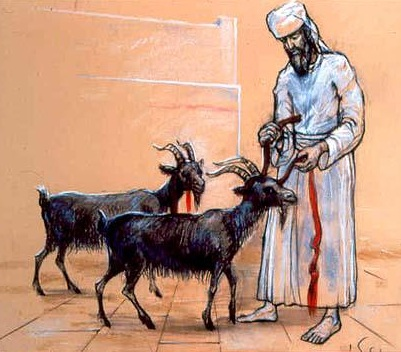
7 And they shall no more offer their sacrifices unto devils, after whom they have gone a whoring. This shall be a statute for ever unto them throughout their generations.’ — and they shall no more offer their sacrifices unto devils; the word, sēirim here translated “devils,” literally indicates hairy or shaggy goats, and then goat-like deities, or demons.
8 “And thou shalt say unto them: ‘Whatsoever man there be of the house of Israel, or of the strangers who sojourn among you, who offereth a burnt offering or sacrifice,
9 and bringeth it not unto the door of the tabernacle of the congregation to offer it unto the Lord, even that man shall be cut off from among his people.
— even that man shall be cut off from his people; from being one of them, and having communion with them, and sharing in their privileges; or by death, either by the hand of the civil magistrate, or rather by the hand of God;
10 “‘And whatsoever man there be of the house of Israel, or of the strangers who sojourn among you, who eateth any manner of blood, I will even set My face against that soul who eateth blood and will cut him off from among his people.
— owing to its great importance, the law is enacted here separately, where it naturally follows the order that the blood of all animals sacrificed in the sanctuary is to be offered to the Lord upon the altar.
11 For the life of the flesh is in the blood, and I have given it to you upon the altar to make an atonement for your souls; for it is the blood that maketh an atonement for the soul. — and I have given it unto you to make an atonement for your souls: that being the life of the creature, was given for theirs to preserve them alive, and secure them from death their sins deserved;
12 Therefore I said unto the children of Israel, “No soul of you shall eat blood, neither shall any stranger that sojourneth among you eat blood.” — neither shall any stranger that sojourneth among you eat blood; any proselyte of righteousness; this may not have been observed before.
13 And whatsoever man there be of the children of Israel or of the strangers who sojourn among you, who hunteth and catcheth any beast or fowl that may be eaten, he shall even pour out the blood thereof and cover it with dust. — he shall even pour out the blood; and cover it with dust; upon the earth, from which all animals came forth at their creation;
14 For it is the life of all flesh: the blood of it is for the life thereof. Therefore I said unto the children of Israel, “Ye shall eat the blood of no manner of flesh, for the life of all flesh is the blood thereof. Whosoever eateth it shall be cut off.” — whosoever eateth it shall be cut off; by death, whether he be an Israelite or a proselyte of righteousness;
15 And every soul that eateth that which died of itself or that which was torn by beasts, whether it be one of your own country or a stranger, he shall both wash his clothes and bathe himself in water, and be unclean until the evening; then shall he be clean. — that which died of itself; the law enacted here is a natural sequel to the one immediately preceding, since it is still based upon the sacredness of blood;
— then shall he be clean; when he has washed his garments, and bathed himself, and the evening is come, and then shall be admitted to society as before:
16 But if he wash them not nor bathe his flesh, then he shall bear his iniquity.’” — then he shall bear his iniquity; his guilt shall remain on him, and he shall suffer the punishment the law exposes him to, either by the hand of God, or the civil magistrate, which is due to persons that enter into the sanctuary in their uncleanness, or eat of holy things.
Leviticus 18
1 And the Lord spoke unto Moses, saying,
2 “Speak unto the children of Israel and say unto them: ‘I am the Lord your God. — I am the Lord your God; the Lord, Yehovah, is their recognised and sole sovereign, the children of Israel are therefore bound to obey His precepts, and not be led astray by the customs or statutes which prevailed among the people whose country they are to possess.
3 According to the doings of the land of Egypt wherein ye dwelt, shall ye not do; and according to the doings of the land of Canaan whither I bring you, shall ye not do; neither shall ye walk in their ordinances.
— after the doings of the land of Egypt, wherein ye dwelt, shall ye not do; where they had dwelt many years, and were just come out from thence, and where they had learned many of their evil practices; not only their idolatrous ones referred to in the preceding chapter;
4 Ye shall do My judgments and keep Mine ordinances to walk therein; I am the Lord your God. — ye shall do my judgments; the expression “my judgments and mine ordinances” is here used emphatically, in opposition to “their ordinances,” and has here the force of Mine only;
5 Ye shall therefore keep My statutes and My judgments, which if a man do, he shall live in them: I am the Lord. — he shall live in them; not only happily here, but also eternally hereafter;
6 “‘None of you shall approach any who is near of kin to him to uncover their nakedness: I am the Lord. — to illicit incestuous relation is illegal;
7 The nakedness of thy father or the nakedness of thy mother shalt thou not uncover: she is thy mother; thou shalt not uncover her nakedness. — by uncovering a father’s nakedness is not meant anything similar to what befell Noah, which Ham beheld with pleasure, and the other two sons of Noah studiously and with reverence to their father covered;
— she is thy mother, thou shalt not uncover her nakedness; that is, not lie with her, nor marry her, because she is his mother that bore him, of whom he was born, and therefore ought not to become his wife, or be taken into his bed; such a marriage must be incestuous and shocking;
8 The nakedness of thy father’s wife shalt thou not uncover: it is thy father’s nakedness. — a man’s father’s wife is for ever prohibited, whether she be simply betrothed or married to his father, whether she be divorced or not, whether she be a widow or not; all connection with her on the part of the father’s son is forbidden;
— this, therefore, includes the sin of Reuben with Bilhah, his father’s concubine (Genesis 35:22), and of Absalom with the wives of his father (II Samuel 16:20-23; I Kings 2:17); which was not incestuous marriage but adultery, since their husbands were alive and the wives were not divorced from them;
9 The nakedness of thy sister, the daughter of thy father or daughter of thy mother, whether she be born at home or born abroad, even their nakedness thou shalt not uncover.
— the nakedness of thy sister; to lie with one in so near a relation is exceeding criminal, and for which the law curses a man, Deuteronomy 27:22; and to marry her is not lawful; for though it was necessary for the propagation of mankind that a man should marry his sister, for who else could Cain and Abel marry?
— yet afterwards, when there was an increase of mankind, and there were people enough remote from each other, it became unlawful for persons in such near ties of consanguinity to marry with each other;
10 The nakedness of thy son’s daughter or of thy daughter’s daughter, even their nakedness thou shalt not uncover; for theirs is thine own nakedness. — for theirs is thine own nakedness; which sprung from his, being the descendants either of his son or daughter; the Targum of Jonathan says,” for they are as thy own nakedness,” his own flesh and blood.
11 The nakedness of thy father’s wife’s daughter, begotten of thy father, she is thy sister; thou shalt not uncover her nakedness. — thy father’s wife’s daughter; if this clause stood alone it would denote the daughter of a man’s stepmother by another or previous husband;
12 Thou shalt not uncover the nakedness of thy father’s sister: she is thy father’s near kinswoman. — thou shalt not uncover the nakedness of thy father’s sister; his aunt by his father’s side;
13 Thou shalt not uncover the nakedness of thy mother’s sister, for she is thy mother’s near kinswoman. — thou shalt not uncover the nakedness of thy mother’s sister; which is the same relation as before, an aunt by the mother’s side; wherefore, if such a marriage was unlawful, this must also, and for the same reason;
14 Thou shalt not uncover the nakedness of thy father’s brother. Thou shalt not approach his wife: she is thine aunt.
— thou shalt not uncover the nakedness of thy father’s brother; which some understand this of committing sodomy with him, on which account he was doubly guilty, partly because of lying with a male, and partly because of uncovering the nakedness of his father’s brother;
15 Thou shalt not uncover the nakedness of thy daughter-in-law: she is thy son’s wife; thou shalt not uncover her nakedness. — she is that son’s wife; and so one flesh with him, and who is of the same flesh and blood with his father, and therefore the nearness of the relation forbids such incestuous copulation or marriage;
16 Thou shalt not uncover the nakedness of thy brother’s wife: it is thy brother’s nakedness. — the Targum of Jonathan adds; by way of explanation, “in the life of thy brother, or after his death, if he has children,” but then that law was but an exception from this general rule, and so did not make it void in other respects, but bound it the more strongly; and besides, it was a special and peculiar law to them;
17 Thou shalt not uncover the nakedness of a woman and her daughter, neither shalt thou take her son’s daughter or her daughter’s daughter to uncover her nakedness: for they are her near kinswomen; it is wickedness.
— a woman and her daughter; that is, if a man marries a widow who has a daughter by a former husband, or if he forms an alliance with a woman who has a daughter out of wedlock, he is forbidden to marry also the daughter.
18 Neither shalt thou take a wife to her sister to vex her, to uncover her nakedness beside the other in her life time. — to vex her; that is, by marrying also the younger sister, the first, who is already the wife, would be roused to jealousy, and the natural love of sisters would thus be converted into enmity, thus precluding the occurrence of a case like that of Jacob with Leah and Rachel.
19 “‘Also thou shalt not approach unto a woman to uncover her nakedness as long as she is put apart for her uncleanness. — to uncover her nakedness, as long as she is put apart for her uncleanness; in her monthly courses; and the time of her separation from her husband on that account was seven days;
20 Moreover thou shalt not lie carnally with thy neighbor’s wife, to defile thyself with her. — thy neighbour’s wife; for committing adultery, which is here branded as a defilement, whether with a betrothed or married woman, both guilty parties incurred the penalty of death by stoning.
21 And thou shalt not let any of thy seed pass through the fire to Molech, neither shalt thou profane the name of thy God: I am the Lord. — pass through the fire to Molech; literally, to let it pass to Molech, that is, to put the child into the hands of the figure of Molech, when it fell into the fire which was kindled in the hollow statue of this idol.
22 Thou shalt not lie with mankind as with womankind: it is abomination. — as with womankind; this was the sin of Sodom (Genesis 19:5), whence it derived its name, and in spite of the penalty of death enacted by the Law against those who were found guilty of it;
23 Neither shalt thou lie with any beast to defile thyself therewith, neither shall any woman stand before a beast to lie down thereto: it is confusion. — any beast; the necessity for the prohibition of this shocking crime, for which the Mosaic law enacts the penalty of death;
24 “‘Defile not ye yourselves in any of these things, for in all these the nations are defiled which I cast out before you, — defile not ye yourselves in any of these things; in incestuous copulations and marriages, in adultery, sodomy and bestiality;
— the Targum of Jonathan says:
Defile not yourselves by any one of all these; for by all these have the peoples defiled themselves whom I am about to drive away from before you. Leviticus 18:24 Targum
Defile not yourselves by any one of all these; for by all these have the peoples defiled themselves whom I am about to drive away from before you.
— for in all these the nations are defiled which I cast out before you; that is, the seven nations of the land of Canaan: the Kenites, the Kenizzites, the Kadmonites, the Hittites, the Perizzites, the Rephaim, the Amorites, the Canaanites, the Girgashites and the Jebusites. Genesis 15:19-21
25 and the land is defiled. Therefore I do visit the iniquity thereof upon it, and the land itself vomiteth out her inhabitants.
— therefore I do visit the iniquity thereof upon it; and the land itself vomiteth out her inhabitants: the Canaanites collectively, as enormous and incorrigible sinners, were to be exterminated; and this extermination was manifestly a judicial punishment inflicted by a ruler whose laws had been grossly and perseveringly outraged;
— and the land itself vomiteth out her inhabitants; as a stomach loaded with corrupt and bad food it has taken in, nauseates it, and cannot bear and retain it, but casts it up; so the land of Canaan is represented as loathing its inhabitants, and as a indignation against them, and as not being able to bear them, but entirely willing to be rid of them and throw them out of their places in it, never to be admitted again, being as nauseous and as useless as the cast of a man’s stomach;
26 Ye shall therefore keep My statutes and My judgments, and shall not commit any of these abominations, neither any of your own nation nor any stranger who sojourneth among you — ye shall therefore keep my statutes; as the perpetration of the above named abominations entailed such disastrous consequences both to the land and to its inhabitants,
27 (for all these abominations have the men of the land done, who were before you, and the land is defiled), — the repetition as those in Leviticus 18:24-25, is of the same sentiments in diiferent words, as is frequently the case in the Scriptures, is designed to impart emphasis. The parentheses are unnecessary.
28 that the land spew not you out also when ye defile it, as it spewed out the nations that were before you. — that the land spue not you out also; better, Lest the land vomit you out; that is, as it spewed out the nations that were before you;
— the judgement is expulsion; hence the Targum Jonathan says
For these abominable things have been done by the men of the land who have been before you, so that the land hath been polluted:
lest, when you pollute the land, it cast you forth, as it will have delivered itself of the people that were before you. Leviticus 18:27-28 Targum
— same thing, the judgement is expulsion; and here from the MSG
“Don’t pollute yourself in any of these ways. This is how the nations became polluted, the ones that I am going to drive out of the land before you. Even the land itself became polluted and I punished it for its iniquities—the land vomited up its inhabitants.
You must keep my decrees and laws—natives and foreigners both. You must not do any of these abhorrent things. The people who lived in this land before you arrived did all these things and polluted the land.
And if you pollute it, the land will vomit you up just as it vomited up the nations that preceded you. Leviticus 18:24-28 MSG
And below a parallel Scripture from Jeremiah:
“Therefore behold, the days come,” saith the Lord, “that it shall no more be said, ‘The Lord liveth who brought up the children of Israel out of the land of Egypt,’
but, ‘the Lord liveth who brought up the children of Israel from the land of the north, and from all the lands whither He had driven them.’ And I will bring them back into their land that I gave unto their fathers. Jeremiah 16:14-15
29 For whosoever shall commit any of these abominations, even the souls who commit them shall be cut off from among their people. — the souls that commit them shall be cut off; this strong denunciatory language is applied to all the crimes specified in this chapter without distinction: from incest as truly as to Sodomy to bestiality, and to other cases of affinity;
30 Therefore shall ye keep Mine ordinance, that ye commit not any one of these abominable customs, which were committed before you, and that ye defile not yourselves therein: I am the Lord your God.’”
— and that ye defile not yourselves therein; for though the land is so often said to be defiled, yet, properly speaking, and chiefly, it was the inhabitants that were defiled by their abominable customs;
— and so should the Israelites do so also, should they observe the same, and thereby become abominable in the sight of God, and incur his same displeasure, and be liable to his vengeance:
— from MSG
“Those who do any of these abhorrent things will be cut off from their people. Keep to what I tell you; don’t engage in any of the abhorrent acts that were practiced before you came.
Don’t pollute yourselves with them. I am God, your God.” Leviticus 18:29-30 MSG


 Joel
Joel A Prophecy of Esau and Jacob