
“Then will I slay my brother Jacob” (Genesis 27)
“And upon thy sword shalt thou depend, entering at every place: yet thou shalt be supple and credulous, and be in subjection to thy brother [Jacob]; but it will be that when his sons [the modern children of Israel] become evil, and fall from keeping the commandments of the law, thou shalt break his yoke of servitude from off thy neck….and then will I kill Jakob my brother,” Genesis 27:41-42 Jonathan

Genesis 27
1 And it came to pass that when Isaac was old, and his eyes were dim so that he could not see, he called Esau his eldest son and said unto him, “My son.” And he said unto him, “Behold, here am I.”
— it came to pass; the importance of this chapter is manifest. Just as in Abraham’s life the decision had to be made which of the two sons, Ishmael and Isaac, was to be the heir of the promise, so, here again, there is the same Divine election: but while Abraham obeyed, though with heavy heart (Genesis 21:11), Isaac even struggled against God’s will;
— in this case, however, the sons are more closely allied, being twins, born of the same mother, but the younger following so closely upon the very heels of the elder as to seem, even at his birth, as if in eager pursuit.
— Esau violated the family law laid down by Abraham, Jacob conformed to it. By marrying Canaanitish women, Esau forfeited by his own act the birthright which previously he had sold; for his children, being illegitimate;

2 And he said, “Behold now, I am old; I know not the day of my death. — when Isaac was old, and his eyes were dim; he was in his hundred thirty-seventh year; but he lived to be 180 (Genesis 35:28).
3 Now therefore take, I pray thee, thy weapons, thy quiver and thy bow, and go out to the field and take me some venison. — take me some venison; in this Isaac designed, as receiving a fresh instance of his son’s filial duty and affection to him, before he bestowed the designed favour upon him.
4 And make me savory meat, such as I love, and bring it to me, that I may eat, that my soul may bless thee before I die.” — that my soul may bless thee; we gather from the solemn blessing given to his sons by Jacob (Genesis 49) that this was a prophetic act, by which the patriarchs, under the influence of God’s spirit, and in expectation of death, decided to which son should belong the birthright;
— that my soul may bless thee before I die; having eaten a comfortable meal, and being refreshed with it, but that having had proof of his son’s duty and affection to him, he might confer the blessing on him heartily: this blessing was not an ordinary and common one, but what parents used to bestow upon their children at the time of their death, or a little before it;
— and good men oftentimes did this under a spirit of prophecy, declaring what would be the case and circumstances of their children in time to come; and particularly the principal part of the blessing of Isaac, which Abraham had entailed upon him by divine direction, and he thought to have entailed on Esau his firstborn; especially of the possession and inheritance of the land of Canaan; between the two great rivers, (Genesis 15);
5 And Rebekah heard when Isaac spoke to Esau his son. And Esau went to the field to hunt for venison, and to bring it. — but Rebekah, who heard what he said, sought to frustrate this intention, and to secure the blessing for her favourite son, Jacob.
6 And Rebekah spoke unto Jacob her son, saying, “Behold, I heard thy father speak unto Esau thy brother, saying, — if Rebekah, when she heard Isaac promise the blessing to Esau, had gone to him, and with humility and seriousness put him in remembrance of that which God had said concerning their sons;
— if she had further showed him how Esau had forfeited the blessing, both by selling his birthright, and by marrying of strange wives; it is probable Isaac would have been prevailed with to confer the blessing upon Jacob, and needed not thus to have been cheated into it;
And Isaac entreated (beseech; ask earnestly) the Lord for his wife, because she was barren; and the Lord was entreated by him, and Rebekah his wife conceived.
And the children struggled together within her; and she said, “If it be so, why am I thus?” And she went to inquire of the Lord.
And the Lord said unto her, “Two nations are in thy womb, and two manner of people shall be separated from thy body; and the one people shall be stronger than the other people, and the elder shall serve the younger.” Genesis 25:21-23
The Targun of Jonathan says:
And Izhak went to the mountain of worship, the place where his father had bound him. And Izhak in his prayer turned the attention of the Holy One, blessed be He! from that which He had decreed concerning him who had been childless. And he was enlarged, and Rivekah his wife was with child.
And the children pressed in her womb as men doing battle. And she said, If this is the anguish of a mother, what then are children to me? And she went into the school of Shem Rabba to supplicate mercy before the Lord.
And the Lord said to her, Two peoples are in thy womb, and two kingdoms from thy womb shall be separated; and one kingdom shall be stronger than the other, and the elder shall serve the younger, if the children of the younger will keep the commandments of the Law. Genesis 25:21-23
— and the elder shall serve the younger; that is only true if the children of the younger, that is, of the children of Israel, would keep all the laws, statutes and ordinances of God;
7 ‘Bring me venison, and make me savory meat, that I may eat and bless thee before the Lord before my death.’ — before the Lord; solemnly, as in God’s presence, in his name, and by his authority, and with his leave and favour, which I shall heartily pray for thee. So he signifies that this was more than an ordinary blessing which he now intended to give him.
8 Now therefore, my son, obey my voice according to that which I command thee. — Rebekah knew that the blessing was intended for Jacob, and expected he would have it. But she wronged Isaac by putting a cheat on him; she wronged Jacob by tempting him to wickedness.
9 Go now to the flock, and fetch me from thence two good kids of the goats, and I will make them savory meat for thy father, such as he loveth;
— two good kids of the goats; though two may seem to be too much to be dressed for Isaac only; it may be observed, that Rebekah intended only to take out some of the choicest and most tender and delicate parts of them, and which would best suit her purpose, and which she would make most like to venison;
— I will make them savoury meat, out of their most tender and delicate parts; wherewith it was not difficult to deceive Isaac, partly because of the likeness of the flesh, especially being altered by convenient sauce; and partly because the same old age which had dimmed Isaac’s sight had also dulled his other senses;
10 and thou shalt bring it to thy father, that he may eat and that he may bless thee before his death.” —that he may eat, and that he may bless thee before his death; to whom she knew by the divine oracle the blessing belonged, Genesis 25:23;
11 And Jacob said to Rebekah his mother, “Behold, Esau my brother is a hairy man, and I am a smooth man. — Jacob said, Esau my brother is a hairy man; it is remarkable that his scruples were founded, not on the evil of the act, but on the risk and consequences of deception.
12 My father perhaps will feel me, and I shall seem to him as a deceiver; and I shall bring a curse upon myself and not a blessing.” — I shall bring a curse upon me, which is due to every one that deceiveth the blind, Deu 27:18, especially his father, and especially in a religious concern;
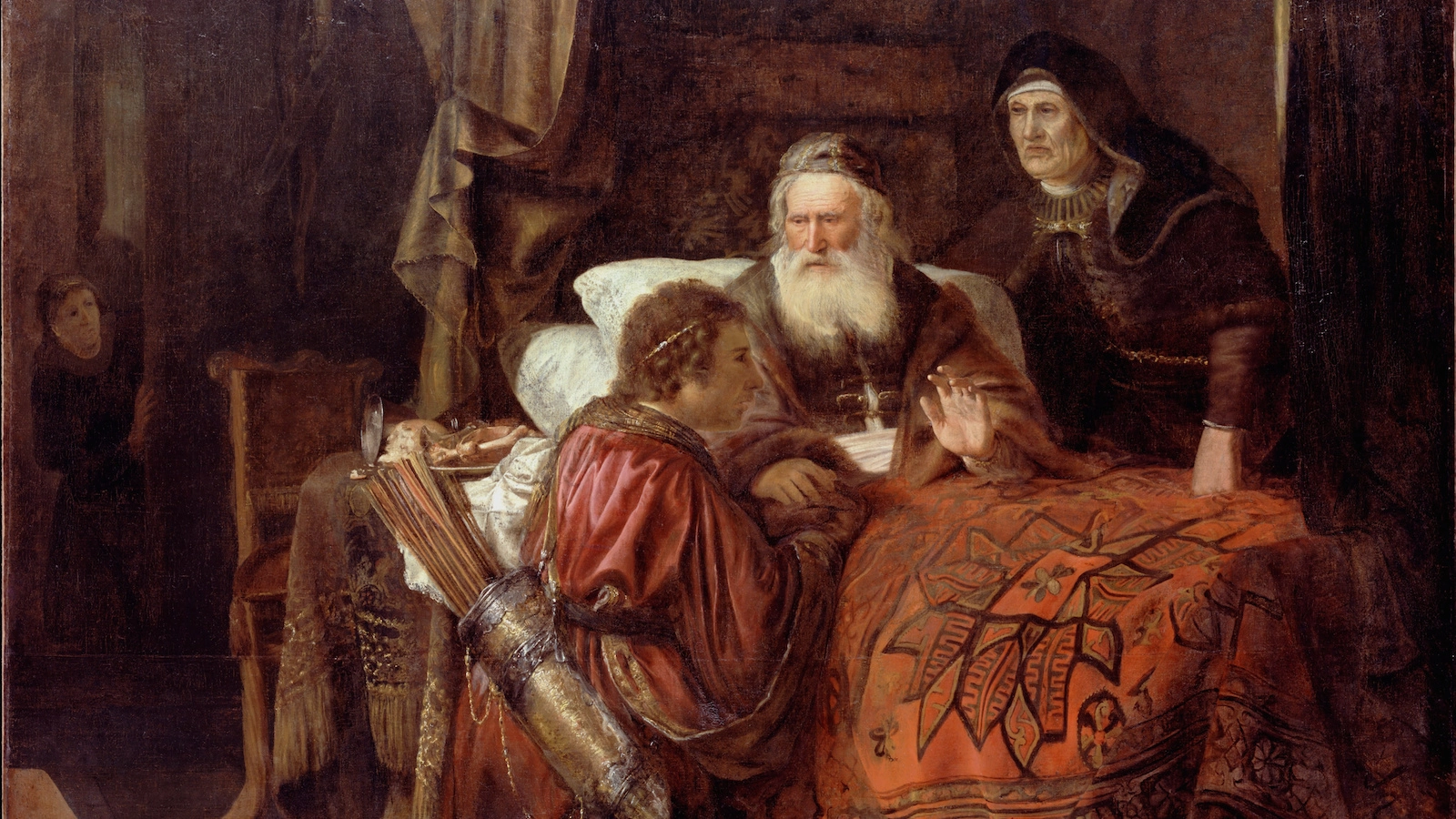
13 And his mother said unto him, “Upon me be thy curse, my son; only obey my voice, and go, fetch me them.” — upon me be thy curse; that is, I will warrant the success; or, if the issue turn out ill, I shall bear the blame and the punishment;
14 And he went, and fetched and brought them to his mother; and his mother made savory meat, such as his father loved. — being satisfied with what his mother had said, he went to the field where the flock was, and took out of it two young kids, and brought them to his mother; and thus far he did right to obey her commands;
15 And Rebekah took goodly raiment of her eldest son Esau, which were with her in the house, and put them upon Jacob her younger son; — goodly raiment; it has been supposed that the elder son held a sort of priestly office in the household, and as Isaac’s sight was growing dim, that Esau ministered for him at sacrifices.
16 and she put the skins of the kids of the goats upon his hands and upon the smooth of his neck. — Upon the two exposed parts of his body, which were most likely to be discovered. As for his face, it is more than probable from his age, which was the same with Esau’s;
17 And she gave the savory meat and the bread, which she had prepared, into the hand of her son Jacob. — and she gave the savoury (salty and spicy instead of being sweet) meat; seasoned and dressed in such a manner as might be taken for venison;
18 And he came unto his father, and said, “My father.” And he said, “Here am I. Who art thou, my son?” — who art thou, my son? for, from the voice and the quick dispatch made, he suspected it was not his son Esau.
19 And Jacob said unto his father, “I am Esau thy firstborn; I have done according as thou badest me. Arise, I pray thee, sit and eat of my venison, that thy soul may bless me.”
— that thy soul may bless me; as this was the thing in view, so speaking of it as soon as he came in, and which he desired might be done after his father had eat and drank, might serve to take off the suspicion of his being another person;
— the disguise, though wanting in one thing, which had nearly upset the whole plot, succeeded in misleading Isaac; and while giving his paternal embrace, the old man was roused into a state of high satisfaction and delight.
20 And Isaac said unto his son, “How is it that thou hast found it so quickly, my son?” And he said, “Because the Lord thy God brought it to me.” — because the Lord thy God brought it to me; Jacob does keep up his acting well, for it was in accordance with Isaac’s protraying to see anything providential in Esau’s success in hunting. This may have helped to arouse Isaac’s suspicions, who immediately proceeds to examine him;
— but it was another falsehood; for it was not the Lord, but his mother brought it to him: and this seems to be the most marvellous of all, that so good a man should dare to bring the name of the Lord God into this affair;
21 And Isaac said unto Jacob, “Come near, I pray thee, that I may feel thee, my son, whether thou be my very son Esau or not.” — whether thou be my very son Esau, or not; which he still was somewhat doubtful.
22 And Jacob went near unto Isaac his father; and he felt him and said, “The voice is Jacob’s voice, but the hands are the hands of Esau.” — but the hands are the hands of Esau; are like them, being hairy as they; or, as the Targums Jonathan says, “the feeling of the hands is as the feeling of the hands of Esau;”
23 And he discerned him not, because his hands were hairy, as his brother Esau’s hands; so he blessed him. — and he discerned him not; as he could not see, he could make no judgment by that sense; and, though he had his hearing;
— and thought the voice was like Jacob’s, he might imagine there might be an alteration in Esau’s voice, coming in haste and weary from the fields; yet, as there could not be any deception in his feeling, he thought it safest to trust to that, as it follows;
24 And he said, “Art thou my very son Esau?” And he said, “I am.” — and he said, I am; in a further excuse from lying, that Jacob does not say, “I am Esau”, only “I”, but it will not do, since it is an answer to Isaac’s question, with a design to deceive him; and he intended by it that he should understand him as he did, that he was really Esau.
25 And he said, “Bring it near to me, and I will eat of my son’s venison, that my soul may bless thee.” And he brought it near to him, and he ate; and he brought him wine, and he drank. — and he brought him wine, and he drank; and so was comfortably refreshed, and in a good temper and disposition of mind to confer the blessing.
26 And his father Isaac said unto him, “Come near now, and kiss me, my son.” — come near now, and kiss me, my son; this was the solemn preparation for the giving of the blessing.
— Isaac’s suspicions had now quite passed away’he had eaten and drunk, and the time had now come for the decision which son was to inherit the promise.
27 And he came near, and kissed him; and he smelled the smell of his raiment, and blessed him and said, “See, the smell of my son is as the smell of a field which the Lord hath blessed. — and he came near, and kissed him; Jacob came near and kissed Isaac his father;
— and Isaac smelled the smell of his raiment; which being not like the smell of a sheep coat, but of a field, might give him more full satisfaction that it was truly Esau: and he blessed Jacob; with his patriarchal and prophetic blessing,
28 Therefore God give thee of the dew of heaven, and the fatness of the earth, and plenty of corn and wine. — the dew of heaven; in Middle-Eastern countries, where there is so little rain, the dew is the most important prerequisite for the growth of the fruits of the earth, and is often mentioned therefore as a source of blessing;
29 Let people serve thee, and nations bow down to thee; be lord over thy brethren, and let thy mother’s sons bow down to thee. Cursed be every one that curseth thee, and blessed be he that blesseth thee!”
— let people serve thee; Heb. peoples (‘am·mîm,); up to this point the blessing had been general, but now Isaac bestows the birthright, carrying with it widespread dominion, precedence over all other members of the family, and special blessedness. The phrases “thy brethren” and “thy mother’s sons” include all nations sprung from Abraham, and all possible offshoots from Isaac’s other descendants.
30 And it came to pass, as soon as Isaac had made an end of blessing Jacob, and Jacob was yet scarcely gone out from the presence of Isaac his father, that Esau his brother came in from his hunting.
— and Jacob was yet scarce gone out from the presence of Isaac his father; which no doubt he made haste to do, as soon as he had got the blessing; partly to avoid his brother, whom he might expect to come in every moment, and partly to relate to his mother the success he had met with;
31 And he also had made savory meat, and brought it unto his father and said unto his father, “Let my father arise and eat of his son’s venison, that thy soul may bless me.” — he also made; Esau returned just as Jacob was leaving Isaac’s presence. There would still be some considerable delay before the captured game was made into savoury meat;
32 And Isaac his father said unto him, “Who art thou?” And he said, “I am thy son, thy firstborn, Esau.” — and Isaac his father said unto him, who art thou? Hearing another voice more like Esau’s than what he had heard before surprised him, and therefore in haste puts this question;
— and he said, I am thy son, thy firstborn Esau; all which was true in a sense; he was his son, and he was Esau, and he was his firstborn by nature, but not by right, for he had sold his birthright.
33 And Isaac trembled exceedingly and said, “Who? Where is he that hath taken venison and brought it me, and I have eaten of all before thou camest, and have blessed him? Yea, and he shall be blessed.” — Isaac trembled very exceedingly; this was not from mere vexation at having been so deceived, and made to give the blessing contrary to his wishes;
— what Isaac felt was that he had been resisting God. In spite of the prophecy given to the mother, and Esau’s own irreligious character and heathen marriages, he had determined to bestow on him the birthright by an act of his own will; and he had failed; he has no word of blame for Rebekah and Jacob, but confirms to him the possession of the birthright, and declares, “Yea, he shall be blessed.”
34 And when Esau heard the words of his father, he cried with a great and exceeding bitter cry, and said unto his father, “Bless me, even me also, O my father!” — and said unto his father, bless me, even me also, O my father; thou art my father, and I am a child of thine as well as Jacob, show paternal affection to me; give me also a child’s blessing, one at least equal to what thou hast given Jacob, if not a greater, as being the firstborn.
35 And he said, “Thy brother came with subtlety, and hath taken away thy blessing.” — and he said, thy brother came with subtilty; the Targum Jonathan interprets it, “with subtilty” taking it in a good sense, “subtilty is the quality of being subtle, or having a high degree of finesse or skill” or with wisdom, and rather commending it, as if it was wisely and prudently managed;
36 And he said, “Is not he rightly named Jacob [that is, A supplanter]? For he hath supplanted me these two times: he took away my birthright, and behold, now he hath taken away my blessing.” And he said, “Hast thou not reserved a blessing for me?”
— and he said, is not he rightly named Jacob? as he was by his parents, and those that were at his birth, because he took his brother by the heel as he came out of his mother’s womb; for Jacob signifies “heeler”, a supplanter, and was given him to keep up the memory of what he had done, to which Esau here refers;
— for he hath supplanted me these two times; to supplant another is to put his foot under the heel of another, in order to trip him up, to which Esau alludes; but uses the word in a figurative sense, for circumventing him, and dealing fraudulently and deceitfully with him, though he is not able to support his charge; for if he dealt fraudulently with any, it was with his father, and not with him, and the two times he refers to prove it not;
— he took away my birthright; which is not true, he did not take it away from him either by force or fraud, Esau sold it to him for a mess of pottage, Genesis 25:29;
— and behold, now he hath taken away my blessing; this is not true, he had not taken it away; it was given him by his father; and though he had used some artful methods to get it, Genesis 27:15, he had neither supplanted Esau, but if anyone, his father; nor had he done any injustice to Esau, since as he had bought from him the birthright, the blessing annexed to it went along with it, and of right belonged to Jacob;
— and he said, hast thou not reserved a blessing for me? is the whole fund of blessings exhausted? are all bestowed upon Jacob? is there not one left for me? he hoped there was, and that as good a one as he had bestowed on his brother, and entreats he might have it.
37 And Isaac answered and said unto Esau, “Behold, I have made him thy lord, and all his brethren have I given to him for servants; and with corn and wine have I sustained him. And what shall I do now unto thee, my son?” — behold, I have made him thy lord; the lord of his posterity, who would be subdued and become tributary to his seed;
— and all his brethren have I given to him for servants; the Edomites, who sprung from his brother Esau, who, according to this prophetic blessing, became servants to David, who was a son of Jacob’s;
— and with corn and wine have I sustained him; promised him a fruitful country, the land of Canaan, abounding with all good things, particularly with corn and wine, which are put for all the rest;
— and what shall I do now unto thee, my son? what is there remains? what can be bestowed upon thee? there is nothing left; dominion over others, even over all nations, yea, over thyself and thy posterity, and plenty of all good things, are given already to Jacob; what is there to be done for thee, or thou canst expect?
38 And Esau said unto his father, “Hast thou but one blessing, my father? Bless me, even me also, O my father!” And Esau lifted up his voice and wept. — and Esau said unto his father, hast thou but one blessing, my father? he seems to speak diminutively of what had been given to Jacob, calling it one blessing:
— whereas there were many, of different sorts, temporal and spiritual; but it may be Esau had not so clear and comprehensive a view of what was contained in Jacob’s blessing; or at least was willing to think and hope that there was not so much given, but there might be some behind for him, and that his father had a greater stock than to be drained of all at once;
— bless me, even me also, O my father: with another blessing, with one equal to what has been given my brother:
— and Esau lift up his voice, and wept; in order to move the affections of his father, and to prevail upon him to reverse the blessing he had bestowed on Jacob, and give it to him; but he could not bring his father to repentance, to change his mind, and revoke the blessing, and give it him, with all his crying and tears;
39 And Isaac his father answered and said unto him, “Behold, thy dwelling shall be away from the fatness of the earth, and of the dew of heaven from above. — and Isaac his father answered and said unto him; being willing to bestow what he could upon him, without lessening or breaking in upon the grant made to Jacob;
— behold, thy dwelling shall be away from the fatness of the earth, and of the dew of heaven from above: this agrees with the blessing of Jacob, and if so, Jacob hasn’t took the birthright; and would have no occasion of complaint or grief; or to have hated his brother and sought his life; to which may be added, that the land of Edom, which Esau and his posterity inhabited, was a very desert country;
— but from the Septuagint:
“And Isaac his father answered and said to him, See, away from the fatness of the earth shall your dwelling be, and away from the dew of the sky on high” (Genesis 27:39 Septuagint NETS)
— and from MSG (the Message)
Isaac said to him, You’ll live far from Earth’s bounty, remote from Heaven’s dew. You’ll live by your sword, hand-to-mouth, and you’ll serve your brother. But when you can’t take it any more you’ll break loose and run free. (Genesis 27:39 MSG)
— but it was deemed from the beginning that the birthright would be dew and fatness from heaven; hence many translations, following the Septuagint, have Esau’s loss of the birthright as “Your dwelling shall be away from the fatness of the earth and away from the dew of heaven from above;” and no mention made of corn and wine; the land of Edom not being so fat and fruitful as the land bestowed upon Jacob’s;
— though Esau was not personally subject to his brother, his posterity would be tributary to the Israelites: “Behold, I have made him thy lord.”
40 And by thy sword shalt thou live, and shalt serve thy brother; and it shall come to pass when thou shalt have the dominion, that thou shalt break his yoke from off thy neck.” — and by thy sword (or by your dagger; Septuagint NETS) shalt thou live; by what he could get by it; his land being so poor that he could not live upon it, but must be obliged to such methods for a livelihood; or his country being surrounded with enemies, his posterity would be obliged to defend themselves by the sword, and other weapons of war;
— and shalt serve thy brother; which is the sense and language of the oracle, Genesis 25:23; and which Isaac perhaps now remembered, and had a clear understanding of it, and delivers out his prophetic blessing agreeably to it;
— and it shall come to pass, when thou shalt have the dominion; not over the Israelites, the posterity of Jacob, which the Edomites, Esau’s posterity, never had; but when they should get a greater degree of strength, power, authority, and dominion in the world;
— that thou shalt break his yoke from off thy neck; the Edomites should revolt from the posterity of Jacob, and shake off the yoke of bondage and subjection they had been long under; thus in this prophecy, Esau is bidding for his time;
41 And Esau hated Jacob because of the blessing wherewith his father blessed him. And Esau said in his heart, “The days of mourning for my father are at hand. Then will I slay my brother Jacob.” — the days of mourning for my father are at hand; Esau evidently expected that his father’s death was near, and such also was Isaac’s own expectation (Genesis 27:2); but he recovered, and lived forty-four years after this;
— perhaps on this account another translation has been suggested, namely, “Days of mourning for my father are at hand: then I will slay Jacob.”
— and the Targum Jonathan says of Esau’s delayed intent of killing his brother Jacob; in fact it is a prophecy for the house for Esau against the house of Jacob:
“And upon thy sword shalt thou depend, entering at every place: yet thou shalt be supple and credulous, and be in subjection to thy brother [Jacob]; but it will be that when his sons [the modern children of Israel] become evil, and fall from keeping the commandments of the law, thou shalt break his yoke of servitude from off thy neck….and then will I kill Jakob my brother, and will be found the killer and the heir” Genesis 27:41 Jonathan
— a bit more on what this phase means “and will be found the killer and the heir”:
Esau says to himself that he will not make the same mistake as Cain. Cain killed his brother Abel, thinking that that would make him the sole heir. But then, Adam had another child, so Cain still had to share the inheritance.
Hence Esau said that he would not do that. Instead, he would delay the killing of Jacob until the death of Isaac, so that when Jacob is killed, Esau will become the sole heir.
So, Esau hopes he would be both be the killer and the only heir.
42 And these words of Esau her elder son were told to Rebekah; and she sent and called Jacob her younger son, and said unto him, “Behold, thy brother Esau doth comfort himself concerning thee, purposing to kill thee.
— and said unto him, behold, thy brother Esau, as touching thee, doth comfort himself, purposing to kill thee; he has determined on it, and has laid a scheme for it, and comforts himself and so be the heir of the promise, and get the blessing; and even that thy death will be a comfort to him under the loss of his blessing, though he gets nothing by it, so sweet is revenge unto him.
43 Now therefore my son, obey my voice; and arise, flee thou to Laban my brother in Haran, — these words of Esau were told Rebekah; poor woman! she now early begins to reap the bitter fruits of her fraudulent device;
— she is obliged to part with her son, for whom she planned it, never, probably, seeing him again; and he felt the retributive justice of heaven fall upon him heavily in his own future family; but she had taken full responsibility upon herself, in fulfilment of her promise in Genesis 27:13, “upon me be thy curse, my son, only obey my voice.”
44 and tarry with him a few days until thy brother’s fury turn away; — and tarry with Laban my brother, and remaining there “some days,” as she mildly puts it, until his brother’s wrath was subdued.
45 until thy brother’s anger turn away from thee, and he forget that which thou hast done to him. Then I will send and fetch thee from thence. Why should I be deprived also of you both in one day?” — why should I be deprived also of you both in one day? who might either in the quarrel kill one another; or however, as one would be murdered, so the other, the murderer, must die by the hand of the law;
— Why should I be deprived of you both? — Jamieson-Fausset-Brown Bible Commentary says this refers to the law of Goelism, by which the nearest of kin would be obliged to avenge the death of Jacob upon his brother.
46 And Rebekah said to Isaac, “I am weary of my life because of the daughters of Heth. If Jacob take a wife of the daughters of Heth, such as these who are of the daughters of the land, what good shall my life do me?” — if Jacob take a wife of the daughters of Heth; as his brother has done, and after his example, as the best are too apt to be led by bad examples;
— such as these which are of the daughters of the land: like those Esau had married, of the same tribe, or other tribes of the Canaanites, for Esau had married two “Hittite” wives (Genesis 26:34-35), which were in religion and manners like them.


 Joel
Joel A Prophecy of Esau and Jacob