
Leviticus (9-10)
Leviticus 9
1 And it came to pass on the eighth day that Moses called Aaron and his sons and the elders of Israel, — the consecration was to last seven days, during which time the persons to be consecrated were not to go away from the door of the tabernacle, and now is the eighth day.
2 and he said unto Aaron, “Take thee a young calf for a sin offering and a ram for a burnt offering, without blemish, and offer them before the Lord.
— and Moses said unto Aaron; take thee a young calf for a sin offering; the directions in these sacred things were still given by Moses, the circumstances being extraordinary;
— and offer them before the Lord; on the altar of burnt offering, which stood in the court of the tabernacle;
3 And unto the children of Israel thou shalt speak, saying, ‘Take ye a kid of the goats for a sin offering, and a calf and a lamb, both of the first year, without blemish, for a burnt offering,
— and unto the children of Israel thou shalt speak; that is, Aaron, who was now constituted high priest, was to give the orders about the sacrifices;
4 also a bullock and a ram for peace offerings to sacrifice before the Lord, and a meat offering mingled with oil; for today the Lord will appear unto you.’”
— for to-day the Lord will appear unto you; that is, prepare and sanctify yourselves with these sacrifices, for the Lord is to manifest himself in an especial manner to signify his approval of the inauguration of Aaron and his family to the priesthood.
5 And they brought that which Moses commanded before the tabernacle of the congregation, and all the congregation drew near and stood before the Lord.
— and all the congregation; that is, the elders who represented the people, whom Moses summoned (see Leviticus 9:1), and as many of the people as could find room assembled before the sanctuary in the court-yard to witness the newly-installed priests officiating for the first time.
6 And Moses said, “This is the thing which the Lord commanded that ye should do, and the glory of the Lord shall appear unto you.”
— and the glory of the Lord shall appear unto you; the fire that should go out from him, and consume the sacrifice, which would be a demonstration of his presence with them, and of his acceptance of the sacrifice.
7 And Moses said unto Aaron, “Go unto the altar, and offer thy sin offering and thy burnt offering, and make an atonement for thyself and for the people; and offer the offering of the people and make an atonement for them, as the Lord commanded.”
— and Moses said unto Aaron; though he was now the duly-installed high priest, yet he did not approach the altar till he was solemnly called upon by Moses to do it.
8 Aaron therefore went unto the altar and slew the calf of the sin offering, which was for himself. — and slew the calf; as the sacrificer Aaron, like every ordinary offerer, slaughtered the calf himself;
9 And the sons of Aaron brought the blood unto him, and he dipped his finger in the blood and put it upon the horns of the altar, and poured out the blood at the bottom of the altar;
— and poured out the blood at the bottom of the altar; what remained after he had put what was proper on the horns of it.
10 but the fat, and the kidneys and the caul above the liver of the sin offering, he burned upon the altar, as the Lord commanded Moses.
11 And the flesh and the hide he burned with fire outside the camp. — and the flesh and the hide he burnt with fire outside the camp; with common fire, for the fire from the Lord came only upon the altar;
12 And he slew the burnt offering; and Aaron’s sons presented unto him the blood, which he sprinkled round about upon the altar. — and Aaron’s sons presented unto him the blood: which they had received into a basin, when it was slain.
13 And they presented the burnt offering unto him, with the pieces thereof and the head; and he burned them upon the altar.
14 And he washed the inwards and the legs, and burned them upon the burnt offering on the altar.
15 And he brought the people’s offering, and took the goat, which was the sin offering for the people, and slew it and offered it for sin, as the first.
16 And he brought the burnt offering and offered it according to the ordinance.
17 And he brought the meat offering, and took a handful thereof and burned it upon the altar beside the burnt sacrifice of the morning.
18 He slew also the bullock and the ram for a sacrifice of peace offerings, which was for the people; and Aaron’s sons presented unto him the blood, which he sprinkled upon the altar round about,
19 and the fat of the bullock and of the ram, the rump, and that which covereth the inwards, and the kidneys, and the caul above the liver.
20 And they put the fat upon the breasts, and he burned the fat upon the altar.
21 And the breasts and the right shoulder Aaron waved for a wave offering before the Lord, as Moses commanded.
22 And Aaron lifted up his hand toward the people and blessed them, and came down from offering the sin offering and the burnt offering and peace offerings.
23 And Moses and Aaron went into the tabernacle of the congregation, and came out and blessed the people; and the glory of the Lord appeared unto all the people.
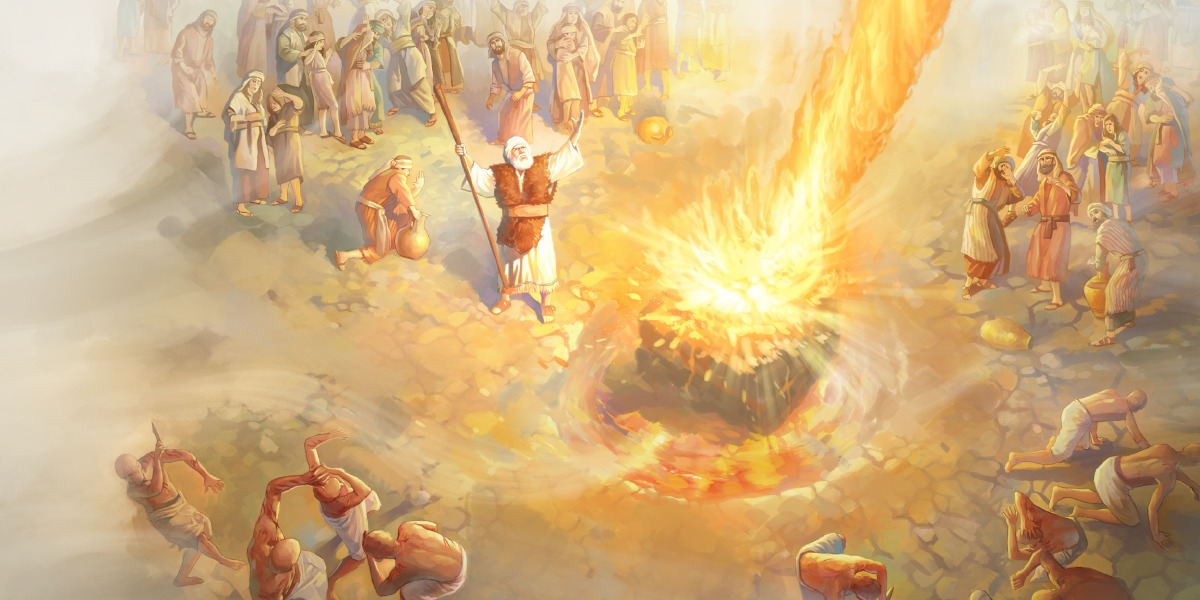
24 And there came a fire out from before the Lord and consumed upon the altar the burnt offering and the fat, which when all the people saw, they shouted and fell on their faces.
— there came a fire out from the Lord; a flame emanating from that resplendent light that filled the holy place flashed upon the brazen altar and kindled the sacrifices;
— this miraculous fire; for the descent of which the people had probably been prepared, was a sign, not only of the acceptance of the offerings and of the establishment of Aaron’s authority, but of God’s actual residence in that chosen dwelling-place;
— which when all the people saw, they shouted, and fell on their faces; Aaron blessing them, and the appearance of the glory of God unto them, no doubt, gave themfear, mixed with joy and pleasure, as the presence of God do to his people.
Leviticus 10
1 And Nadab and Abihu, the sons of Aaron, took each of them his censer and put fire therein, and put incense thereon and offered strange fire before the Lord, which He commanded them not. — and Nadab and Abihu, the sons of Aaron; his two eldest sons, as seems from Exodus 6:23;
— took either of them his censer; the sin of Nadab and Abihu was of a complicated nature, and involved and consisted of several transgressions:
— (a) they each took his own censer, and not the sacred utensil of the sanctuary; (b) they both offered it together, whereas the incense was only to be offered by one; (c) they presumptuously encroached upon the functions of the high priest; for according to the Law the high priest alone burnt incense in a censer: see Leviticus 16:12-13; Numbers 17:11;
— the ordinary priests only burnt it on the golden altar in the holy place (Exodus 30:7-8), or on the brazen altar as a part of the memorial, (see Leviticus 2:2-3; Leviticus 2:16) The case of Korah and his company was an exception, since it was ordered by Moses for an especial purpose (Numbers 16:6-25); (d) they offered the incense at an unauthorised time, since it was apart from the morning and evening sacrifice;
— and offered strange fire; they filled their vessels with common fire instead of taking it from the holy fire of the altar, which was always to be used in burning incense; (Leviticus 9:24; Leviticus 16:12);
— which he commanded them not; according to a figure of speech frequently used in Hebrew, where the negative form is used for the emphatic affirmative, this phrase is better rendered, “which he had strongly forbidden them.”
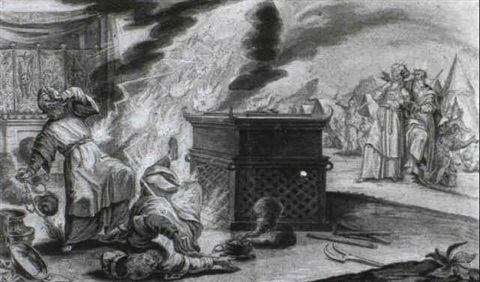
2 And there went out fire from the Lord and devoured them, and they died before the Lord. — they died before the Lord; that is, in the court of the sanctuary (Leviticus 10:1), or from the most holy place, where the Lord dwelt between the cherubim; on the very spot where the sin was committed;
— and devoured them; not reduced them to ashes, for neither their bodies nor their clothes were burnt with this fire; and so the Targum of Jonathan says of these, “without destroying their bodies,” their bodies were not burnt:
3 Then Moses said unto Aaron, “This is that which the Lord spoke, saying, ‘I will be sanctified in them that come nigh Me, and before all the people I will be glorified.’” And Aaron held his peace.
— and Aaron held his peace; he was in a stupor, as the Septuagint, quite amazed, thunderstruck, but silently submitted to the righteous judgment which bereft him of his two sons.
4 And Moses called Mishael and Elzaphan, the sons of Uzziel the uncle of Aaron, and said unto them, “Come near; carry your brethren from before the sanctuary out of the camp.”
— the first cousins of Aaron Exodus 6:22 are selected by Moses to convey the bodies of Nadab and Abihu out of the camp and bury them, probably because they were the nearest relations who were not priests.
5 So they went near and carried them in their coats out of the camp, as Moses had said. — the Targum of Jonathan says “and carried them with hooks of iron in their garments, and buried them outside the camp;”
6 And Moses said unto Aaron and unto Eleazar and unto Ithamar, his sons, “Uncover not your heads, neither rend your clothes, lest ye die, and lest wrath come upon all the people; but let your brethren, the whole house of Israel, bewail the burning which the Lord hath kindled.
— Aaron and his two surviving sons are forbidden to show the accustomed signs of mourning, or to leave the court of the tabernacle in order to attend the funeral;
— lest ye die, and lest wrath come upon all the people; so very provoking to God would be any signs of mourning in Aaron and his sons, on this account;
— but let your brethren, the whole house of Israel, bewail the burning which the Lord hath kindled: though Aaron and his sons might not mourn on this occasion, the whole body of the people might;
— the whole house of Israel, who are here designedly called “the brethren” of the bereaved, to show the depth of their sympathy, were allowed to mourn over the great calamity which had thus befallen them.
7 And ye shall not go out from the door of the tabernacle of the congregation, lest ye die; for the anointing oil of the Lord is upon you.” And they did according to the word of Moses.
— and ye shall not go out from the door of the tabernacle of the congregation, lest ye die; that is, they were not to relinquish the service of the sanctuary, on the account of the death of these relations of theirs, and through grief for it;
8 And the Lord spoke unto Aaron, saying,
9 “Do not drink wine nor strong drink, thou, nor thy sons with thee, when ye go into the tabernacle of the congregation, lest ye die. It shall be a statute for ever throughout your generations,
— do not drink wine or strong drink; this law following upon the affair of Nadab and Abihu has caused some to think, and not without some reason, that they were drunk with wine or strong drink, when they offered strange fire;
10 that ye may put difference between holy and unholy, and between unclean and clean, — and that ye may put difference between holy and unholy; that being sober they might be able to distinguish between the one and the other; which a drunken man, having his mind and senses disturbed, is not capable of;
11 and that ye may teach the children of Israel all the statutes which the Lord hath spoken unto them by the hand of Moses.” — and that ye may teach the children of Israel all the statutes: laws, precepts, ordinances, which was the business of the priests to do;

12 And Moses spoke unto Aaron and unto Eleazar and unto Ithamar, his sons who were left: “Take the meat offering that remaineth of the offerings of the Lord made by fire, and eat it without leaven beside the altar; for it is most holy. — for it is most holy; hence it could only be eaten by the male members of the families of the priests within the court of the sanctuary;
13 And ye shall eat it in the holy place, because it is thy due and thy sons’ due of the sacrifices of the Lord made by fire; for so I am commanded. — because it is thy due, and thy sons’ due, of the offerings of the Lord made by fire;
— and not any others; neither their wives nor daughters, nor any other related to him, or whom he might invite, as in other cases, might eat of it; this none but he and his sons might eat of, and nowhere else but in the sanctuary;
14 And the wave breast and heave shoulder shall ye eat in a clean place, thou, and thy sons, and thy daughters with thee; for they are thy due and thy sons’ due, which are given out of the sacrifices of peace offerings of the children of Israel. — and the wave breast and heave shoulder; that is, of the peace offering which was offered by the nation;
— thou and thy sons, and thy daughters with thee; these were not restrained to him and his sons only, as the meat offerings, and the flesh of the sin offerings were, but were common to the whole family; and how about their wives?
15 The heave shoulder and the wave breast shall they bring with the offerings made by fire of the fat, to wave it for a wave offering before the Lord; and it shall be thine and thy sons’ with thee by a statute for ever, as the Lord hath commanded.”
— the heave shoulder and the wave breast shall they bring; that is, the offerers who devoted these portions of the peace offering to the Lord, are to bring them to the officiating priests.
16 And Moses diligently sought the goat of the sin offering, and behold, it was burned; and he was angry with Eleazar and Ithamar, the sons of Aaron who were left alive, saying, — and Moses diligently sought the goat; that is, the flesh of the goat of the sin offering which was offered by the nation on the eighth day;
— and, behold, it was burnt, being overwhelmed with grief at the loss of their brothers, Eleazar and Ithamar could not eat, and as none but priests were allowed to partake of the flesh of the sin offering, they burnt it on the altar; they did this all the more readily since the flesh of Aaron’s sin offering was just before burnt outside the camp;
— and he was angry with Eleazar and Ithamar; when their two elder brothers were killed with lightning for doing what was not commanded, which should have made them more observant of the laws of God, to do that which was commanded them: and though they were spared, and survived their brethren;
— yet they transgressed, in burning the sin offering of the people, when they should have eaten it. Moses expressed his anger not to Aaron, but to his sons, which he did for the honour of Aaron, laying the blame not on him, who was overwhelmed with grief, but on his sons;
17 “Why have ye not eaten the sin offering in the holy place, seeing it is most holy, and God hath given it to you to bear the iniquity of the congregation, to make atonement for them before the Lord?
— ye not eaten of the sin offering in the holy place, seeing it is most holy; the sin offering was one of the most holy things, and therefore to be eaten only in the sanctuary; though this was not the fault they are here charged with that they had eat it, but not in the holy place; for they had not eaten it at all, but burnt it;
— they are reminded of the whole law concerning it, that it was to he eaten by them, that it was to be eaten in the holy place, the reason of which is given; but they had not eaten it but burnt it;
18 Behold, the blood of it was not brought in within the holy place; ye should indeed have eaten it in the holy place, as I commanded.”
— Moses diligently sought the goat of the sin offering, and, behold, it was burnt; in a sacrifice presented on behalf of the people, it was the duty of the priests, as typically representing them and bearing their sins, to have eaten the flesh after the blood had been sprinkled upon the altar;
— the blood of it was not brought in within the holy place; the reason was because Aaron was not yet admitted into the holy place, whither that blood should have been brought, till he had prepared the way by the sacrifices which were to be offered in the court.
19 And Aaron said unto Moses, “Behold, this day have they offered their sin offering and their burnt offering before the Lord, and such things have befallen me. And if I had eaten the sin offering today, should it have been accepted in the sight of the Lord?”
— and such things, such calamity, have befallen me; but whilst he, Eleazar, and Ithamar were thus duly performing the sacrificial rites, Nadab and Abihu, his other two sons, transgressed, and were suddenly struck down dead, thus overwhelming the survivors with sorrow, and rendering them unfit to partake of the sacrifices;
— and if I had eaten the sin offering today, should it have been accepted in the sight of the Lord? Aaron being a mourner; the high priest may offer, being a mourner, but not eat; but today, he might eat with rejoicing and thanksgiving as appears from Deuternomy 12:7, 26:14; so should this be accepted?
20 And when Moses heard that, he was content. — and when Moses heard that, he was content; he said no more, he did not proceed in blaming Aaron nor his sons, but was satisfied with the answer received.


 Joel
Joel A Prophecy of Esau and Jacob