
Leviticus (7-8)
Leviticus 7
1 “‘Likewise this is the law of the trespass offering (it is most holy): — it is most holy; wholly devoted for sacred use, either to the Lord, or to his priests; there were some things call light holy things, and others most holy in the highest degree, of this sort was the trespass offering.
2 In the place where they kill the burnt offering shall they kill the trespass offering; and the blood thereof shall he sprinkle round about upon the altar.
— and the blood thereof shall he sprinkle round about upon the altar; on the upper part of it. There was a scarlet thread that was drawn around the altar in the middle, the blood of some of the sacrifices was sprinkled below it; and some above it, as was the blood of the trespass offering.
3 And he shall offer from it all the fat thereof: the rump, and the fat that covereth the inwards, — the fat portions only were to be burned upon the altar, viz., the same as in the sin and peace-offerings; but the flesh was to be eaten by the priests, as in the sin-offering.
4 and the two kidneys and the fat that is on them which is by the flanks, and the caul that is above the liver, with the kidneys; it shall he take away. — with the kidneys, it shall he take away; all the fat before mentioned, together with the kidneys, were to be taken away from the ram of the trespass offering, and burnt;
5 And the priest shall burn them upon the altar for an offering made by fire unto the Lord: it is a trespass offering. — and the priest shall burn; these fat pieces he shall burn, as in the case of the sin offering and peace offering.
6 Every male among the priests shall eat thereof. It shall be eaten in the holy place; it is most holy. — every male among the priests shall eat thereof; of the flesh of it, after the fat was taken off and burnt, the rest belonged to the priests and their sons, and to them only, leaving their wives and daughters bewildered;
7 As the sin offering is, so is the trespass offering; there is one law for them: the priest who maketh atonement therewith shall have it. — the priest that maketh atonement therewith shall have it; who by offering it made atonement for the trespass of the person that brings it;
8 And the priest who offereth any man’s burnt offering, even the priest shall have to himself the skin of the burnt offering which he hath offered. — the priest shall have to himself the skin; as the skin was the only part not consumed by the fire, in the case of the burnt offering, it fell to the share of the officiating priest.
9 And all the meat offering that is baked in the oven, and all that is dressed in the frying pan and in the pan, shall be the priest’s who offereth it. — shall be the priest’s; with the exception of the memorial part, which was burnt upon the altar;
10 And every meat offering mingled with oil, or dry, shall all the sons of Aaron have, one as much as another. — shall all the sons of Aaron have; that is, whether with or without oil, the remainder of this kind of raw offering is to be equally shared by all the priests.
11 “‘And this is the law of the sacrifice of peace offerings which he shall offer unto the Lord: — the Peace-Offering may be brought for three reasons: a. for thanksgiving (Leviticus 7:12), to commemorate deliverance from sickness or danger; b. iIn fulfilment of a vow (Leviticus 7:16); c. as a freewill offering (Leviticus 7:16) when the heart is moved by the remembrance of God’s kindness and mercies.
12 If he offer it for a thanksgiving, then he shall offer with the sacrifice of thanksgiving unleavened cakes mingled with oil, and unleavened wafers anointed with oil, and cakes mingled with oil of fine flour, fried.
13 Besides the cakes, he shall offer for his offering leavened bread with the sacrifice of thanksgiving of his peace offerings.
14 And of it he shall offer one out of the whole oblation for a heave offering unto the Lord, and it shall be the priest’s who sprinkleth the blood of the peace offerings. — and it shall be the priest’s that sprinkleth the blood of the peace offerings; that is, that part of the cakes and bread, which is offered as an heave offering to the Lord, was the portion of the priests;
15 And the flesh of the sacrifice of his peace offerings for thanksgiving shall be eaten the same day that it is offered; he shall not leave any of it until the morning. — shall be eaten the same day that it is offered; partly by him that brought them; and what about his family? Wives and daughters?
16 But if the sacrifice of his offering be a vow or a voluntary offering, it shall be eaten the same day that he offereth his sacrifice; and on the morrow also the remainder of it shall be eaten. — and on the morrow also the remainder of it shall be eaten; some of it, if thought fit, might be kept till the day after the sacrifice, but no longer.
17 But the remainder of the flesh of the sacrifice on the third day shall be burned with fire. — shall be burnt with fire; that it might neither corrupt, nor be put to superstitious uses, nor be of any profit in any respect;
18 And if any of the flesh of the sacrifice of his peace offerings is eaten at all on the third day, it shall not be accepted, neither shall it be imputed unto him that offereth it; it shall be an abomination, and the soul that eateth of it shall bear his iniquity.
— it shall be an abomination; to God, the flesh being kept so long, through a sordid and stubborn disposition: and the soul that eateth of it shall bear his iniquity; it shall not be forgiven him; he shall bear the punishment of it.
19 “‘And the flesh that toucheth any unclean thing shall not be eaten; it shall be burned with fire; and as for the flesh, all who are clean shall eat thereof. — and the flesh that toucheth any unclean thing shall not be eaten; that is, the flesh of the peace offerings;
20 But the soul that eateth of the flesh of the sacrifice of peace offerings that pertain unto the Lord, having his uncleanness upon him, even that soul shall be cut off from his people. — even that soul shall be cut off from his people; be disfranchised as an Israelite, be debarred the privileges of the sanctuary, or be cut off by death before the usual time and term of man’s life;
21 Moreover the soul that shall touch any unclean thing, as the uncleanness of man or any unclean beast or any abominable unclean thing, and eat of the flesh of the sacrifice of peace offerings which pertain unto the Lord, even that soul shall be cut off from his people.’”
22 And the Lord spoke unto Moses, saying,
23 “Speak unto the children of Israel, saying, ‘Ye shall eat no manner of fat, of ox or of sheep or of goat. —of ox, or of sheep, or of goats: creatures used in sacrifice; though this is not to be restrained to such of them, and the fat of them that were sacrificed, whose fat was claimed by the Lord as his, and was burnt on his altar;
24 And the fat of the beast that dieth of itself and the fat of that which is torn by beasts may be used in any other use, but ye shall in no wise eat of it. — and the fat of the beast that dieth of itself; of any disease, and is not regularly killed: and the fat of that which is torn with beasts;
25 For whosoever eateth the fat of the beast of which men offer an offering made by fire unto the Lord, even the soul that eateth it shall be cut off from his people. — even the soul that eateth it shall be cut off from his people; if he did it presumptuously he incurred the penalty of excision;
26 Moreover ye shall eat no manner of blood in any of your dwellings, whether it be of fowl or of beast.
27 Whatsoever soul it be that eateth any manner of blood, even that soul shall be cut off from his people.’”
28 And the Lord spoke unto Moses, saying,
29 “Speak unto the children of Israel, saying, ‘He that offereth the sacrifice of his peace offerings unto the Lord shall bring his oblation unto the Lord from the sacrifice of his peace offerings.
30 His own hands shall bring the offerings of the Lord made by fire; the fat with the breast it shall he bring, that the breast may be waved as a wave offering before the Lord. — his own hands shall bring; this act the owner himself was to perform, and it was not to be deputed to any one else.
31 And the priest shall burn the fat upon the altar, but the breast shall be Aaron’s and his sons’. — but the breast shall be Aaron’s and his sons; which being waved before the Lord for a wave offering, was the Lord’s, and so was given to his priests to eat of, for the service done by them;
32 And the right shoulder shall ye give unto the priest for a heave offering of the sacrifices of your peace offerings. — and the right shoulder shall ye give unto the priest for an heave offering; whether of an ox or a cow, a lamb or a goat.
33 He among the sons of Aaron who offereth the blood of the peace offerings and the fat, shall have the right shoulder for his part. — shall have the right shoulder for his part; that the right shoulder was given to him that sprinkled the blood, and the breast to all the priests;
34 For the wave breast and the heave shoulder have I taken from the children of Israel from the sacrifices of their peace offerings, and have given them unto Aaron the priest and unto his sons by a statute for ever, from among the children of Israel.’”
35 This is the portion of the anointing of Aaron and of the anointing of his sons out of the offerings to the Lord made by fire, on the day when he presented them to minister unto the Lord in the priest’s office, — this is the portion of the anointing of Aaron; of his being anointed to the priestly office.
36 which the Lord commanded to be given them by the children of Israel on the day that He anointed them, by a statute for ever throughout their generations. — in the day that he anointed them; or from the day they were anointed of Moses, by the direction of the Lord;
37 This is the law of the burnt offering, of the meat offering, and of the sin offering, and of the trespass offering, and of the consecrations, and of the sacrifice of the peace offerings,
38 which the Lord commanded Moses on Mount Sinai on the day that He commanded the children of Israel to offer their oblations unto the Lord in the Wilderness of Sinai.
Leviticus 8
1 And the Lord spoke unto Moses, saying,
2 “Take Aaron and his sons with him, and the garments, and the anointing oil, and a bullock for the sin offering, and two rams, and a basket of unleavened bread;
3 and gather thou all the congregation together unto the door of the tabernacle of the congregation.”
4 And Moses did as the Lord commanded him, and the assembly was gathered together unto the door of the tabernacle of the congregation.
5 And Moses said unto the congregation: “This is the thing which the Lord commanded to be done.”
6 And Moses brought Aaron and his sons, and washed them with water. — and washed them with water; to show that they should be clean that bear the vessels of the Lord, and offer the sacrifices of the people;
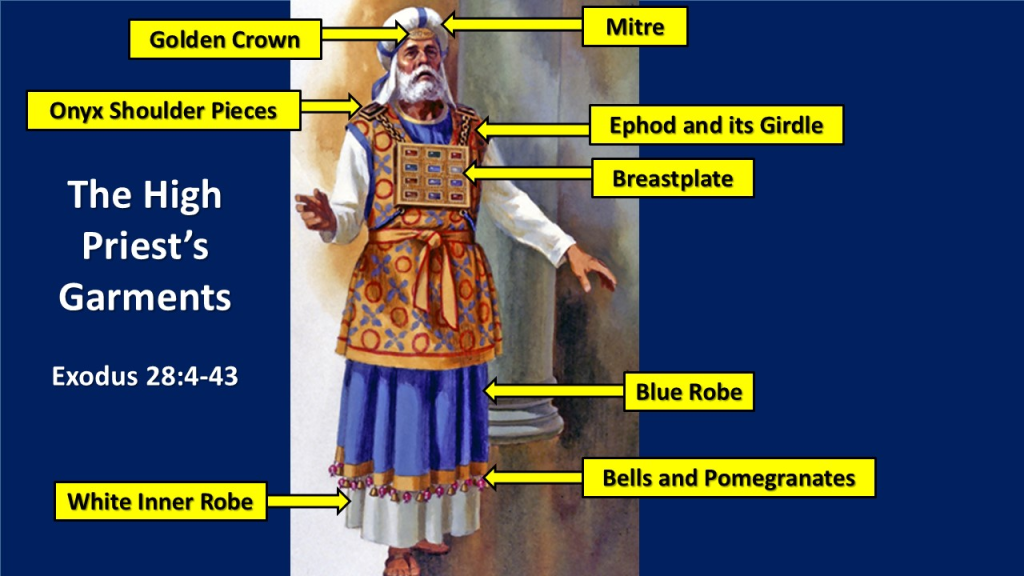
7 And he put upon him the coat, and girded him with the girdle, and clothed him with the robe, and put the ephod upon him, and he girded him with the woven girdle of the ephod, and bound it unto him therewith.
8 And he put the breastplate upon him. Also he put in the breastplate the Urim and the Thummim. — also he put in the breastplate the Urim and Thummim: that is, Moses did it, as all the rest;
9 And he put the miter upon his head. Also upon the miter, even upon the front thereof, did he put the golden plate, the holy crown, as the Lord commanded Moses.
10 And Moses took the anointing oil and anointed the tabernacle and all that was therein, and sanctified them. — and sanctified them; that is, by this action Moses separated them from the laity, and dedicated them to the service of God, so that they were not to come in contact with any defilement.
11 And he sprinkled thereof upon the altar seven times, and anointed the altar and all his vessels, both the laver and his foot, to sanctify them.
12 And he poured of the anointing oil upon Aaron’s head and anointed him, to sanctify him.
13 And Moses brought Aaron’s sons and put coats upon them, and girded them with girdles, and put headdresses upon them, as the Lord commanded Moses. — and Moses brought Aaron’s sons; having consecrated the father as high priest, Moses now invests Aaron’s four sons, Nadab, Abihu, Eleazar and Ithamar, with the visible signs of the priestly office by robing them in the sacerdotal garments.

14 And he brought the bullock for the sin offering; and Aaron and his sons laid their hands upon the head of the bullock for the sin offering. — and Aaron and his sons laid their hands upon the head of the bullock for the sin offering; their right hands, according to the Targum of Jonathan;
15 And he slew it; and Moses took the blood, and put it upon the horns of the altar round about with his finger and purified the altar, and poured the blood at the bottom of the altar and sanctified it, to make reconciliation upon it. — and he slew it; in ordinary cases the offerer himself slaughtered the victim but in the case Moses performed this act.
16 And he took all the fat that was upon the inwards, and the caul above the liver, and the two kidneys, and their fat, and Moses burned it upon the altar. — and Moses took all the acts here;
17 But the bullock and his hide, his flesh, and his dung he burned with fire outside the camp, as the Lord commanded Moses.
18 And he brought the ram for the burnt offering; and Aaron and his sons laid their hands upon the head of the ram. — and Moses acting like the officiating priest;
19 And he killed it; and Moses sprinkled the blood upon the altar round about.
20 And he cut the ram into pieces; and Moses burned the head and the pieces and the fat. — and Moses burnt the head, and the pieces, and the fat; even all of it, as the following verse shows.
21 And he washed the inwards and the legs in water; and Moses burned the whole ram upon the altar. It was a burnt sacrifice for a sweet savor, and an offering made by fire unto the Lord, as the Lord commanded Moses.
22 And he brought the other ram, the ram of consecration; and Aaron and his sons laid their hands upon the head of the ram. — and he brought the other ram; that is, the second of the two rams mentioned in Leviticus 8:2.
23 And he slew it; and Moses took of the blood of it and put it upon the tip of Aaron’s right ear and upon the thumb of his right hand and upon the great toe of his right foot.
24 And he brought Aaron’s sons, and Moses put of the blood upon the tip of their right ear and upon the thumbs of their right hands and upon the great toes of their right feet; and Moses sprinkled the blood upon the altar round about.
25 And he took the fat, and the rump, and all the fat that was upon the inwards, and the caul above the liver, and the two kidneys and their fat, and the right shoulder;
26 and out of the basket of unleavened bread that was before the Lord he took one unleavened cake and a cake of oiled bread and one wafer, and put them on the fat and upon the right shoulder.
27 And he put all upon Aaron’s hands and upon his sons’ hands, and waved them for a wave offering before the Lord.
28 And Moses took them from their hands and burned them on the altar upon the burnt offering. They were consecrations for a sweet savor; it is an offering made by fire unto the Lord. — they were consecrated for a sweet savour; acceptable to the Lord, and so the priests, Aaron and his sons likewise, on whose account they were made.
29 And Moses took the breast and waved it for a wave offering before the Lord; for of the ram of consecration, it was Moses’ part, as the Lord commanded Moses. — for the ram of consecration it was Moses’s part; the breast of it was also his;
30 And Moses took of the anointing oil and of the blood which was upon the altar, and sprinkled it upon Aaron and upon his garments, and upon his sons and upon his sons’ garments with him, and sanctified Aaron and his garments, and his sons and his sons’ garments with him. — and Moses was acting like the officiating priest; —
31 And Moses said unto Aaron and to his sons, “Boil the flesh at the door of the tabernacle of the congregation, and there eat it with the bread that is in the basket of consecrations, as I commanded, saying, ‘Aaron and his sons shall eat it.’ — ‘Aaron and his sons shall eat it’ because this is holy: no layman or non-priest could partake of the meal;
32 And that which remaineth of the flesh and of the bread shall ye burn with fire. — ye, that is, Aaron and his sons;
33 And ye shall not go out of the door of the tabernacle of the congregation for seven days, until the days of your consecration are at an end; for seven days shall He consecrate you. — and ye shall not go out of the door of the tabernacle; that is, Aaron and his sons are not to go out of the court, as the consecration was not performed within but at the entrance of the tent of meeting.
34 As He hath done this day, so the Lord hath commanded to do, to make an atonement for you. — to make an atonement for you, of the day of atonement; and say, that the high priest was obliged to be separate (from his own house and family) seven days;
35 Therefore shall ye abide at the door of the tabernacle of the congregation day and night seven days, and keep the charge of the Lord, that ye die not; for so I am commanded.” — during the seven days of their consecration; and the penalty being death in case of failure, was to make them more careful and cautious of transgressing; and which was the more necessary;
— for so I am commanded; that is, to declare unto them, that if they did not punctually observe the above orders, they must expect to die.
36 So Aaron and his sons did all things which the Lord commanded by the hand of Moses. — after all these preliminaries, they had still to undergo a week’s probation in the court of the tabernacle before they obtained permission to enter into the interior of the sacred building for their official duties.


 Joel
Joel A Prophecy of Esau and Jacob