
Leviticus (5-6)
Note the Five types of Offerings in Leviticus:
Leviticus 1:2 “Speak unto the children of Israel and say unto them: ‘If any man of you bring an offering unto the Lord
Leviticus 1:3 ‘If his offering be a burnt sacrifice
Leviticus 2:1 ‘And when any will offer a meat offering
Leviticus 3:1 ‘And if his oblation be a sacrifice of peace offering
Leviticus 4:3 ‘If the priest … a young bullock … for a sin offering
Leviticus 5:6 ‘And he shall bring his trespass offering
Compare to the Five types of Offerings during the Millennium in Ezekiel:
Ezekiel 46:12 ‘Now when the prince prepares a voluntary burnt offering, or peace offerings unto the Lord
Ezekiel 44:29 ‘They shall eat the meat offering and the sin offering and the trespass offering
Leviticus 5
1 “‘And if a soul sin and hear the voice of swearing, and is a witness, whether he hath seen or known of it, if he does not utter it, then he shall bear his iniquity. — swearing; the case appears to be that of one who has been put upon his oath as a witness by a magistrate, and fails to utter all he has seen and heard;
2 Or if a soul touch any unclean thing, whether it be a carcass of an unclean beast, or a carcass of unclean cattle, or the carcass of unclean creeping things, and if it be hidden from him, he also shall be unclean and guilty. — of unclean cattle; cattle are normally clean; became unclean perhaps by being worshipped as an idols by any of the heathens;
3 Or if he touch the uncleanness of man, whatsoever uncleanness it be, that a man shall be defiled thereby, and it be hid from him, when he knoweth of it, then he shall be guilty. — if he touch the uncleanness of man; the dead body of a man, or the bone of a dead body, or a grave, or any profluvious person:
4 Or if a soul swear, pronouncing with his lips to do evil or to do good, whatsoever it be that a man shall pronounce with an oath, and it be hid from him, when he knoweth of it, then he shall be guilty in one of these.
— if a soul swear; a rash oath, without duly considering the nature and consequences of the oath, perhaps inconsiderately binding himself to do anything wrong, or neglecting to perform a vow to do something good. In all such cases a person might have transgressed one of the commandments unwittingly, and have been afterwards brought to a sense of his delinquency.
5 And it shall be, when he shall be guilty in one of these things, that he shall confess that he hath sinned in that thing; — it shall be, when he shall be guilty; that he shall confess that he hath sinned in that thing; make a voluntary acknowledgment of his sin from his own conscience, and before it come to the knowledge of the world.
6 and he shall bring his trespass offering unto the Lord for his sin which he hath sinned, a female from the flock, a lamb or a kid of the goats for a sin offering; and the priest shall make an atonement for him concerning his sin.
— he shall bring his trespass offering unto the Lord for his sins which he hath sinned; a trespass offering differed from a sin offering in the following respects: that it was appointed for persons who had either done evil unwittingly, or were in doubt as to their own criminality;
— MSG
3 “Or if you touch human uncleanness, any sort of ritually contaminating uncleanness, and you’re not aware of it at the time, but later you realize it and you’re guilty;
4 “Or if you impulsively swear to do something, whether good or bad—some rash oath that just pops out—and you aren’t aware of what you’ve done at the time, but later you come to realize it and you’re guilty in any of these cases;
5-6 “When you are guilty, immediately confess the sin that you’ve committed and bring as your penalty to God for the sin you have committed a female lamb or goat from the flock for an Absolution-Offering.
“In this way, the priest will make atonement for your sin.
7 “‘And if he is not able to bring a lamb, then he shall bring for his trespass, which he hath committed, two turtledoves or two young pigeons unto the Lord: one for a sin offering and the other for a burnt offering.
— one for a sin offering, and the other for a burnt offering; one of the turtle doves or pigeons, whichsoever were brought, was offered up as a sin offering, and the other that remained was offered up as a burnt offering;
— so that the poor man had two sorts of offerings out of what he brought, when the rich had but one; and may indicate the completeness of his sacrifice, and the full atonement made by it.
8 And he shall bring them unto the priest, who shall offer that which is for the sin offering first, and wring off his head from his neck, but shall not divide it asunder.
9 And he shall sprinkle of the blood of the sin offering upon the side of the altar, and the rest of the blood shall be wrung out at the bottom of the altar: it is a sin offering.
— and he shall sprinkle; here again there is a striking difference between the ritual in the sacrifice and that in the case of the sin offering described in the previous chapters; the blood is simply to be thrown on the walls of the altar, whilst in the ordinary sin offering, the priest had not only to dip his finger seven times in the blood of the sacrifice, but had to put it on the horns of the altar;
10 And he shall offer the second for a burnt offering according to the ordinance; and the priest shall make an atonement for him for his sin which he hath sinned, and it shall be forgiven him. — a trespass offering differed from a sin offering in that it was appointed for persons who had either done evil unwittingly, or were in doubt as to their own criminality;
11 “‘But if he is not able to bring two turtledoves or two young pigeons, then he that sinned shall bring for his offering a tenth part of an ephah of fine flour for a sin offering. He shall put no oil upon it, neither shall he put any frankincense thereon, for it is a sin offering.
— the trespass offering appointed in such cases was a female lamb or kid; if unable to make such an offering, he might bring a pair of turtledoves or two young pigeons; the one to be offered for a sin offering, the other for a burnt offering; or if even that was beyond his ability, the law would be satisfied with the tenth part of an ephah of fine flour without oil or frankincense.
12 Then shall he bring it to the priest and the priest shall take his handful of it, even a memorial thereof, and burn it on the altar according to the offerings made by fire unto the Lord: it is a sin offering.
13 And the priest shall make an atonement for him for his sin that he hath sinned in one of these, and it shall be forgiven him; and the remnant shall be the priest’s as a meat offering.’”
14 And the Lord spoke unto Moses, saying,
15 “If a soul commit a trespass and sin through ignorance in the holy things of the Lord, then he shall bring for his trespass unto the Lord a ram without blemish out of the flocks, with thy valuation in shekels of silver according to the shekel of the sanctuary, for a trespass offering. — and sin through ignorance; if at the time of its committal he did not know that it was a transgression;
16 And he shall make amends for the harm that he hath done in the holy thing, and shall add a fifth part thereto and give it unto the priest; and the priest shall make an atonement for him with the ram of the trespass offering, and it shall be forgiven him.
— and shall add the fifth part thereto; besides paying the principal, the fifth part of the value of the holy property thus restored is to be added to the original amount; for example, if he has had profited to the value of four shekels, now he should pay five shekels; for the fifth of the shekels they add the fifth part to the four shekels;
17 “And if a soul sin, and commit any of these things which are forbidden to be done by the commandments of the Lord, though he knew it not, yet is he guilty and shall bear his iniquity. — yet he is guilty, and shall bear the iniquity; be chargeable with guilt, and is liable to punishment, and must make an atonement and satisfaction for it;
18 And he shall bring a ram without blemish out of the flock, according to thy valuation for a trespass offering unto the priest; and the priest shall make an atonement for him concerning his ignorance wherein he erred and knew it not, and it shall be forgiven him.
— in the case of the trespass-offering, the animal sacrificed was usually a ram, this fact alone clearly distinguishes the trespass-offerings from the sin-offerings, for which all kinds of sacrifices were offered from an ox to a pigeon;
19 It is a trespass offering; he hath certainly trespassed against the Lord.” — it is a trespass offering; that is, though the prescribed fifth part is here dispensed with, it is still a trespass offering, for his conscience tells him that he has trespassed against the Lord.
Leviticus 6
1 And the Lord spoke unto Moses, saying,
2 “If a soul sin and commit a trespass against the Lord by lying unto his neighbor about that which was delivered to him to keep, or in dealings, or in a thing taken away by violence, or hath deceived his neighbor,
— or in a thing taken away by violence: without the will and knowledge of the owner; privately and secretly, but being suspected, is challenged with it, and denying it, is made to swear, which he does falsely;
3 or has found that which was lost and lieth concerning it, and sweareth falsely — in any of all these that a man doeth, sinning therein, — in any of all these that a man doeth, sinning therein; by unfaithfulness in a trust, cheating, defrauding, lying, and false swearing.
4 then it shall be, because he hath sinned and is guilty, that he shall restore that which he took violently away, or the thing which he hath deceitfully gotten, or that which was delivered him to keep, or the lost thing which he found, — or the thing which he hath deceitfully gotten; by outwitting him, by extortion, by false accusation, or detention of wages;
5 or all that about which he hath sworn falsely. He shall even restore the principal thereof, and shall add a fifth part more thereto, and give it unto him to whom it appertaineth, on the day of his trespassoffering.
6 And he shall bring his trespass offering unto the Lord, a ram without blemish out of the flock, according to thy valuation, for a trespass offering, unto the priest. — he shall even restore it in the principal; whatsoever he has embezzled, or cheated another of, or detained from the right owner, the whole of that was to be restored: and shall add the fifth part more thereto; to the principal;
7 And the priest shall make an atonement for him before the Lord; and it shall be forgiven him for any thing of all that he hath done in trespassing therein.” — and the priest shall make an atonement for him before the Lord; by offering the ram he brought, by which a typical, for atonement to be presented before the Lord;

8 And the Lord spoke unto Moses, saying,
9 “Command Aaron and his sons, saying, ‘This is the law of the burnt offering: It is the burnt offering because of the burning upon the altar all night unto the morning, and the fire of the altar shall be burning in it. — command Aaron and his sons; having instructed the people concerning the sacrifices to be brought by them, Moses now proceeds, at God’s command, to direct the priests respecting several parts of their official services;
— better, “This, the burnt-offering, shall be upon the fire on the altar all night unto the morning,” the meaning is, the evening burnt-offering was to be so managed and laid on piece after piece, so that the fire might be constantly maintained by it; that the morning burnt-offerings were to be kept burning all the day from morning to night also;
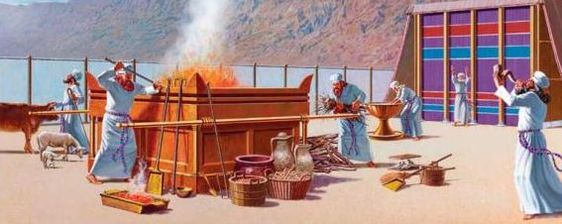
10 And the priest shall put on his linen garment, and his linen breeches shall he put upon his flesh, and take up the ashes which the fire hath consumed with the burnt offering on the altar; and he shall put them beside the altar.
— he shall put them beside the altar; during the second Temple, a priest was appointed by lot to take off from the altar every morning at least a shovelful of ashes and carry it outside the camp, and when the ashes accumulated they were entirely removed to the same place.
11 And he shall take off his garments and put on other garments, and carry forth the ashes outside the camp unto a clean place.
— and he shall put off his garments; that is, the priest shall change the sacred robes in which he ministered at the altar; for other garments, though less holy, were not common, since the removing of the ashes was still a sacerdotal function.
12 And the fire upon the altar shall be burning in it; it shall not be put out. And the priest shall burn wood on it every morning and lay the burnt offering in order upon it; and he shall burn thereon the fat of the peace offerings. — the wood for the burnt-offering of the morning is kindled from the fire which has been kept in all night.
13 The fire shall ever be burning upon the altar; it shall never go out. — the fire shall ever be burning; this fire, which first came down from heaven (Leviticus 9:24), was to be continually fed with fuel especially provided by the congregation, and with the daily burnt offerings.
14 “‘And this is the law of the meat offering: The sons of Aaron shall offer it before the Lord, before the altar. — the sons of Aaron shall offer it; though in the chapter before us it literally means Aaron’s sons, the phrase is intended to comprise his lineal descendants who succeeded to the priestly office.
15 And he shall take from it his handful of the flour of the meat offering, and of the oil thereof and all the frankincense which is upon the meat offering, and shall burn it upon the altar for a sweet savor, even the memorial of it unto the Lord.
16 And the remainder thereof shall Aaron and his sons eat. With unleavened bread shall it be eaten in the holy place; in the court of the tabernacle of the congregation they shall eat it. — the males only might eat these, because they were most holy things; whereas the daughters of Aaron might eat other holy things, Numbers 18:11.
17 It shall not be baked with leaven. I have given it unto them for their portion of My offerings made by fire; it is most holy, as is the sin offering and as the trespass offering.
— be regarded as “most holy” and the way in which it was prepared was: on any meat offerings being presented, the priest carried them to the altar, and taking a handful from each of them as an oblation, he salted and burnt it on the altar; the residue became the property of the priests;
18 All the males among the children of Aaron shall eat of it. It shall be a statute for ever in your generations concerning the offerings of the Lord made by fire. Every one who toucheth them shall be holy.’” — every one that toucheth them shall be holy; that is; the meaning is that any one who touches the sacrifices of the first order of holiness must be a descendant of Aaron and a male;
19 And the Lord spoke unto Moses, saying,
20 “This is the offering of Aaron and of his sons, which they shall offer unto the Lord in the day when he is anointed: a tenth part of an ephah of fine flour for a perpetual meat offering, half of it in the morning and half thereof at night.
— in the day when he is anointed; that is, when he is anointed or when his anointing ceremony is completed, and he entered upon the duties of his office;
21 In a pan it shall be made with oil; and when it is baked thou shalt bring it in, and the baked pieces of the meat offering shalt thou offer for a sweet savor unto the Lord. —
as a new law, with a special formula, and is inserted here in its proper place in the sacrificial instructions given for the priests, as it would have been altogether out of place among the general laws for the laity.
22 And the priest from among his sons, who is anointed in his stead, shall offer it. It is a statute for ever unto the Lord; it shall be wholly burned.
— and the priest of his sons; that is, any one of his descendants who succeeds to the high priesthood is to do the same in all times to come, since it is a statute to last as long as the priesthood continues;
— it shall be wholly burnt; unlike the ordinary meat offerings brought by the laity, which, with the exception of a handful, was the perquisite of the officiating priest (Leviticus 2:2-3), the high priest could not eat of this because he presented it himself, since it would be unseemly both to offer it to God and at the same time eat it himself; nor was an ordinary priest allowed to eat it, because he was subordinate in rank to the officiating high priest.
23 For every meat offering for the priest shall be wholly burned; it shall not be eaten.” — it shall not be eaten; no part of it shall be eaten by the priest, as it was when the offering was for the people;
24 And the Lord spoke unto Moses, saying,
25 “Speak unto Aaron and to his sons, saying, ‘This is the law of the sin offering: In the place where the burnt offering is killed shall the sin offering be killed before the Lord; it is most holy. — it is most holy; sacred to the Lord, offered up to him, and accepted by him, and typical of the most pure and holy sacrifice and an offering for sin, in the room and stead of his people.
26 The priest who offereth it for sin shall eat it; in the holy place shall it be eaten, in the court of the tabernacle of the congregation. — the priest that offereth it for sin shall eat it; thereby signifying that he bore the sin of the person that brought the offering, and made atonement for it;
27 Whatsoever shall touch the flesh thereof shall be holy; and when there is sprinkled of the blood thereof upon any garment, thou shalt wash that whereon it was sprinkled in the holy place.
— whatsoever shall touch the flesh thereof shall be holy; none but holy persons, such as were devoted to holy services, even the priests and their sons, might touch and eat of the flesh of the sin offering;
28 But the earthen vessel wherein it is boiled shall be broken; and if it is boiled in a brazen pot, it shall be both scoured and rinsed in water.
— all that did so were sacred persons; and even what were the earthen vessel used in preparing and eating it, dishes and knives, were to be put to no other use, not to any common service, or for anything but holy things;
29 All the males among the priests shall eat thereof; it is most holy. — all the males among the priests; ot only did the officiating priest, whose perquisite the flesh of the sin offering became, and his male children, partake of it, and he could invite any other priests and their sons to the meal; but leaving their daughters a bit bewildered.
30 And no sin offering, from which any of the blood is brought into the tabernacle of the congregation for reconcilement thereby in the holy place, shall be eaten: it shall be burned in the fire. — it shall be burnt in the fire; none was to be eaten.


 Joel
Joel A Prophecy of Esau and Jacob