
Exodus (29-30)
~~~~
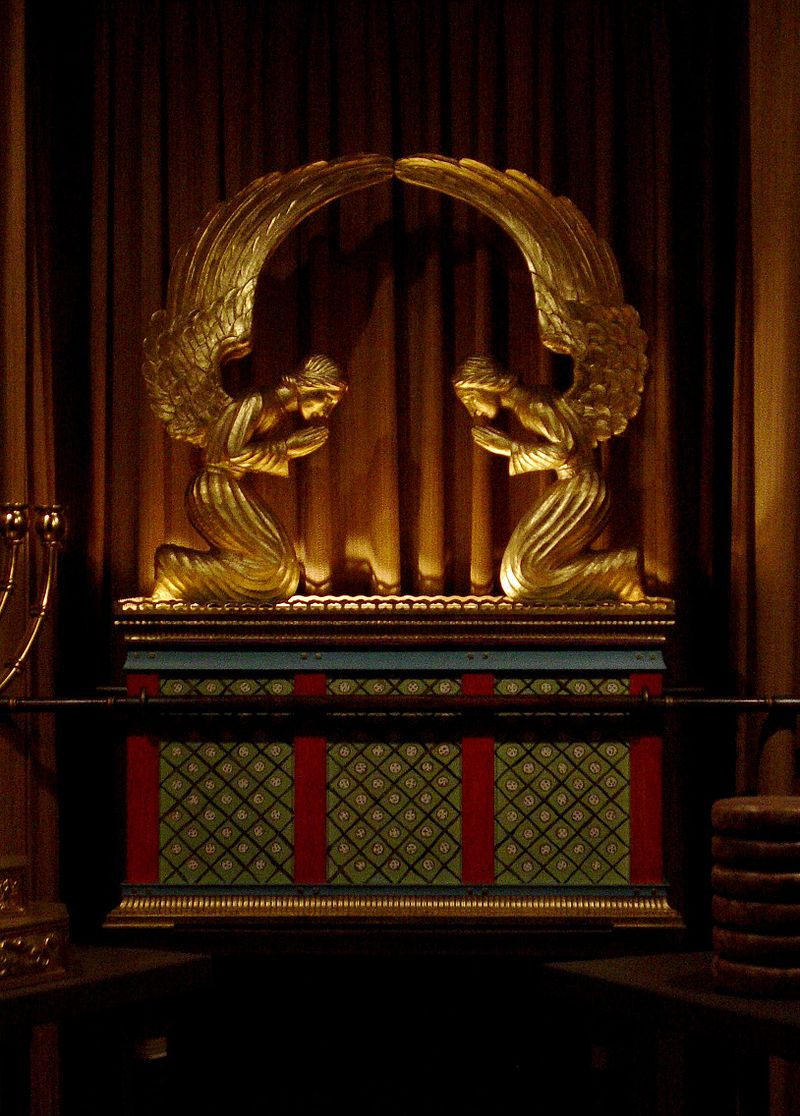
Q. Could on one unexpected day the Jews bring out the Ark of the Covenant and cause both the Dome of the Rock and the Al-Aqsa Mosque to collapse?
Exodus 29
~~~~
1 “And this is the thing that thou shalt do unto them to hallow them, to minister unto Me in the priest’s office: Take one young bullock and two rams without blemish, — this is the thing that thou shalt do unto the priests; that is, Aaron and his sons; their consecration had been commanded in the preceding chapter;
2 and unleavened bread and cakes unleavened tempered with oil, and wafers unleavened anointed with oil — of wheat flour shalt thou make them — unleavened bread; unleavened bread, as used to be eaten at the time of the Passover, seems to have been required as purer than leavened, since fermentation was viewed as a species of corruption.
3 and thou shalt put them into one basket and bring them in the basket, with the bullock and the two rams. — in the basket, with the bullock and the two rams; along with the bread, cakes, and wafers; ãnd to be brought to the door of the tabernacle of the congregation, to the altar, in order to be slain and sacrificed.
4 And Aaron and his sons thou shalt bring unto the door of the tabernacle of the congregation, and shalt wash them with water. — and shalt wash Aaron and his sons; water is so natural a symbol of purity, and ablution so apt a representative of the purging from sin; also to signify that they must be clean who bear the vessels and work of the Lord;
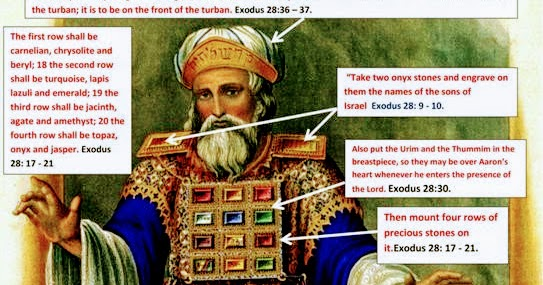
5 And thou shalt take the garments, and put upon Aaron the coat and the robe of the ephod and the ephod and the breastplate, and gird him with the embroidered girdle of the ephod. — and the robe of the ephod: which was all of blue, and had pomegranates and golden bells at the hem of it; this was put over the broidered coat;
— and the breastplate; with the Urim and Thummim in it, or the twelve precious stones on which were engraven the names of the twelve tribes of Israel, which hung down over the breast by wreathen chains of gold, from the shoulder pieces of the ephod;
6 And thou shalt put the miter upon his head and put the holy crown upon the miter. — and Moses shall put the holy crown upon the mitre; the holy crown was a plate of gold or a diadem which had these words, “holiness to the Lord” engraven on it;
— and says the Targum of Jonathan, “And thou shalt set the mitre on his head, and put the diadem upon which is engraven the Name of Holiness upon the mitre;” the mitre was on top of Aaron’s head, and upon his forehead;
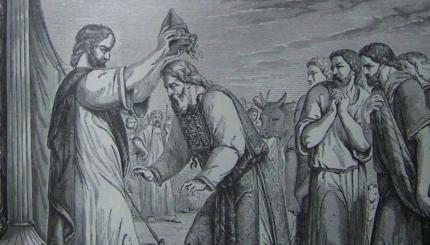
7 Then shalt thou take the anointing oil, and pour it upon his head and anoint him. — and Moses shall pour the oil upon Aaron’s head, between his eyebrows; and anoint him;
— the Investiture of Aaron’s sons; they do not seem to have been anointed, as Aaron was, by having the holy oil poured upon their heads, but only by having some of it sprinkled upon their garments.
9 And thou shalt gird them with girdles, Aaron and his sons, and put the bonnets on them. And the priest’s office shall be theirs for a perpetual statute; and thou shalt consecrate Aaron and his sons. — and thou shall consecrate Aaron and his sons; or “fill the hand of them” that is, with sacrifices to offer for themselves and others;
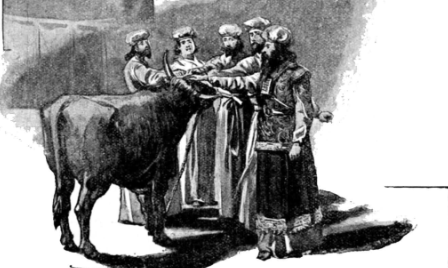
10 “And thou shalt cause a bullock to be brought before the tabernacle of the congregation, and Aaron and his sons shall put their hands upon the head of the bullock. — “to be brought before the tabernacle” means outside the tabernacle; and thus the altar was a much larger one;
— and Aaron and his sons shall put their hands upon the head of the bullock; not Aaron first alone, and then his sons, but all together, not one after another;
11 And thou shalt kill the bullock before the Lord by the door of the tabernacle of the congregation. — and thou shalt kill the bullock before the Lord; that is, Moses being ordered to do it, who now officiated as a priest; Aaron and his sons not yet completely invested with that office, or thoroughly consecrated to it, yet;
12 And thou shalt take of the blood of the bullock, and put it upon the horns of the altar with thy finger, and pour all the blood alongside the bottom of the altar. — that some of the victim’s blood should be smeared upon the altar’s horns; and the remainder should be poured at its base;
13 And thou shalt take all the fat that covereth the inwards, and the caul that is above the liver, and the two kidneys and the fat that is upon them, and burn them upon the altar.
14 But the flesh of the bullock and his skin and his dung shalt thou burn with fire outside the camp. It is a sin offering. — shalt thou burn with fire outside the camp; so the Messiah, the antitype, suffered outside the gates of Jerusalem a most painful and shameful death;
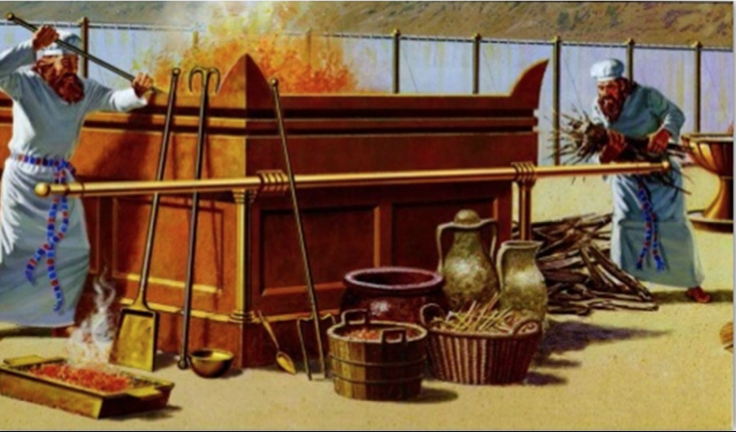
15 “Thou shalt also take one ram, and Aaron and his sons shall put their hands upon the head of the ram. — and Aaron and his sons shall put their hands upon the head of the ram; confessing their sins, acknowledging their guilt, and by this act transferring the same to the ram, which was to be a burnt offering, and was typical of the imputation of sin to the Messiah, or the Son of God, the Christ;
16 And thou shalt slay the ram, and thou shalt take his blood and sprinkle it round about upon the altar. — and thou shall take his blood, and sprinkle it round about upon the altar; the blood being received into a basin, it was not to be put upon the altar with the finger, as the blood of the bullock, but was to be sprinkled probably with a bunch of hyssop, round about upon the altar;
— this may signify that his blood has its virtue and efficacy from that, to make atonement for the sins of men, and to cleanse men from their sins.
17 And thou shalt cut the ram in pieces, and wash the inwards of him and his legs, and put them on top of his pieces and on top of his head; — and put them unto his pieces, and unto his head; lay them together, so that they might be entirely consumed at once;
18 and thou shalt burn the whole ram upon the altar. It is a burnt offering unto the Lord: it is a sweet savor, an offering made by fire unto the Lord. — for a smell of sweet savour, or a sweet smelling savour; an offering pleasing to God;
19 “And thou shalt take the other ram, and Aaron and his sons shall put their hands upon the head of the ram. —and Aaron and his sons shall put their hands on the head of the ram, as they were to do, and did, upon the head of the other;
20 Then shalt thou kill the ram, and take of his blood and put it upon the tip of the right ear of Aaron, and upon the tip of the right ear of his sons, and upon the thumb of their right hand, and upon the great toe of their right foot, and sprinkle the blood upon the altar round about.
— and put it upon the tip of the right ear of Aaron, and upon the tip of the right ear of his sons; upon the great toe of their right foot, it sanctified their whole walk in life, their “going out,” and their “coming in;” and sprinkle the blood upon the altar round about; as was done with the blood of the other ram;
21 And thou shalt take of the blood that is upon the altar and of the anointing oil, and sprinkle it upon Aaron and upon his garments, and upon his sons and upon the garments of his sons with him; and he shall be hallowed, and his garments, and his sons and his sons’ garments with him.
22 “Also thou shalt take of the ram the fat, and the rump, and the fat that covereth the inwards, and the caul above the liver, and the two kidneys and the fat that is upon them, and the right shoulder (for it is a ram of consecration),
23 and one loaf of bread and one cake of oiled bread, and one wafer out of the basket of the unleavened bread that is before the Lord.
24 And thou shalt put all in the hands of Aaron and in the hands of his sons, and shalt wave them for a wave offering before the Lord. — and shalt wave them for a wave offering before the Lord: which was waved or shook to and fro, from east to west, and from north to south, to or before him, whose are the four winds of the world;
— this was done by Moses and Aaron; “both were employed in waving, both the owners and the priest, how? the priest put his hand under the hand of the owner and waved, and in this Aaron and his sons were the owners and Moses the priest.”
25 And thou shalt receive them from their hands, and burn them upon the altar for a burnt offering, for a sweet savor before the Lord. It is an offering made by fire unto the Lord. — for a sweet savour before the Lord; that it might be pleasing and acceptable to him;
26 “And thou shalt take the breast of the ram of Aaron’s consecration, and wave it for a wave offering before the Lord; and it shall be thy part.
27 And thou shalt sanctify the breast of the wave offering and the shoulder of the heave offering, which is waved and which is heaved up, of the ram of the consecration, even of that which is for Aaron and of that which is for his sons.
28 And it shall be Aaron’s and his sons’ by a statute for ever from the children of Israel, for it is a heave offering; and it shall be a heave offering from the children of Israel from the sacrifice of their peace offerings, even their heave offering unto the Lord.
29 “And the holy garments of Aaron shall be his sons’ after him, to be anointed therein and to be consecrated in them. — and the holy garments of Aaron shall be his son’s after him; the son that succeeded him in the priesthood; for the priesthood continued in Aaron’s family by succession, the eldest son being high priest;
30 And that son who is priest in his stead shall put them on seven days, when he cometh into the tabernacle of the congregation to minister in the holy place. — shall put them on seven days; the next successor was to wear the garments seven days running;
31 “And thou shalt take the ram of the consecration and boil his flesh in the holy place. — in the courtyard at the door of the tabernacle, where it was both boiled and eaten;
32 And Aaron and his sons shall eat the flesh of the ram, and the bread that is in the basket by the door of the tabernacle of the congregation.
33 And they shall eat those things with which the atonement was made, to consecrate and to sanctify them; but a stranger shall not eat thereof, because they are holy. —but a stranger shall not eat thereof, because they are holy;
— meaning not just one of another nation, but of another family, though an Israelite; the Targum of Jonathan renders it, a profane or common person, a layman, one that was not a priest; who, though he was of the seed of Israel, yet not being of the seed of Aaron, as he might not eat of the above things, because they were devoted to holy uses;
34 And if aught of the flesh of the consecrations or of the bread remain unto the morning, then thou shalt burn the remainder with fire. It shall not be eaten, because it is holy. — it was not to be given to a stranger, nor to be cast to dogs;
35 “And thus shalt thou do unto Aaron and to his sons, according to all things which I have commanded thee. Seven days shalt thou consecrate them. — to make it the more solemn and efficacious, the entire sacrifice and ceremony are to be repeated every day for seven days;
36 And thou shalt offer every day a bullock for a sin offering for atonement; and thou shalt cleanse the altar when thou hast made an atonement for it, and thou shalt anoint it to sanctify it. — and thou shall offer every day a bullock for a sin offering for atonement; that is, every day of the seven days of consecration;
37 Seven days thou shalt make an atonement for the altar and sanctify it; and it shall be an altar most holy. Whatsoever toucheth the altar shall be holy. — whatsoever toucheth the altar shall be holy; that is, must be holy; nothing which is not holy must touch it;
— that such should be holy who were of the sons of Aaron, but of the rest of the people it was not lawful for them to draw nigh; the Targum of Jonathan adds “lest they be burned with the fiery flame which cometh from the holy place.”
38 “Now this is that which thou shalt offer upon the altar: two lambs of the first year, day by day continually. — two lambs day by day continually; which is the daily sacrifice;
39 The one lamb thou shalt offer in the morning, and the other lamb thou shalt offer at evening. — a lamb offered upon the altar every morning, and the other every evening “between the two evenings” hā·‘ar·bā·yim.
40 And with the one lamb a tenth part of flour mingled with a fourth part of a hin of beaten oil, and a fourth part of a hin of wine for a drink offering.
41 And the other lamb thou shalt offer at evening, and shalt do thereto according to the meat offering of the morning and according to the drink offering thereof, for a sweet savor, an offering made by fire unto the Lord.
42 “This shall be a continual burnt offering throughout your generations at the door of the tabernacle of the congregation before the Lord, where I will meet you to speak there unto thee. — this shall be a continual burnt offering throughout your generations; to be offered up morning and evening in every age; at “the tabernacle of meeting, where I will meet you.”
43 And there I will meet with the children of Israel, and [the tabernacle] shall be sanctified by My glory. — and there will I meet with the children of Israel; not only with Moses or with Aaron, and his sons, but with the people themselves, by granting them his gracious presence in public ordinances; “and (Israel) shall be sanctified through My glory.”
— “the tabernacle” is added, since they are not in the original; but it makes more sense to substitute the space with Israel, that is, the people that are sanctified by his glory;
44 And I will sanctify the tabernacle of the congregation and the altar. I will sanctify also both Aaron and his sons to minister to Me in the priest’s office. — the tabernacle and the altar were sanctified, or set apart for holy uses, as well as cleansed and expiated by sacrifices;
— I will sanctify also both Aaron and his sons, to minister to me in the priest’s office;
45 And I will dwell among the children of Israel and will be their God. — I will dwell among the children of Israel; it is the fulfilment of this promise by the presence of the Shekinah within the Tabernacle; will watch over them as a nation, by a peculiar providence;
46 And they shall know that I am the Lord their God, who brought them forth out of the land of Egypt, that I may dwell among them. I am the Lord their God. — I am the Lord their God; of which he had given full proof and evidence by what he had done for them, and would yet give more; and to have the Lord our God with the greatest protection and happiness that can be enjoyed.
Exodus 30
The tabernacle, and subsequently the Temple, were arranged in three compartments: the outermost court, which was accessible to all Israelites; the second, which could only be trodden by the priests alone; and the third, where the Shekinah dwelt in solitude, broken only once a year by the foot of the High Priest.
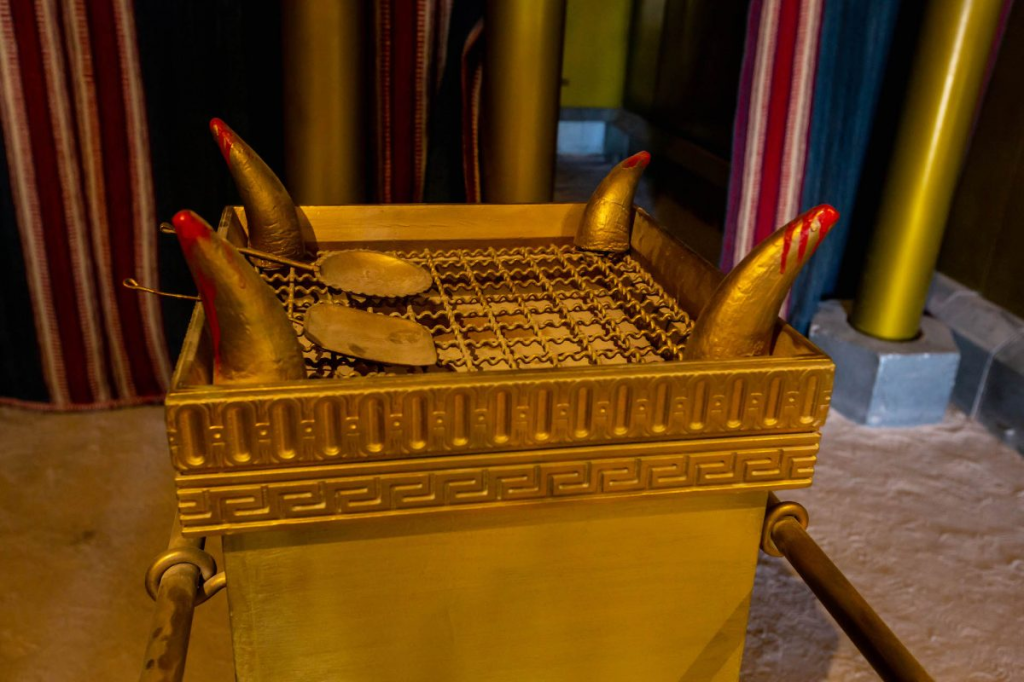
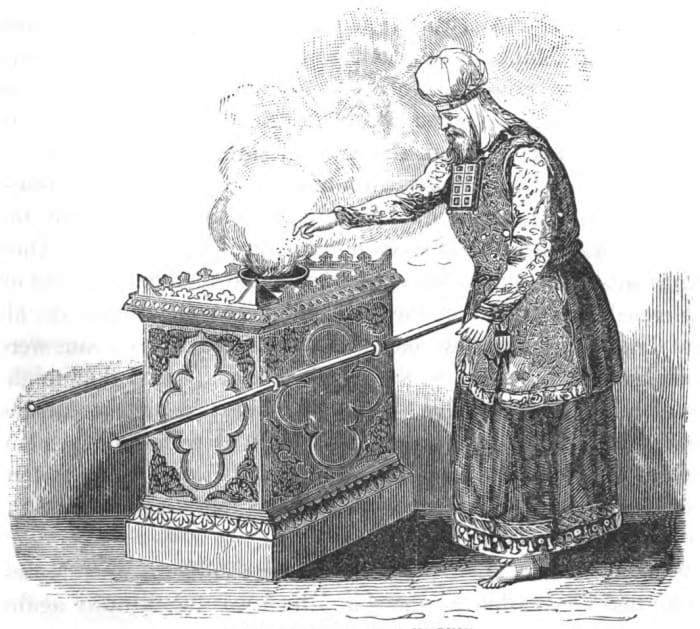
1 “And thou shalt make an altar to burn incense upon; of shittim wood shalt thou make it. — an altar to burn incense; not an altar to burn sacrifices: cows bulls, lambs and others; here it is called the incense of spices or perfumes;
2 A cubit shall be the length thereof and a cubit the breadth thereof. Foursquare shall it be, and two cubits shall be the height thereof. The horns thereof shall be part of the same. — the main altar outside for sacrifices is much larger, five cubits square and three cubit in height;
3 And thou shalt overlay it with pure gold, the top thereof and the sides thereof round about, and the horns thereof; and thou shalt make unto it a crown of gold round about. — the top thereof, and the sides thereof, and the horns thereof: all and each of them were covered with gold; this altar had a top;
4 And two golden rings shalt thou make for it under the crown of it, by the two corners thereof; upon the two sides of it shalt thou make it; and they shall be for places for the staves to bear it.
5 And thou shalt make the staves of shittim wood and overlay them with gold. — and thou shalt make the staves of shittim wood; that is, of the same wood the altar itself was made;
6 And thou shalt put it before the veil that is by the ark of the Testimony, before the mercy seat that is over the Testimony, where I will meet with thee. — this altar to burn incense is to be placed in the sanctuary just before the veil; between the candlestick and the table of shewbread, outside the Holy of Holies;
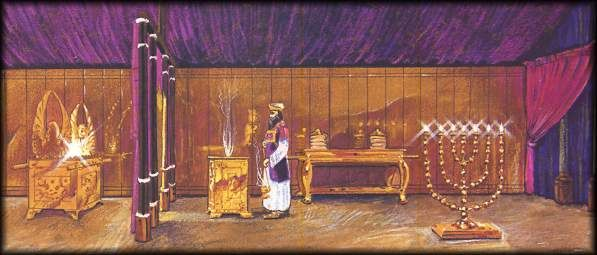
7 And Aaron shall burn thereon sweet incense every morning. When he dresseth the lamps, he shall burn incense upon it. — Aaron was to burn sweet incense upon this altar every morning and every evening;
8 And when Aaron lighteth the lamps at evening, he shall burn incense upon it, a perpetual incense before the Lord throughout your generations. — a perpetual incense before the Lord throughout your generations; no “strange incense” was to be offered upon it;
9 Ye shall offer no strange incense thereon, nor burnt sacrifice, nor meat offering; neither shall ye pour drink offering thereon. — burnt sacrifice and meat offering are offered in another larger altar outside the sancturay;
10 And Aaron shall make an atonement upon the horns of it once in a year with the blood of the sin offering of atonements. Once in the year shall he make atonement upon it throughout your generations. It is most holy unto the Lord.” — this atonement made on the Day of Atonement; once in the year; the tenth day of the seventh month;
11 And the Lord spoke unto Moses, saying,
12 “When thou takest the sum of the children of Israel according to their number, then shall they give every man a ransom for his soul unto the Lord when thou numberest them, that there be no plague among them when thou numberest them.
— that there be no plague among them; if a man did not feel his need of “ransom,” and gladly pay the small sum at which the ransom was fixed, he would show himself so proud and presumptuous that he might well provoke a Divine “plague,” or punishment;
13 This they shall give, every one that passeth among them that are numbered: half a shekel according to the shekel of the sanctuary (a shekel is twenty gerahs); a half shekel shall be the offering to the Lord. — king David offended in not demanding payment of this tribute or atonement-tax when he numbered the people.
14 Every one who passeth among them that are numbered, from twenty years old and above, shall give an offering unto the Lord.
15 The rich shall not give more and the poor shall not give less than half a shekel, when they give an offering unto the Lord to make an atonement for your souls.
16 And thou shalt take the atonement money of the children of Israel, and shalt appoint it for the service of the tabernacle of the congregation, that it may be a memorial unto the children of Israel before the Lord, to make an atonement for your souls.”
— MSG
God spoke to Moses: “When you take a head count of the Israelites to keep track of them, all must pay an atonement-tax to God for their life at the time of being registered so that nothing bad will happen because of the registration.
“Everyone who gets counted is to give a half-shekel (using the standard Sanctuary shekel of a fifth of an ounce to the shekel)—a half-shekel offering to God. Everyone counted, age twenty and up, is to make the offering to God.
“The rich are not to pay more nor the poor less than the half-shekel offering to God, the atonement-tax for your lives. Take the atonement-tax money from the Israelites and put it to the maintenance of the Tent of Meeting. It will be a memorial fund for the Israelites in honor of God, making atonement for your lives.”
17 And the Lord spoke unto Moses, saying,
18 “Thou shalt also make a laver of brass, with his foot also of brass, for washing; and thou shalt put it between the tabernacle of the congregation and the altar, and thou shalt put water therein. — a round, cauldron-shaped vessel for use by the officiating priests to wash before their entrance on their ministry; and denotes in general the necessity of purity;
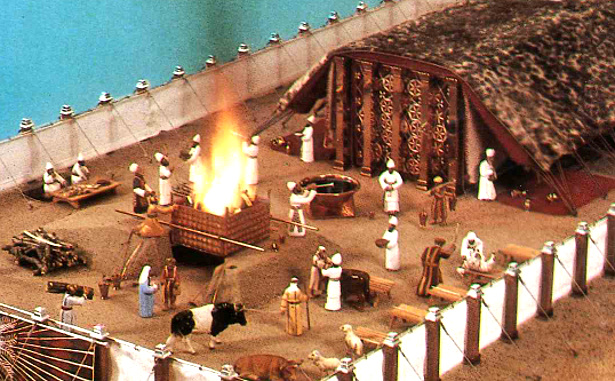
19 For Aaron and his sons shall wash their hands and their feet thereat.
20 When they go into the tabernacle of the congregation, they shall wash with water, that they die not. Or when they come near to the altar to minister, to burn offering made by fire unto the Lord,
21 so they shall wash their hands and their feet, that they die not. And it shall be a statute for ever to them, even to him and to his seed throughout their generations.”
22 Moreover the Lord spoke unto Moses, saying,
23 “Take thou also unto thee principal spices: of pure myrrh five hundred shekels, and of sweet cinnamon half as much (even two hundred and fifty shekels), and of sweet calamus two hundred and fifty shekels, — details and directions are here given for making the holy anointing oil, and the incense to be used in the service of the tabernacle.
24 and of cassia five hundred shekels, according to the shekel of the sanctuary, and of olive oil a hin.
25 And thou shalt make from it an oil of holy ointment, an ointment compound according to the art of the perfumer; it shall be a holy anointing oil.
26 And thou shalt anoint the tabernacle of the congregation therewith, and the ark of the Testimony,
27 and the table and all his vessels, and the candlestick and his vessels, and the altar of incense,
28 and the altar of burnt offering with all his vessels, and the laver and his foot;
29 and thou shalt sanctify them, that they may be most holy. Whatsoever toucheth them shall be holy. — the Targum of Jonathan interprets it of persons that approach these holy places, and things so anointed, shall be sanctified, while others would be consumed, paraphrasing the words thus;
“and consecrate them, and they shall be most holy. Every one of the priests who approacheth to them shall be sanctified; but of the rest of the tribes, (whoever toucheth them) shall be consumed by the fiery flame from before the Lord.”
30 And thou shalt anoint Aaron and his sons and consecrate them, that they may minister unto Me in the priest’s office.
31 And thou shalt speak unto the children of Israel, saying, ‘This shall be a holy anointing oil unto Me throughout your generations.
32 Upon man’s flesh shall it not be poured, neither shall ye make any other like it, according to the composition of it. It is holy, and it shall be holy unto you.
33 Whosoever compoundeth any like it, or whosoever putteth any of it upon a stranger, shall even be cut off from his people.’”
— the word stranger is commonly used to imply the Gentiles, or such as were not an Israelite; but sometimes it indicates those that are not of the priestly line, and is shown here; as the Targum of Jonathan says: one that is not of the seed of Aaron;
34 And the Lord said unto Moses, “Take unto thee sweet spices: stacte and onycha and galbanum; these sweet spices with pure frankincense, of each shall there be a like weight. — various spices: stacte, onycha and galbanum; these sweet spices with pure frankincense; are holy to the Lord;
35 And thou shalt make it a perfume, a confection according to the art of the perfumer, tempered together, pure and holy.
36 And thou shalt beat some of it very small, and put it before the testimony in the tabernacle of the congregation where I will meet with thee; it shall be unto you most holy.
— thou shalt . . . put it before the testimony; some pieces of the incense were to be continually before the ark of the covenant, that is, upon the altar of incense; it was to be put there in order to be burnt, and to be smelled to.
37 And as for the perfume which thou shalt make, ye shall not make it for yourselves according to the composition thereof; it shall be unto thee holy for the Lord. — ye shall not make to yourselves according to the composition thereof; that is, for your own use, for the scenting of your rooms, or to snuff up, or smell to;
38 Whosoever shall make like unto that, to smell thereto, shall even be cut off from his people.” — the recipe for the incense as well as for the oil in the tabernacle “it shall be unto thee holy for the Lord;” that is, are sort off copyrighted by the Most High; anyone who duplicate this recipe and use it for themselves would be put to death.


 Joel
Joel A Prophecy of Esau and Jacob