
Who are the Amalekites?
The Israelites fought the Amalekites numerous times; so who are the Amalekites?
(1i) Exodus 17 • on the Plain of Rephidim (ii) Deuteronomy 25; (2) I Samuel 15 • during the reign of King Saul (3) I Samuel 30 • during the reign of King David (4) Esther 3 • Haman and Mordecai (5) Ezekiel 38 • Gog and Magog
Jewish Women’s Archive by Tamar Kadari
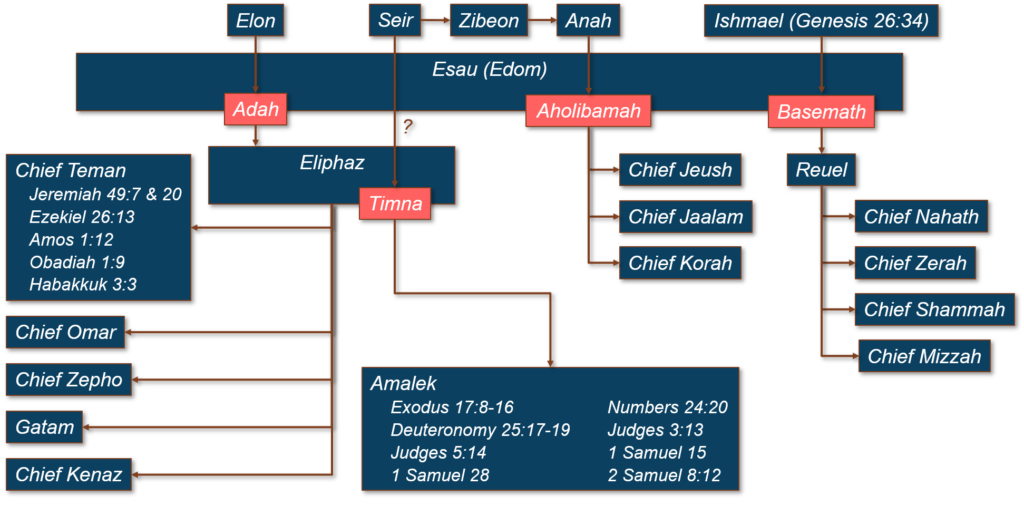
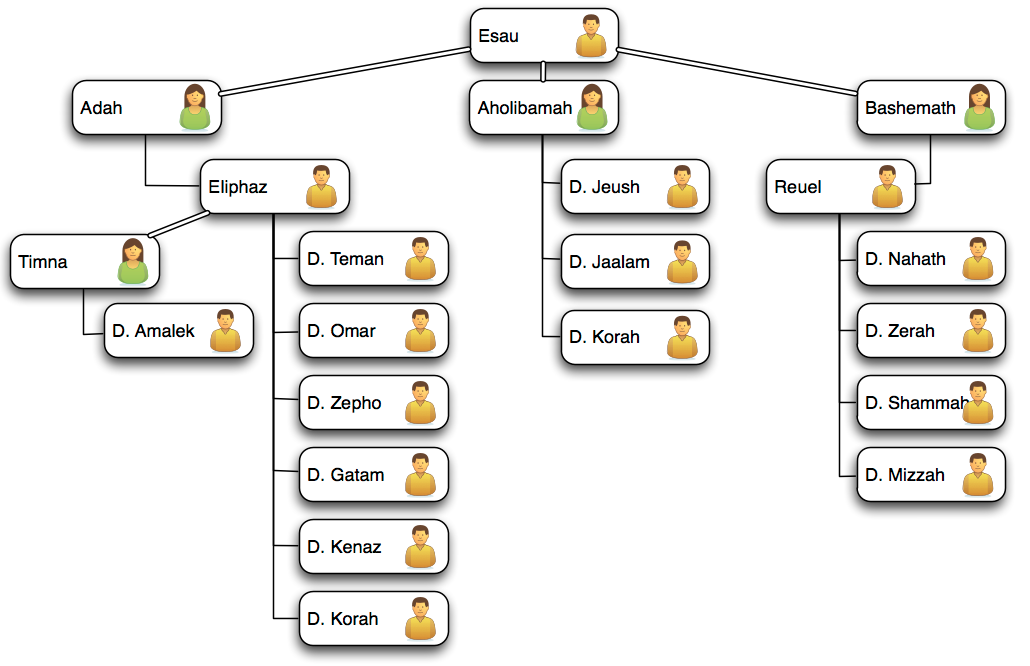
Timna, concubine of Eliphaz: Midrash and Aggadah
In Brief
After being denied conversion by the men of Abraham’s household, Timna becomes the concubine of Eliphaz. The Rabbis portray this action as proof of her genuine desire to convert, and Israel is punished for the Patriarch’s actions. Another midrash uses Timna to clarify an issue of lineage, ultimately showing that Esau’s descendants were born of adultery.
Timna was the sister of Lotan, one of Esau’s chiefs, and therefore the daughter of royalty. The Rabbis relate that she sought to convert and join Abraham’s household. She went to Abraham, Isaac, and Jacob, but since they would not accept her, she went and became the concubine of Eliphaz. She declared: “Better for me to be a handmaiden to this nation [Israel], and not a noblewoman of that nation [the chiefs of Esau]” (Midrash Tannaim on Deut., 32:47).
The Rabbis assert that Timna’s willingness to exchange her status of noblewoman for that of concubine attests to her pure intent to convert. The Patriarchs did not understand her true aim; instead of rejecting her, they should have drawn her to the bosom of Judaism. They were accordingly punished, for her union with Eliphaz produced Amalek, who would cause Israel to suffer (BT Sanhedrin 99b).
According to another tradition (Tanhuma, Vayeshev 1), the description of Eliphaz’s “marriage” to Timna teaches of corruption and degeneration among the descendants of Seir. This midrash is based on the inconsistency concerning Timna’s lineage between Gen. 36:20–22, in which she is presented as the sister of Lotan (the son of Seir), and I Chron. 1:36, that mentions her as the daughter of Eliphaz.
The Rabbis reconcile this discrepancy by explaining that Timna was indeed Eliphaz’s daughter, as a result of his adulterous relations with Seir’s wife; to compound his sin, Eliphaz took his own daughter as his concubine. The Torah charts the lineage of Esau’s descendants at length, in order to show that this lineage was founded in adultery.
(1) Exodus 17
When the Israelites had just came out of Egypt
8 Then came Amalek and fought with Israel in Rephidim. — then came Amalek, a grandson of Esau; the Amalekites had not been previously (except in the anticipatory flashforwarding in Genesis 14:7) mentioned as a tribe or nation;
— their hatred could be the old grudge of the children of Esau returning against the children of Israel; because of the affair of the birthright and blessing which Jacob stole from Esau, who were now on their march for the land of Canaan, claiming their birthright land which came to children of Esau thereby;
9 And Moses said unto Joshua, “Choose us out men, and go out, fight with Amalek. Tomorrow I will stand on the top of the hill with the rod of God in mine hand.” — Joshua; he was a prince of the tribe of Ephraim; chosen as a leader to fight the Amalekites;
10 So Joshua did as Moses had said to him, and fought with Amalek; and Moses, Aaron, and Hur went up to the top of the hill.
— Hur; according to Josephus (Ant. Jud., iii. 2, § 4) Hur was the husband of Miriam, and so the brother-in-law of Moses and Aaron. He was a descendant of Judah through Pharez and Hezron;
— to the top of the hill; to the top of Mount Sinai or Horeb, not so much to see the battle fought, as to be seen by Joshua and his warriors;
11 And it came to pass, when Moses held up his hand, that Israel prevailed; and when he let down his hand, Amalek prevailed. — Moses was getting old and was tired; his strongest arm will fail with being long held out; but it is God only whose hand is stretched out still;
12 But Moses’ hands were heavy; and they took a stone and put it under him, and he sat thereon. And Aaron and Hur held up his hands, the one on the one side and the other on the other side; and his hands were steady until the going down of the sun.
— both the Targums of Jonathan and Jerusalem paraphrase the words, “when Moses lift up his hands in prayer, the house of Israel prevailed, but when he restrained his hands from prayer, the house of Amalek prevailed.”
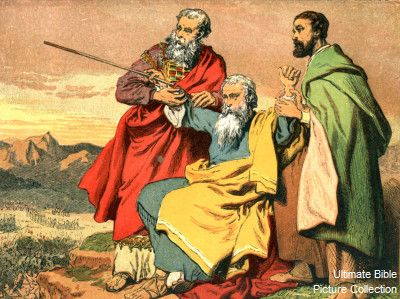
13 And Joshua discomfited Amalek and his people with the edge of the sword. — Amalek being distinguished from “his people” has established a strong sense that Amalek was the title of their king, or chief of the army (hence Chief Amalek in Genesis 36:16), and that it was a common title to the kings of that nation of the Amalekites, as Pharaoh was to the kings of Egypt, or Caesar to Rome;
— that’s a significant truth; a truth during Moses time during the Exodus; more probable, later, is that the name Agag had evolved into a title for their king in place of Amalek; as stated by Balaam, employed by the king of the Moabites, to pronounce a ‘curse:’
“He (the children of Israel) shall pour the water out of his buckets, and his seed shall be in many waters; and his king shall be higher than Agag (hence, used in this way, it is more likely that Agag is the title of a king rather than the name of one king; and Agag was named as the king of the Amalekites in Samuel’s experience: 1 Samuel 15:8), and his kingdom (of Israel) shall be exalted” Numbers 24:7.
14 And the Lord said unto Moses, “Write this for a memorial in a book, and recount it in the ears of Joshua; for I will utterly put out the remembrance of Amalek from under heaven.” — I will utterly put out the remembrance of Amalek; the extermination of Amalek, here prophesied, was partly accomplished in part by Saul (1 Samuel 15:8) and David (1 Samuel 30:17);
— Moses must write what had been done, what Amalek had done against Israel; write their bitter hatred; write their cruel attempts; let them never be forgotten, nor what God had done for Israel in saving them from Amalek.
15 And Moses built an altar, and called the name of it Jehovahnissi [that is, The Lord my banner]; — Moses built an altar; primarily, no doubt, to sacrifice thank-offerings upon it, as an acknowledgment of the Divine help in giving Israel the victory.
16 for he said, “Because the Lord hath sworn that the Lord will have war with Amalek from generation to generation.” — the Lord will have war with Amalek from generation to generation; until they are utterly destroyed; and so in fact he had, and thus it was;
— the Targum of Jonathan is, “he by his word will make war against those that are of the house of Amalek, and destroy them to three generations, from the generation of this world, from the generation of the Messiah, and from the generation of the world to come.”
(ii) Deuteronomy 25
17 “Remember what Amalek did unto thee on the way, when ye had come forth out of Egypt,
18 how he met thee on the way and smote the hindmost of thee, even all who were feeble behind thee, when thou wast faint and weary; and he feared not God.
19 Therefore it shall be, when the Lord thy God hath given thee rest from all thine enemies round about, in the land which the Lord thy God giveth thee for an inheritance to possess it, that thou shalt blot out the remembrance of Amalek from under heaven; thou shalt not forget it.
(2) I Samuel 15
During the reign of King Saul
1 Samuel also said unto Saul, “The Lord sent me to anoint thee to be king over His people, over Israel. Now therefore hearken thou unto the voice of the words of the Lord.
2 Thus saith the Lord of hosts: ‘I remember that which Amalek did to Israel, how he lay in wait for him on the way when he came up from Egypt.
3 Now go and smite Amalek and utterly destroy all that they have, and spare them not; but slay both man and woman, infant and suckling, ox and sheep, camel and ass.’”
4 And Saul gathered the people together and numbered them in Telaim, two hundred thousand footmen and ten thousand men of Judah.
5 And Saul came to a city of Amalek, and lay in wait in the valley.
6 And Saul said unto the Kenites, “Go, depart, get you down from among the Amalekites, lest I destroy you with them; for ye showed kindness to all the children of Israel when they came up out of Egypt.” So the Kenites departed from among the Amalekites.
7 And Saul smote the Amalekites from Havilah until thou comest to Shur, which is over against Egypt.
8 And he took Agag the king of the Amalekites alive, and utterly destroyed all the people with the edge of the sword.
9 But Saul and the people spared Agag, and the best of the sheep and of the oxen, and of the fatlings and the lambs, and all that was good, and would not utterly destroy them; but every thing that was vile and refuse, that they destroyed utterly.
10 Then came the word of the Lord unto Samuel, saying,
11 “I repent that I have set up Saul to be king, for he has turned back from following Me and hath not performed My commandments.” And it grieved Samuel, and he cried unto the Lord all night.
12 And when Samuel rose early to meet Saul in the morning, it was told Samuel, saying, “Saul came to Carmel, and behold, he set him up a place, and has gone about and passed on and gone down to Gilgal.”
13 And Samuel came to Saul; and Saul said unto him, “Blessed be thou of the Lord. I have performed the commandment of the Lord.”
14 And Samuel said, “What meaneth then this bleating of the sheep in mine ears and the lowing of the oxen which I hear?”
15 And Saul said, “They have brought them from the Amalekites; for the people spared the best of the sheep and of the oxen to sacrifice unto the Lord thy God, and the rest we have utterly destroyed.”
16 Then Samuel said unto Saul, “Stay, and I will tell thee what the Lord hath said to me this night.” And he said unto him, “Say on.”
17 And Samuel said, “When thou wast little in thine own sight, wast thou not made the head of the tribes of Israel, and the Lord anointed thee king over Israel?
18 And the Lord sent thee on a journey and said, ‘Go, and utterly destroy the sinners, the Amalekites, and fight against them until they be consumed.’
19 Why then didst thou not obey the voice of the Lord, but didst leap upon the spoil and didst evil in the sight of the Lord?”
20 And Saul said unto Samuel, “Yea, I have obeyed the voice of the Lord and have gone the way which the Lord sent me, and have brought Agag the king of Amalek, and have utterly destroyed the Amalekites.
21 But the people took of the spoil, sheep and oxen, the chief of the things which should have been utterly destroyed, to sacrifice unto the Lord thy God in Gilgal.”
22 And Samuel said, “Hath the Lord as great delight in burnt offerings and sacrifices as in obeying the voice of the Lord? Behold, to obey is better than sacrifice, and to hearken than the fat of rams.
23 For rebellion is as the sin of witchcraft, and stubbornness is as iniquity and idolatry. Because thou hast rejected the word of the Lord, He hath also rejected thee from being king.”
24 And Saul said unto Samuel, “I have sinned; for I have transgressed the commandment of the Lord and thy words, because I feared the people and obeyed their voice.
25 Now therefore, I pray thee, pardon my sin, and return with me, that I may worship the Lord.”
26 And Samuel said unto Saul, “I will not return with thee; for thou hast rejected the word of the Lord, and the Lord hath rejected thee from being king over Israel.”
27 And as Samuel turned about to go away, he laid hold upon the skirt of his mantle, and it rent.
28 And Samuel said unto him, “The Lord hath rent the kingdom of Israel from thee this day, and hath given it to a neighbor of thine, who is better than thou.
29 And also the Strength of Israel will not lie nor repent; for He is not a man, that He should repent.”
30 Then he said, “I have sinned; yet honor me now, I pray thee, before the elders of my people and before Israel, and return with me, that I may worship the Lord thy God.”
31 So Samuel turned back after Saul, and Saul worshiped the Lord.
32 Then said Samuel, “Bring ye hither to me Agag, the king of the Amalekites.” And Agag came unto him charily; and Agag said, “Surely the bitterness of death is past.”
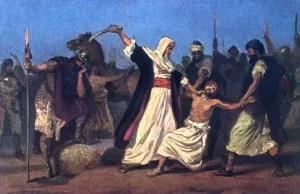
33 And Samuel said, “As thy sword hath made women childless, so shall thy mother be childless among women.” And Samuel hewed Agag in pieces before the Lord in Gilgal.
34 Then Samuel went to Ramah; and Saul went up to his house to Gibeah of Saul.
35 And Samuel came no more to see Saul until the day of his death. Nevertheless Samuel mourned for Saul; and the Lord repented that He had made Saul king over Israel.
(3) I Samuel 30
During the reign of King David
1 And it came to pass, when David and his men had come to Ziklag on the third day, that the Amalekites had invaded the South and Ziklag, and smitten Ziklag and burned it with fire,
2 and had taken the women captive, who were therein. They slew not any, either great or small, but carried them away and went on their way.
3 So David and his men came to the city, and behold, it was burned with fire; and their wives and their sons and their daughters were taken captive.
4 Then David and the people who were with him lifted up their voice and wept, until they had no more power to weep.
5 And David’s two wives were taken captive: Ahinoam the Jezreelitess, and Abigail the wife of Nabal the Carmelite.
6 And David was greatly distressed, for the people spoke of stoning him because the soul of all the people was grieved, every man for his sons and for his daughters; but David encouraged himself in the Lord his God.

7 And David said to Abiathar the priest, Ahimelech’s son, “I pray thee, bring me hither the ephod.” And Abiathar brought thither the ephod to David.
8 And David inquired of the Lord, saying, “Shall I pursue after this troop? Shall I overtake them?” And He answered him, “Pursue, for thou shalt surely overtake them and without fail recover all.”
9 So David went, he and the six hundred men who were with him, and came to the Brook Besor, where those who were left behind stayed.
10 But David pursued, he and four hundred men; for two hundred remained behind, who were so faint that they could not go over the Brook Besor.
11 And they found an Egyptian in the field, and brought him to David and gave him bread, and he ate; and they made him drink water.
12 And they gave him a piece of a cake of figs and two clusters of raisins; and when he had eaten his spirit came again to him, for he had eaten no bread nor drunk any water three days and three nights.
13 And David said unto him, “To whom belongest thou, and from whence art thou?” And he said, “I am a young man of Egypt, servant to an Amalekite; and my master left me, because three days ago I fell sick.
14 We made an invasion upon the south of the Cherethites, and upon the border which belongeth to Judah and upon the south of Caleb; and we burned Ziklag with fire.”
16 And when he had brought him down, behold, they were spread abroad upon all the earth, eating and drinking and dancing, because of all the great spoil that they had taken out of the land of the Philistines and out of the land of Judah.
17 And David smote them from the twilight even unto the evening of the next day; and there escaped not a man of them, save four hundred young men who rode upon camels and fled.
18 And David recovered all that the Amalekites had carried away, and David rescued his two wives.
19 And there was nothing lacking to them, neither small nor great, neither sons nor daughters, neither spoil nor any thing that they had taken from them; David recovered all.
20 And David took all the flocks and the herds which they drove before those other cattle, and said, “This is David’s spoil.”
21 And David came to the two hundred men who were so faint that they could not follow David, whom they had made also to remain at the Brook Besor; and they went forth to meet David and to meet the people who were with him. And when David came near to the people, he saluted them.
22 Then answered all the wicked men and men of Belial of those who went with David, and said, “Because they went not with us, we will not give them aught of the spoil that we have recovered, save to every man his wife and his children, that they may lead them away and depart.”
23 Then said David, “Ye shall not do so, my brethren, with that which the Lord hath given us, who hath preserved us and delivered the company that came against us into our hand.
24 For who will hearken unto you in this matter? But as his part is who goeth down to the battle, so shall his part be who tarrieth by the supplies: they shall divide alike.”
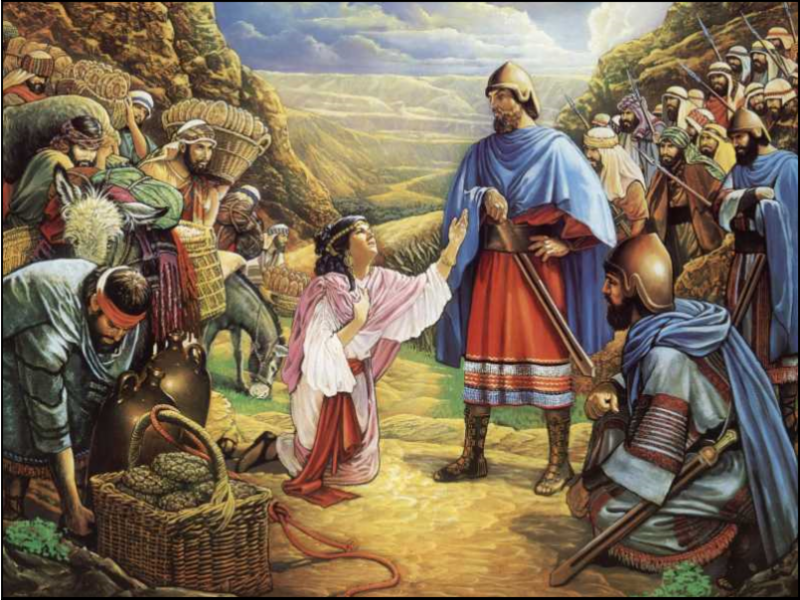
25 And it was so from that day forward, that he made it a statute and an ordinance for Israel unto this day.
26 And when David came to Ziklag, he sent a portion of the spoil unto the elders of Judah, even to his friends, saying, “Behold, a present for you of the spoil of the enemies of the Lord”—
27 to those who were in Bethel, and to those who were in South Ramoth, and to those who were in Jattir;
28 and to those who were in Aroer, and to those who were in Siphmoth, and to those who were in Eshtemoa,
29 and to those who were in Rachal, and to those who were in the cities of the Jerahmeelites, and to those who were in the cities of the Kenites;
30 and to those who were in Hormah, and to those who were in Chorashan, and to those who were in Athach;
31 and to those who were in Hebron, and to all the places where David himself and his men were wont to haunt.
(4) Esther 3 • Haman and Mordecai
1 After these things did King Ahasuerus promote Haman the son of Hammedatha the Agagite, and advanced him and set his seat above all the princes who were with him. — Haman was a direct descendant of Agag in the sixteenth generation and consequently an Amalekite (Targ. Sheni; Josephus, “Ant.” xi. 6, § 5).
2 And all the king’s servants who were in the king’s gate bowed and reverenced Haman, for the king had so commanded concerning him. But Mordecai bowed not, nor did him reverence.
3 Then the king’s servants, who were in the king’s gate, said unto Mordecai, “Why transgressest thou the king’s commandment?”
4 Now it came to pass, when they spoke daily unto him and he hearkened not unto them, that they told Haman to see whether Mordecai’s matters would stand; for he had told them that he was a Jew.
5 And when Haman saw that Mordecai bowed not nor did him reverence, then was Haman full of wrath.
<< Esther 3 to Esther 7 >>
Esther 7
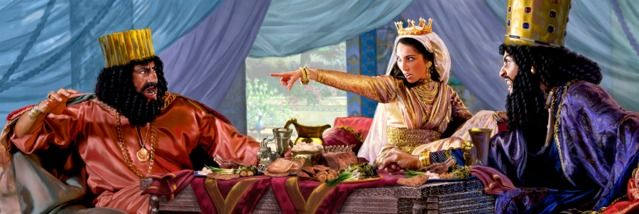
5 Then King Ahasuerus answered and said unto Esther the queen, “Who is he, and where is he, who dared presume in his heart to do so?”
6 And Esther said, “The adversary and enemy is this wicked Haman.” Then Haman was afraid before the king and the queen.
7 And the king, arising from the banquet of wine in his wrath, went into the palace garden; and Haman stood up to make request for his life to Esther the queen, for he saw that there was evil determined against him by the king.
8 Then the king returned from the palace garden into the place of the banquet of wine, and Haman had fallen upon the bed whereon Esther was. Then said the king, “Will he force the queen also before me in the house?” As the word went out of the king’s mouth, they covered Haman’s face.

9 And Harbonah, one of the chamberlains, said before the king, “Behold also the gallows fifty cubits high which Haman had made for Mordecai, who had spoken good for the king, standeth in the house of Haman.” Then the king said, “Hang him thereon!”
10 So they hanged Haman on the gallows that he had prepared for Mordecai. Then was the king’s wrath pacified.
(5) Ezekiel 38 • Gog and Magog
Ezekiel 38:2 “Son of man, set thy face against Gog, in the land of Magog, the chief prince of Meshech and Tubal, and prophesy against him — Gog1463 גוג (Agag 90אגג) of the land of Magog, is an abbreviated expression for “Gog from the land of Magog;”
— Magog, Meshech and Tubal, these are the sons of Japheth; Gomer, and his son, Togarmah, are mentioned later in verse 6; omitting the Japhetic tribes of Madai, Javan and Tiras; Genesis 10:2), and led by their chief, Gog, Russia; and Gog is acting as their Chief; their Prince;

The sons of Japheth: Gomer, and Magog, and Madai, and Javan, and Tubal, and Meshech, and Tiras. 3And the sons of Gomer: Ashkenaz and Riphath and Togarmah 4And the sons of Javan: Elishah and Tarshish, Kittim and Dodanim. Genesis 10:2-4
— in Revelation 20:8, after the thousand years are over, “Gog and Magog” might be a term adopted by John either as mystical names or symbolic names of rebellious nations against the eminence of those ruling from Jerusalem; or rebelling “against the mountains of Israel” with Jerusalem as its Capital;
— second, could the term chief or title “Gog” be translated as Agag or as the Amalekitish kings instead? The name Gog occurs only in connection with Magog, except in 1 Chronicles 5:4.
In Numbers 24:7 it was translated as “Gog” in the Septuagint in place of Agag. Thus it strengthens the view that “Agag” was a dynastic name of the kings of Amalek, a grandson of Esau; just as Pharaoh was used as a dynastic name for the ancient Egyptians; Caesar for Rome and of more modern times, the Czar of Russia;
There shall come a man out of his seed, and he shall rule over many nations; and the kingdom of Gog shall be exalted, and his kingdom shall be increased. Numbers 24:7 (Septuagint) “Agag” in the Masoretic; throughout history there is no concept of any “kingdom of Gog” but a “kingdom of Agag” could easily be conceptualized as the kingdom of the Amalekites.
— a third opinion says the countries of Gog and Magog, which they call Gug and Mungug; from hence came the Turks, even from Tartary; Josephus (Antiqu.l.1.c.6.sect.1) says that the posterity of Magog are called Scythians, and these inhabited Tartary; so some commentaries make Gog to be the general of the Ishmaelites or Edomites or Turks. This land of Magog is the same with Cathaia or Scythia, that part of Tartary from whence the Turks came; Joel Richardson is of this opinion.
For more about the South, a prophecy of Esau or Edom, see Obadiah
For more on the enemy from the South, see A Sword from the South!
For more into another Captivity: see Ezekiel Timeline – 190/40 Years


 Joel
Joel A Prophecy of Esau and Jacob