
Exodus (17-18)

Exodus 17
1 And all the congregation of the children of Israel journeyed from the Wilderness of Sin after their journeys, according to the commandment of the Lord, and pitched camp in Rephidim; and there was no water for the people to drink. — being a sandy desert place there was no water for the people to drink.
2 Therefore the people chided Moses and said, “Give us water that we may drink.” And Moses said unto them, “Why chide ye me? Why do ye tempt the Lord?” — and Moses said unto them, why chide ye with me? as if it was I that brought you hither,
— whereas it is the Lord that goes before you in the pillar of cloud and fire, and as if I kept water from you, or could give it you at pleasure; how unreasonable, as well as how ungenerous is it in you to chide with me on this account;
3 And the people thirsted there for water; and the people murmured against Moses and said, “Why is this that thou hast brought us up out of Egypt to kill us and our children and our cattle with thirst?” — to kill us and our children and our cattle with thirst: which is intolerable to any, and especially to children and cattle, which require frequent drinking;
4 And Moses cried unto the Lord, saying, “What shall I do unto this people? They are almost ready to stone me!” — they be almost ready to stone me; this is the first which we hear of stoning as a punishment.
5 And the Lord said unto Moses, “Go on before the people, and take with thee of the elders of Israel; and thy rod with which thou smotest the river, take in thine hand and go. — go on before the people, lead them on nearer to Mount Sinai or Horeb, within sight of which they now were; “and see if they will stone thee.”
6 Behold, I will stand before thee there upon the rock in Horeb; and thou shalt smite the rock and there shall come water out of it, that the people may drink.” And Moses did so in the sight of the elders of Israel. — I will stand before thee there, in my cloudy pillar, which shall stand over that place.
7 And he called the name of the place Massah [that is, Temptation], and Meribah [that is, Chiding], because of the chiding of the children of Israel, and because they tempted the Lord, saying, “Is the Lord among us or not?”
— Is the Lord among us or not? to protect and provide for us according to his word; will he be as good as his word, or will he not? Words which implied that to them it was very doubtful.
8 Then came Amalek and fought with Israel in Rephidim. — then came Amalek, a grandson of Esau; the Amalekites had not been previously (except in the anticipatory flashforwarding in Genesis 14:7) mentioned as a tribe or nation;
— their hatred could be the old grudge of the children of Esau returning against the children of Israel; because of the affair of the birthright and blessing which Jacob stole from Esau, who were now on their march for the land of Canaan, claiming their birthright land which came to children of Esau thereby;
9 And Moses said unto Joshua, “Choose us out men, and go out, fight with Amalek. Tomorrow I will stand on the top of the hill with the rod of God in mine hand.” — Joshua; he was a prince of the tribe of Ephraim; chosen as a leader to fight the Amalekites;
10 So Joshua did as Moses had said to him, and fought with Amalek; and Moses, Aaron, and Hur went up to the top of the hill.
— Hur; according to Josephus (Ant. Jud., iii. 2, § 4) Hur was the husband of Miriam, and so the brother-in-law of Moses and Aaron. He was a descendant of Judah through Pharez and Hezron;
— to the top of the hill; to the top of Mount Sinai or Horeb, not so much to see the battle fought, as to be seen by Joshua and his warriors;
11 And it came to pass, when Moses held up his hand, that Israel prevailed; and when he let down his hand, Amalek prevailed. — Moses was getting old and was tired; his strongest arm will fail with being long held out; but it is God only whose hand is stretched out still;
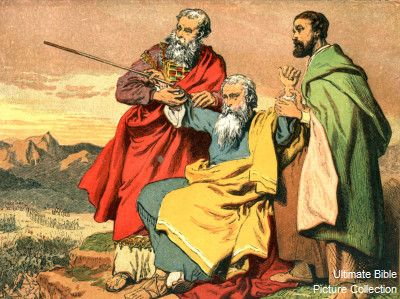
12 But Moses’ hands were heavy; and they took a stone and put it under him, and he sat thereon. And Aaron and Hur held up his hands, the one on the one side and the other on the other side; and his hands were steady until the going down of the sun.
— both the Targums of Jonathan and Jerusalem paraphrase the words, “when Moses lift up his hands in prayer, the house of Israel prevailed, but when he restrained his hands from prayer, the house of Amalek prevailed.”
13 And Joshua discomfited Amalek and his people with the edge of the sword. — Amalek being distinguished from “his people” has established a strong sense that Amalek was the title of their king, or chief of the army (hence Chief Amalek in Genesis 36:16), and that it became the title to the kings of that nation of the Amalekites, as Pharaoh was to the kings of Egypt, or Caesar to Rome;
— that’s a significant truth; a truth during Moses time during the Exodus; more probable, later, is that the name Agag had evolved into a title for their king in place of Amalek; as stated by Balaam, employed by the king of the Moabites, to pronounce a ‘curse:’
“He (the children of Israel) shall pour the water out of his buckets, and his seed shall be in many waters; and his king shall be higher than Agag (hence, used in this way, it is more likely that Agag is the title of a king rather than the name of one king; and Agag was named as the king of the Amalekites in Samuel’s experience: 1 Samuel 15:8), and his kingdom (of Israel) shall be exalted” Numbers 24:7.
14 And the Lord said unto Moses, “Write this for a memorial in a book, and recount it in the ears of Joshua; for I will utterly put out the remembrance of Amalek from under heaven.” — I will utterly put out the remembrance of Amalek; the extermination of Amalek, here prophesied, was partly accomplished in part by Saul (1 Samuel 15:8) and David (1 Samuel 30:17);
— Moses must write what had been done, what Amalek had done against Israel; write their bitter hatred; write their cruel attempts; let them never be forgotten, nor what God had done for Israel in saving them from Amalek.
15 And Moses built an altar, and called the name of it Jehovahnissi [that is, The Lord my banner]; — Moses built an altar; primarily, no doubt, to sacrifice thank-offerings upon it, as an acknowledgment of the Divine help in giving Israel the victory.
16 for he said, “Because the Lord hath sworn that the Lord will have war with Amalek from generation to generation.” — the Lord will have war with Amalek from generation to generation; until they are utterly destroyed; and so in fact he had, and thus it was;
— the Targum of Jonathan is, “he by his word will make war against those that are of the house of Amalek, and destroy them to three generations, from the generation of this world, from the generation of the Messiah, and from the generation of the world to come.”
Exodus 18
1 When Jethro, the priest of Midian, Moses’ father-in-law, heard of all that God had done for Moses and for Israel His people, and that the Lord had brought Israel out of Egypt,
— as both the Amalekites and Midianites were descended from Abraham, and stood in blood-relationship to Israel, the different attitudes which they assumed towards the Israelites foreshadowed and typified the twofold attitude which the heathen world would assume towards the kingdom of God.
2 then Jethro, Moses’ father-in-law, took Zipporah, Moses’ wife, after Moses had sent her back — after he had sent her back: upon his call and mission to Egypt, he took his wife and children with him; but upon an affair which occurred in the inn by the way, he sent them back again to his father-in-law, where they had remained ever since;
3 and her two sons (of whom the name of the one was Gershom [that is, A stranger there], for he said, “I have been an alien in a strange land”; — for he said, I have been an alien in a strange land; meaning, not the land of Egypt, where he was born, and had lived forty years; but in the land of Midian, where he was when this son of his was born;
4 and the name of the other was Eliezer [that is, My God is a help], “For the God of my father,” said he, “was my help and delivered me from the sword of Pharaoh”);
5 and Jethro, Moses’ father-in-law, came with his sons and his wife unto Moses into the wilderness, where he encamped at the mount of God. — is there a possibility that Caleb as a young man met an aging Moses “in the land of Midian?”
— Caleb the son of Jephunneh the Kenizzite Numbers 32:12; these were chiefs of the sons of Esau: Eliphaz, Teman, Omar, Zepho, Kenaz; and could the Kenizzites be the sons of Kenaz? Genesis 36:15
6 And he said unto Moses, “I, thy father-in-law Jethro, have come unto thee and thy wife and her two sons with her.” — the Targum of Jonathan adds, “I, thy father-in-law Jethro, have come to thee to be a proselyte;”
7 And Moses went out to meet his father-in-law, and did obeisance and kissed him; and they asked each other of their welfare, and they came into the tent.
8 And Moses told his father-in-law all that the Lord had done unto Pharaoh and to the Egyptians for Israel’s sake, and all the travail that had come upon them by the way, and how the Lord delivered them. — and how the Lord delivered them; out of all this travail and trouble, and out of the hands of all their enemies, Egyptians and Amalekites.
9 And Jethro rejoiced for all the goodness which the Lord had done to Israel, whom He had delivered out of the hand of the Egyptians. — being a proselyte, Jethro, a Midianite, a descendant of Abraham by Keturah, rejoiced for all the goodness which the Lord had done to Israel;
10 And Jethro said, “Blessed be the Lord, who hath delivered you out of the hand of the Egyptians and out of the hand of Pharaoh, who hath delivered the people from under the hand of the Egyptians.
11 Now I know that the Lord is greater than all gods; for in the thing wherein they dealt proudly, He was above them.”
12 And Jethro, Moses’ father-in-law, took a burnt offering and sacrifices for God; and Aaron came, and all the elders of Israel, to eat bread with Moses’ father-in-law before God. — Jethro took a burnt offering and sacrifices for God; Jethro had brought sacrifices with him, and now offered them in token of his thankfulness for God’s mercies towards himself and towards his kinsman;
— Jethro was a priest in Midian, and a worshipper of the true God, and the priesthood was not yet settled to be Aaron and his sons in Israel; and they did eat bread before God, indicating such an offering and feast was accepted by God;
13 And it came to pass on the morrow that Moses sat to judge the people, and the people stood by Moses from the morning unto the evening (hā·‘ā·reḇ). — it may be probable that numerous cases of difficulty arose out of the division of the spoil of the Amalekites;
14 And when Moses’ father-in-law saw all that he did for the people, he said, “What is this thing that thou doest for the people? Why sittest thou thyself alone, and all the people stand by thee from morning unto evening?” — why sittest thou thyself alone? the emphatic word is “alone.” Why dost thou not, Jethro means, to palm out some of the duty upon others?
15 And Moses said unto his father-in-law, “Because the people come unto me to inquire of God. — because the people come unto me to inquire of God; in doubtful cases, what was his will, and to desire Moses to inform them; which in later times was done by the Sanhedrin and Urim and Thummim; hence giving birth and growth of the Oral Law.
16 When they have a matter, they come unto me, and I judge between one and another, and I make them know the statutes of God and His laws.” — if the laws and statutes of God had yet been given on Mount Sinai, the people would be ignorant of them, and so needed not such daily judgement and instruction from Moses.
17 And Moses’ father-in-law said unto him, “The thing that thou doest is not good. — Moses was occupied from morning till evening in judging the people; hence it was not good for his health;
18 Thou wilt surely wear away, both thou and this people who are with thee. For this thing is too heavy for thee. Thou art not able to perform it thyself alone. — for this thing is too heavy for thee: it was too great a burden upon his shoulders, what his strength was not equal to;
19 Hearken now unto my voice! I will give thee counsel, and God shall be with thee: Be thou for the people to Godward, that thou mayest bring the causes unto God. — may Go be with thee; may he give thee wisdom to direct the right course.
20 And thou shalt teach them ordinances and laws, and shalt show them the way wherein they must walk and the work that they must do. — thou shalt teach them ordinances and laws; or “statutes and laws.”
21 Moreover thou shalt provide out of all the people able men, such as fear God — men of truth, hating covetousness — and place such over them to be rulers of thousands and rulers of hundreds, rulers of fifties and rulers of tens. — the word “rulers” sometimes rendered “princes” is general, including all ranks of officials placed in command;
— men of truth; true men, sincere, upright, and faithful men, that love truth and hate lies and falsehood; hating covetousness; in themselves and others, filthy lucre, dishonest gain, mammon of unrighteousness, and so not to be bribed and corrupted, and execute wrong judgment for the sake of money.
22 And let them judge the people at all seasons; and it shall be that every great matter they shall bring unto thee, but every small matter they shall judge. So shall it be easier for thyself, and they shall bear the burden with thee.
— the people at all times; in their districts, whenever a matter of difference between man and man arises, and the case is brought before them, let them judge impartially between them, and determine what is right and wrong, and execute judgment and justice truly; which would take off a great deal of business from the hands of Moses;
— and it be that every great matter they shall bring to thee; any affair of great importance, and difficult of determination, and about which the judges may have some doubt in their minds, and they are not clear as to the decision of it; this, they the judges, not the people, were to bring to Moses.
23 If thou shalt do this thing and God command thee so, then thou shalt be able to endure, and all this people shall also go to their place in peace.” — then thou shall be able to endure; to continue in his office and post, and hold on for decades to come, God granting him life and health; whereas otherwise, his time would be wasted in ruin;
24 So Moses hearkened to the voice of his father-in-law, and did all that he had said. — so Moses hearkened to the voice of Jethro; considered what he said, weighed it well in his mind, and judged it good advice, and determined to put them into action;
25 And Moses chose able men out of all Israel and made them heads over the people: rulers of thousands, rulers of hundreds, rulers of fifties, and rulers of tens. — and made them heads over the people; rulers, governors, judges, and officials;
— according to the Targum of Jonathan, the rabbans or rulers of thousands were six hundred, rulers of hundreds 6000, rulers of fifties 12,000, and the rulers of tens 60,000;
26 And they judged the people at all seasons. The hard causes they brought unto Moses, but every small matter they judged themselves. — only those causes which seemed “hard” to the “rulers of thousands” were brought before Moses for decision.
27 And Moses let his father-in-law depart, and he went his way into his own land. — and Moses went his way into his own land; the land of Midian: the Targum of Jonathan, “he went to proselyte all the children of his own country.”


 Joel
Joel A Prophecy of Esau and Jacob