
Americans Loosing their Patriotism
More Americans Don’t Want to Fight For Their Country Anymore
Newsweek • November 10, 2023 // Yahoo News
A majority of American adults would not be willing to serve in the military were the US to enter into a major war, recent polling has found, while public confidence in the armed forces appears to be waning.
The figures come as all branches of the armed forces have in recent years struggled to meet their recruitment targets, suggesting a growing apathy towards a career of military service. In 2023, the Army and Air Force fell short of their respective goals by around 10,000 recruits, while the Navy was under by 6,000. Since 1987, the number of active-duty personnel has fallen by 39 percent.
Experts say that such shortfalls are worrisome in an increasingly volatile global picture with American leadership unsure when it will next have to bring its full military force to bear.
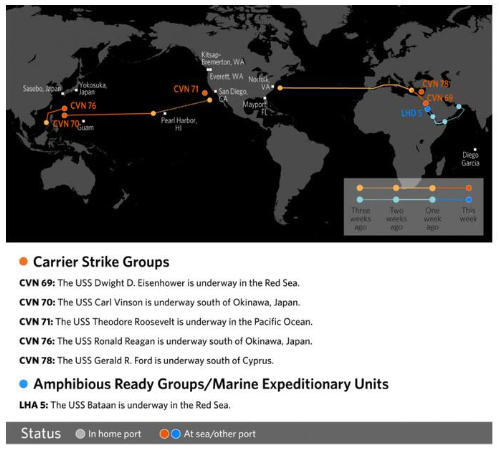
“We have strike groups, aircraft carriers with a Marine Expeditionary Unit outside Israel now,” Justin Henderson, a former transport operator for the US Marines turned military recruiter, told Newsweek. “We’re funding two wars, but we’re actually boots on the ground, drones above Gaza. So we’re already involved in there—and we’re not sure what’s happening in Taiwan. So this is a very tumultuous time for us, because we don’t know what’s going to happen.”
“How much it matters depends on what kind of people you’re talking about and which bit you’re not getting,” Tom Shugart, a senior fellow at the Center for a New American Security and a former Navy attack submarine commander, told Newsweek.
While infantry recruits could be trained in a matter of weeks, the same was not true for other roles. “Let’s say the Navy misses recruiting targets for an extended period and wasn’t able to bring on the people that it needs to manage submarines and fly its airplanes…if you end up in a major conflict, it’s going to take time to train those people,” he said.
Experts say, though, that there is a complex mix of factors contributing to the military’s recruitment issues, including adapting its messaging to a younger target generation more engrossed in modern technology and stories of supposed “woke” marketing hurting recruitment, as well as an economic outlook that is proving a challenging environment for those efforts.
“We are actively making efforts to ensure the military remains a viable and productive career choice for a majority of people,” Commander Nicole Schwegman, a Department of Defense (DOD) spokesperson, told Newsweek when asked to comment.
A Generational Shift
A poll by the research institute Echelon Insights of 1,029 likely voters, conducted between October 23-26, found that 72 percent of those asked would not be willing to volunteer to serve in the armed forces were America to enter a major conflict, compared with 21 percent who would. The remainder were unsure. The poll was conducted after Hamas led an unprecedented militant attack on Israel on October 7.
Shugart said that the results needed context, however.
“I’m very skeptical of that being accurate because I think the ‘why’ you’re in a war can dramatically change the answer to that question,” he said. “I was in the military before 9/11; a lot of society didn’t really think about the military very much [before then].”
“If you look at our history, we need to be convinced to get into [a] war,” David Eustice, CEO of Military Recruiting Experts, told Newsweek. While Americans needed a reason to support the war in Vietnam, he said, the war in Afghanistan “was immediate and had wide support because something happened to our country.”
“If we are convinced that it’s something that we need to do Americans generally will do it; less people joining is another matter and it’s very complex,” he added.
At the start of October, a survey of 1,000 likely voters conducted by J.L. Partners for the Daily Mail found that while an overall majority of Americans said they would die fighting for their country were the US invaded, when broken down by age this sentiment was lowest among those who were 18-29 years old.
Meanwhile, a Gallup poll in June found confidence in the military declined for a sixth consecutive year, to 60 percent.
Eustice, who served 26 years in the Minnesota National Guard, noted that young adults were the military’s prime target for new recruits—currently Generation Z, or those born after 1997—and argued that growing up in the internet age had made them used to “immediate gratification.”
“There’s so many choices out there; we’re an a la carte society,” he said. “You can have it if you want to have it, you can have it delivered to you. Almost anything is a swipe or click away.” In a world where a college degree can be earned from a bedroom, Eustice suggested, the rigor of training could appear unappealing.

Having observed his young children watching videos on the internet of feats of physical activity, Henderson said they were “getting that dopamine hit” of seeing someone accomplish something physically taxing, “but their body didn’t go through it. And that’s where the disconnect really comes in.”
The current generation is also less likely to interact with members of the military, the recruiters said. Eustice noted that while his father, who served in Korea, saw seven of his 10 children serve in the military, that sort of family was very uncommon nowadays.
The military is also facing a high level of unfitness to serve among the general population: as of 2020, it assessed that 77 percent of those aged 17-24 were unqualified due to medical reasons, drug use or criminal records.
But there are signs that the military is adapting to Generation Z. Henderson spoke of a gaming truck designed by the Air Force so young adults could simulate flying drones. “The military is now trying to speak their language,” he said.
Still, God, you are our Father. We’re the clay and you’re our potter: All of us are what you made us. Don’t be too angry with us, O God. Don’t keep a permanent account of wrongdoing. Keep in mind, please, we are your people—all of us.
Your holy cities are all ghost towns: Zion’s a ghost town, Jerusalem’s a field of weeds. Our holy and beautiful Temple, which our ancestors filled with your praises, Was burned down by fire, all our lovely parks and gardens in ruins.
In the face of all this, are you going to sit there unmoved, God? Aren’t you going to say something? Haven’t you made us miserable long enough? Isaiah 64:8-12 (Message Bible)


 Joel
Joel A Prophecy of Esau and Jacob