
ECOWAS: Africa’s NATO?
Africa’s NATO? How ECOWAS becomes a tool for Western imperism
MintPress News • August 11, 2023
Niger is shaping up to be the surprising frontline of the new Cold War. Yesterday, the 15-member Economic Community of West African States (ECOWAS) ordered the “activation” and “deployment” of “standby” military forces to the country, an action that threatens to spark a major international war that could make Syria look minor by comparison.
ECOWAS MEMBERS
Benin Burkina Faso Cabo Verde Côte d’Ivoire The Gambia
Ghana Guinea Guinea Bissau Liberia Mali
Niger Nigeria Senegal Sierra Leone Togo
In this venture, ECOWAS has been fully supported by the United States and Europe, leading many to suspect it is being used as an imperial vehicle to stamp out anti-colonial projects in West Africa.
On July 26, a group of Nigerien officers overthrew the corrupt government of Mohamed Bazoum. The move, which the junta presents as a patriotic uprising against a Western puppet, is widely popular in the country, and many of Niger’s neighbors have declared that any attack on it will be considered an attack on all their sovereignty. The United States and France are also considering military action, while many in Niger are calling for Russian aid.
Consequentially, the world waits to see if the region will be engulfed in a war that promises to pull in many of the major global powers.
But what is ECOWAS? And why do so many in Africa consider the organization a tool of Western neocolonialism?

Africa is preparing for war
Even before the dust settled in Niger, ECOWAS sprung into action, imposing a no-fly zone and tough economic sanctions, including freezing Nigerien national assets and halting all financial sanctions. Nigeria suspended electricity to its northern neighbor.
The regional bloc also immediately came to the defense of Bazoum, releasing an ominous statement declaring that it would “take all necessary measures,” including “the use of force,” to restore the constitutional order.
ECOWAS also gave the new military government a deadline to stand down or face the consequences. That deadline has already passed, and ECOWAS troops are preparing for action.
Member states of ECOWAS may therefore be obliged to send their troops into Niger. Yet many nations are balking at the prospect. Nevertheless, the bloc still seems adamant that military action could come at any time.
“We are determined to stop it, but ECOWAS is not going to tell the coup plotters when and where we are going to strike. That is an operational decision that will be taken by the heads of state,” explained Abdel-Fatau Musah, the group’s commissioner for political affairs, peace and security.
Despite not yet acting, the threat of an invasion is far from an idle one. Since 1990, ECOWAS has launched military interventions in seven West African countries, the most recent being in the Gambia in 2017.

This response has disappointed many onlookers. Journalist Eugene Puryear, for example, described the bloc as “part of a corrupt cabal that is directly linked to Western imperial powers to keep Africans poor.”
Those Western powers immediately lined up behind ECOWAS’ position. “The United States welcomes and commends the strong leadership of ECOWAS Heads of State and Government to defend constitutional order in Niger, actions that respect the will of the Nigerien people and align with enshrined ECOWAS and African Union principles of ‘zero tolerance for unconstitutional change,’” read a State Department press release.
Deeming the coup “completely illegitimate,” the French government also said that it “supports with firmness and determination the efforts of ECOWAS to defeat this putsch attempt.” “The EU also associated itself with ECOWAS’ first response to the matter,” said Josep Borrell, the European Union’s High Representative for Foreign Affairs, thereby greenlighting an intervention.
US Acting Deputy Secretary Victoria Nuland also strongly hinted that the United States is considering invading Niger itself. “It is not our desire to go there, but they [the new military junta] may push us to that point,” Nuland said about her recent trip to Niger, where, she said, she had an “extremely frank and at times quite difficult” meeting with the new leadership.
A measure of how close ECOWAS is to the United States is the constant support Washington gives to the organization. Throughout 2022, the State Department issued statements backing ECOWAS’s position on Mali (another country where the military deposed an unpopular, Western-backed government).
“The United States commends the strong actions taken by ECOWAS in defense of democracy and stability in Mali,” the State Department wrote. It has also issued similar memos reaffirming its unwavering support for ECOWAS’ actions against military coups in Guinea and Burkina Faso. This has led to many critics seeing ECOWAS as little more than a pawn of the United States.
While Washington has presented the situation as ECOWAS defending democracy against authoritarianism, the reality is more complex. Firstly, many of its member states’ governments have decidedly shaky democratic credentials.
President Alassane Ouattara of Cote D’Ivoire, for example, violated the country’s term limit law and was controversially sworn in for a third term last year. Protests against his power grab were suppressed, leaving dozens dead. Meanwhile, Senegalese President Macky Sall’s government has banned the main opposition party and imprisoned its leader.
ECOWAS imposes strict, Western-approved economic measures on its member states, forcing them to obey neoliberal economic laws that make escaping the circle of debt and underdevelopment harder and helped make peaceful, democratic change harder to achieve and, ironically, spurred a flurry of military insurrections across the region.
The coup in Niger follows similar actions in Mali in 2020 and 2021, Burkina Faso (two in 2022) and Guinea (2021). All have positioned themselves as progressive, patriotic, anti-imperialist uprisings against a Western-created economic order. All four nations are currently suspended from ECOWAS.
A host of states have pushed back against the West/ECOWAS’ position. “The authorities of the Republic of Guinea dissociate themselves from the sanctions imposed by ECOWAS,” wrote the Guinean government, describing them as “illegitimate and inhuman” and “urg[ed] ECOWAS to return to better thinking.”
The governments of Mali and Burkina Faso went much further. In a joint communiqué, those nations welcomed Bazoum’s ouster, describing the event as Niger “tak[ing] its destiny into its own hand and to be accountable in the face of history for complete sovereignty.” Together, they denounced “regional organizations” [i.e., ECOWAS] for imposing sanctions that “increase the populations’ suffering and imperil the spirit of Pan-Africanism.”
Perhaps most importantly, however, they bluntly stated that they would come to Niger’s aid militarily if ECOWAS invaded. “Any military intervention against Niger would mean a declaration of war against Burkina Faso and Mali,” they wrote. Algeria, which shares a long border with Niger, has also warned that it would not stand idle if the West or its puppets attacked Niger.
Russia’s Role
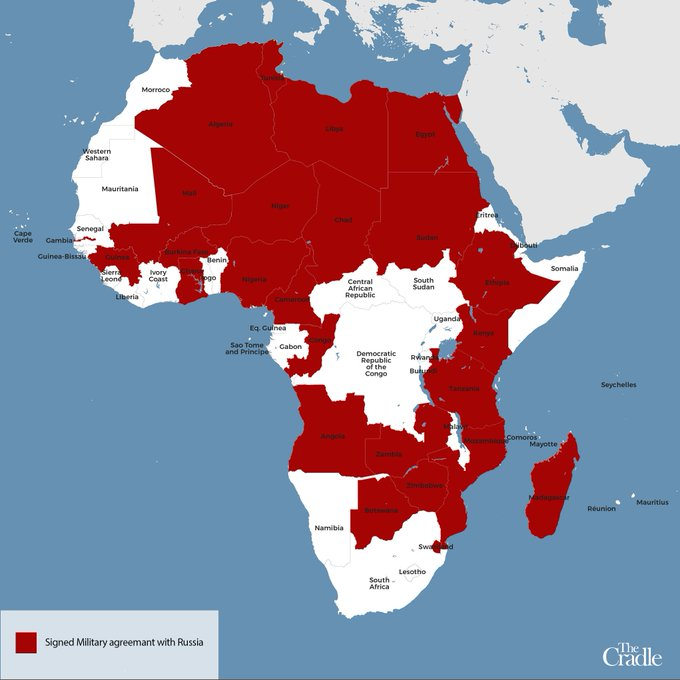
While Russia is largely seen in the West as a nefarious, authoritarian regime that interferes in other nations, much of Africa views Moscow in a positive light. The Soviet Union generally supported African independence struggles, and the Russian Federation has not invaded any African nation.
Nearly every African state attended the Russia-Africa Summit in July, while only four African leaders participated in an official meeting with Ukrainian President Volodymyr Zelensky last year. The same “Economist” poll asked Nigeriens which foreign power they trusted the most. 60% chose Russia. Only around 1 in 10 chose the U.S., even fewer chose France, and none at all chose Great Britain.
Russian flags are now a common sight in Niamey, with many hoping for some sort of help from Moscow. Ousted President Bazoum, however, took to the pages of “The Washington Post” to ask the US for help, warning that “the entire central Sahel region could fall to Russian influence via the Wagner Group.”
Wagner has indeed been invited in by various African governments, including Mali, who see the Russian mercenary force as a counterweight to Western troops. Wagner leader Yevgeny Prigozhin recently spoke approvingly of the coup, although Moscow has been far more reluctant to take sides.
The great worry for many is that the strife in Niger will spark a wider war between West African nations that will no doubt ask for help from Europe and the United States. If this happens, the military governments of Mali, Burkina Faso and Niger will doubtless call for Russian aid, turning the situation into something resembling the Syrian Civil War but on a grander scale.
In the wake of Russia’s invasion of Ukraine, France shut off energy imports from Russia, making Nigerien uranium for its aging nuclear power plants more crucial. Yet any attempt at regime change in Niger to restart the uranium supply will anger Algeria, with which it recently signed a natural gas importation agreement. Thus, the French position is fraught with contradictions and complications.
As Western power diminishes, a multipolar world is beginning to be born. As part of that birth, the people of Western Africa are dreaming of a different future. Time will tell if the military coups will prove to be a liberatory force or actions that do nothing to help the oppressed people of the region.
One thing is clear, however: the United States and France are unhappy with the changes going on and will fight to maintain their control over Africa. To this end, ECOWAS has proved an important tool at their disposal. Yet with so many conflicting interests and so many forces unwilling to compromise, the situation in Niger threatens to boil over into an international war that will bring global attention to one of the world’s most overlooked regions.
“Behold, therefore I will gather all thy lovers with whom thou hast taken pleasure, and all them that thou hast loved, with all them that thou hast hated. I will even gather them round about against thee and will uncover thy nakedness unto them, that they may see all thy nakedness” Ezekiel 16:37
“For the day of the Lord is near upon all the nations. As thou hast done, it shall be done unto thee: thy reward shall return upon thine own head” Obadiah 1:15


 A Prophecy of Esau and Jacob